Events
Training courses
Structural characterisation of macromolecular complexes
| - |
In Grenoble
Sixth Annual LBMS Cryo-EM Course
|
In Brookhaven
This course is designed to introduce high-resolution cryo-EM to the
structural biology research community. The curriculum will cover
fundamental theories of image formation and three-dimensional
reconstruction, as well as practical applications including available
software, tutorials, and demonstrations for data collection and analysis.
Instruct course on flexibility analysis using Scipion
| - |
In Madrid, WI
67th Polish Crystallographic Meeting
|
In Wroclaw
The Scientific Session of the Young Crystallographers Section of PCrA is a forum for exchanging experiences addressed primarily to students, PhD students and young doctors (maximum 5 years after defense).
The topics of the Meeting include basic and applied research on the ideal and real structure of crystals carried out with the use of X-ray radiation obtained both with traditional methods and in synchrotrons, research with the use of neutrons and electrons, problems of symmetry, phase transformations and crystal growth, new research and computational methods and all other aspects of crystallography. The conference is an annual meeting place and a forum for exchanging ideas of all Polish crystallographers.
During the inauguration of the 67th Polish Crystallography Meeting, the winners of the National Crystallography Olympiad will be decorated: http://olimpiadakrystalograficzna.pl.
Cryo-EM in Structural Biology March 2026 course
| - |
In Leeds
The course will take place on 2?6 March 2026 in a hybrid format, with online lectures followed by in-person, hands-on training across our partner cryo-EM facilities, including ABSL (University of Leeds), eBIC (Diamond Light Source), Birkbeck College (University of London), the Midlands Regional Cryo-EM Facility (University of Leicester), and the Scottish Centre for Macromolecular Imaging (University of Glasgow).
Â
It is aimed at postgraduate students and postdoctoral researchers who are new to the field and plan to use cryo-EM single-particle analysis or cryo-ET in their research. Financial support for travel and accommodation is available.
Zurich School of crystallography
| - |
In University of Zurich, Switzerland
NYSBC 2026 SPA short course
| - |
In New York
This 1-week course will step through each stage of the SPA workflow (sample preparation, data acquisition and computational processing). The mornings will include lectures and stimulating round table discussions. The afternoons will have hands-on practicals to reinforce the concepts and topics covered earlier in the day.
Â
The regular application deadline is December 15, 2025 by 5pm. Accepted applicants will be informed in early January 2026.

WiSe-Cryst 2026: Winter School on Electron Crystallography
| - |
In Jülich
I2PC - Instruct Course on Electron Tomography and Subtomogram Averaging
| - |
In Madrid
The course aims at providing a comprehensive overview of the whole image
processing pipeline in Electron Tomography (ET) from the movie alignment
of the tilt series, 3D reconstruction of the tomogram, particle
identification, and subtomogram averaging, *all inside Scipion
integration framework*.

The course is aimed at researchers of all levels wanting to adopt
electron microscopy as one of the tools at their disposal for
elucidating biological structures.

3D ED/microED short course
-
In New York
EMBO Practical Course on ?In-situ structural biology by Cryo-FIB and Cryo-ET
-
In Frankfurt am Main
The course is aimed at early-career researchers and facility staff with experience in cryo-EM who are interested in expanding their practical and theoretical knowledge of cryo-FIB/SEM and cryo-ET. The program includes focused lectures and intensive hands-on sessions covering:
- Sample vitrification and lamella thinning
- Plasma FIB milling and cryo-lift-out
- Tomographic data acquisition and analysis
EMBO Practical Course on Volume EM by automated serial SEM
-
In Heidelberg
Learn cutting-edge vEM workflows from leading experts. This hands-on course covers all aspects of volume EM from sample prep to image acquisition, reconstruction, and analysis.

Virtual Workshop: How to use the docking software GOLD to perform virtual screening simulations
In Online
In drug discovery, Virtual Screening (VS) is a widely used computational method to search libraries of small molecules for hit identification, lead optimization, and scaffold hopping. Virtual Screening can reduce research time and cost by using two different approaches: Structure-Based Virtual Screening (SBVS) and Ligand-Based Virtual Screening (LBVS).
What we will cover
In this virtual workshop, we will familiarise you with the Hermes GUI and learn how to set up and run a virtual screening campaign in GOLD. The session will include presentations and demonstrations by CCDC expert tutors and a hands-on part for you to try the software, with the tutors available to help you and answer your questions.
You will learn:
- Brief overview of structure-based virtual screening.
- Basics of the Hermes interface, the CCDC’s 3D visualizer for proteins.
- Cavity detection and extraction in Hermes.
- Step-by-step set-up of a virtual screening simulation in GOLD.
- Analysis of virtual screening results.
- Protein-ligand interactions insights using hotspots via Superstar.
- The workshop will be recorded and all registered participants will have access to the recording.
LINXS Young Researchers' Symposium III - Hard Matter
-
In Lund
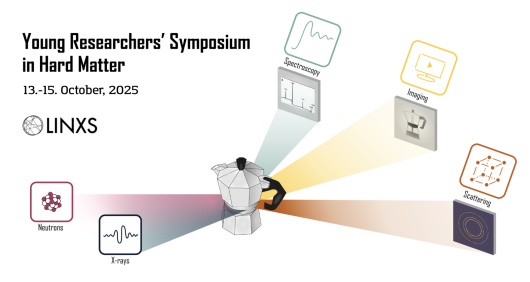
Join us for the YRI Hard Matter Symposium - an engaging 2 ½ -day event designed to connect and inspire early-career researchers exploring or utilizing synchrotron- and neutron-based techniques such as diffraction, spectroscopy, and imaging in the field of hard matter. This symposium offers a unique opportunity to network with peers, share ideas, and spark new collaborations.
Hosted at LINXS in Lund, this year’s symposium features a rich mix of keynote talks, panel discussions, a poster session, and interactive formats tailored to provide participants with both scientific insights and practical career guidance.
The first day is dedicated to career development, featuring speakers from both academia and industry who will share their professional journeys, offer insights on navigating career transitions, and provide practical strategies for securing research funding. Day 2 focuses on beamline experiments with a special emphasis on multimodal approaches to research questions by exploring the integration of complementary techniques and theoretical methods. Furthermore, practicalities of conducting successful experiments will be addressed by beamline scientists, highlighting common challenges in preparation, beamtime execution, and data analysis. The symposium concludes with a tour of MAX IV in the morning of Day 3.
Virtual Workshop: Advanced Structural Visualization and Analysis of Porous Materials Using Mercury
In Online
If you are looking to improve your Mercury skills and upgrade your structure visualization and analysis tools, then this free, 90-minute, hands-on workshop is for you!
This virtual workshop will include examples of porous materials, in particular metal-organic framework (MOF) structures from the Cambridge Structural Database (CSD). Such structures have a variety of applications, including designing new energetic or magnetic materials, new catalysts, porous frameworks for gas storage and even drugs.
What we will cover
We will focus on tools from the CSD Software designed to enhance and assist the visualization and analysis of structural data. You will learn some tips and tricks for using a range of functionality in the desktop molecular visualization software Mercury, with spotlight on some of the new features. The session will include presentations and demonstrations by CCDC expert tutors and a hands-on part for you to try the software, with the tutors available to help you and answer your questions.
You will learn:
- Which subsets of the CSD are available, how to access them in ConQuest, Mercury and the CSD Python API, and how they can help you in your research.
- How to visualize porous materials effectively in Mercury.
- How to analyse pore space in your structures using Pore Analyser.
- Applications of the disorder visualization feature, including recent advances and integrations with other functionality available in Mercury.
And more Mercury tips and tricks!
The workshop will be recorded and all registered participants will have access to the recording.
How To Use Particle Informatics Tools To Connect Virtual Workshop: Crystal Structure to Particle Behaviour
In Online
In silico digital design methods are becoming more popular in the formulated products industries as tools to anticipate manufacturing and processing bottlenecks before they occur. Particle Informatics tools enable you to leverage the wealth of data in the Cambridge Structural Database (CSD) to provide insight into the surface chemistry and topology of crystal facets.
What we will cover
In this virtual workshop, we will provide an overview of the functionality available in the CSD-Particle suite, focusing on tools for particle surface analysis. The session will include presentations and demonstrations by CCDC expert tutors and a hands-on part for you to try the software, with the tutors available to help you and answer your questions.
You will learn:
- How to use the desktop molecular visualizer software Mercury for Particle Informatics studies.
- How to use the Surface Analysis tool.
- How to calculate Full Interaction Maps on surfaces.
- Recent advances and improvements of the CSD-Particle tools.
- How you can best use Mercury and CSD-Particle in your workflows.
International School on Electron Crystallography 2025
-
In Erice
We are excited to announce the International School on Electron Crystallography, which will be held in the charming town of Erice, Italy, from 30 May - 7 June 2025. This event will bring together leading experts, researchers, and students in the field of electron crystallography to explore the latest developments and techniques.
Dates: 30 May - 7 June 2025
Location: Ettore Majorana Foundation and Centre for Scientific Culture, Erice, Italy
About the School:
The International School on Electron Crystallography offers a comprehensive learning experience for participants at all levels, from beginners to advanced researchers. Through lectures, hands-on tutorials, and interactive sessions, attendees will gain valuable insights into the principles and applications of electron crystallography, including electron diffraction, 3D electron diffraction (3D ED), structure determination, and the latest innovations in the field.
Key Topics:
Fundamentals of electron crystallography and diffraction
3D electron diffraction techniques
Structure determination of molecular and inorganic materials
Applications in nanomaterials, pharmaceuticals, and structural biology
Recent advances in instrumentation and data analysis
Who Should Attend:
The school is designed for students, postdocs, and professionals working in electron microscopy, crystallography, materials science, chemistry, physics, and related disciplines. Whether you are new to electron crystallography or looking to deepen your expertise, this school provides a unique opportunity to expand your knowledge and network with experts in the field.
Travel and Grants:
Various travel grants from different organizations will be advertised on the school's webpage to support student participation.
How to Apply:
Details on registration, abstract submission, and travel grant applications will be made available on the official website: https://crystalerice.org/2025/
Join us in Erice for an inspiring week of learning, networking, and exploring the beautiful surroundings of Sicily!
For further information, please visit our website or contact the course directors: Alexander Eggeman (University of Manchester, UK), Mauro Gemmi (Istituto Italiano di Tecnologia, Pisa, IT), Tatiana Gorelik (Forschungszentrum Juelich, DE).
Virtual Workshop: How to use the docking software GOLD to perform virtual screening simulations
|
In Online
What we will cover
In this virtual workshop, we will familiarise you with the Hermes GUI and learn how to set up and run a virtual screening campaign in GOLD. The session will include presentations and demonstrations by CCDC expert tutors and a hands-on part for you to try the software, with the tutors available to help you and answer your questions.
You will learn:
- Brief overview of structure-based virtual screening.
- Basics of the Hermes interface, the CCDC’s 3D visualizer for proteins.
- Cavity detection and extraction in Hermes.
- Step-by-step set-up of a virtual screening simulation in GOLD.
- Analysis of virtual screening results.
- Protein-ligand interactions insights using hotspots via Superstar.Â
- The workshop will be recorded and all registered participants will have access to the recording.

Virtual Workshop: Advanced Structural Visualization and Analysis of Porous Materials Using Mercury
|
In Online
This virtual workshop will include examples of porous materials, in particular metal-organic framework (MOF) structures from the Cambridge Structural Database (CSD). Such structures have a variety of applications, including designing new energetic or magnetic materials, new catalysts, porous frameworks for gas storage and even drugs.
Â
What we will cover
We will focus on tools from the CSD Software designed to enhance and assist the visualization and analysis of structural data. You will learn some tips and tricks for using a range of functionality in the desktop molecular visualization software Mercury, with spotlight on some of the new features. The session will include presentations and demonstrations by CCDC expert tutors and a hands-on part for you to try the software, with the tutors available to help you and answer your questions.
Â
You will learn:
- Which subsets of the CSD are available, how to access them in ConQuest, Mercury and the CSD Python API, and how they can help you in your research.
- How to visualize porous materials effectively in Mercury.
- How to analyse pore space in your structures using Pore Analyser.
- Applications of the disorder visualization feature, including recent advances and integrations with other functionality available in Mercury.
And more Mercury tips and tricks!
The workshop will be recorded and all registered participants will have access to the recording.Â
Â
How To Use Particle Informatics Tools To Connect Virtual Workshop: Crystal Structure to Particle Behaviour
|
In Online
What we will cover
In this virtual workshop, we will provide an overview of the functionality available in the CSD-Particle suite, focusing on tools for particle surface analysis. The session will include presentations and demonstrations by CCDC expert tutors and a hands-on part for you to try the software, with the tutors available to help you and answer your questions.
You will learn:
- How to use the desktop molecular visualizer software Mercury for Particle Informatics studies.
- How to use the Surface Analysis tool.
- How to calculate Full Interaction Maps on surfaces.
- Recent advances and improvements of the CSD-Particle tools.
- How you can best use Mercury and CSD-Particle in your workflows.