Events
Schools
9th International Doctoral School on Biological Crystallization (ISBC2026)
| - |
In Granada
Nucleation: Classical and non-classical approaches.
Crystal growth kinetics and mechanisms.
Impurities in protein crystallization: definition and influence.
Screening: The search for crystallization conditions
Crystallization techniques: Batch, Vapour and Counter Diffusion, MMS, How do they work?
Crystallization and diffusion transport: gels, microfluidics and microgravity.
Crystallization at large scale for pharma and industrial application.
In vivo crystallization.
Serial Crystallography.
Polymorphism in protein crystals.
Membrane protein crystallization: Lipid cubic phase, bicelles and detergents.
AI & ML in protein crystallization prediction.

4th High-Pressure Single-Crystal X-Ray Diffraction Summer School
| - |
In Edinburgh
IUCr Computing School - Artificial Intelligence in Crystallography
| - |
In Lethbridge, Alberta
Transmission Electron Microscopy of Nanomaterials - European Summer School (TEM-UCA)
| - |
In Puerto Real (Cádiz)
MCCS-2026. Macromolecular Crystallography and CryoEM School
| - |
In Madrid

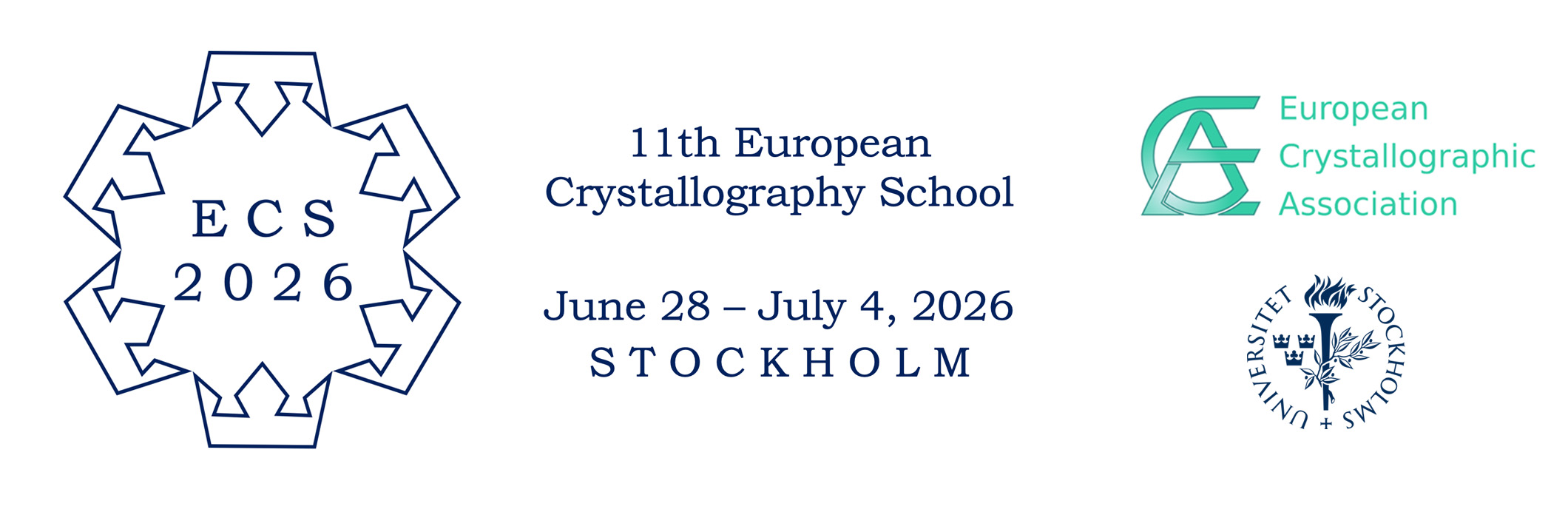
11th European Crystallography School (ECS11)
| - |
In Stockholm
The 11th European Crystallography School (ECS11) will be held in Stockholm,Sweden, June 28 - July 4, 2026. The school will offer international students and scientists a series of lectures and hands-on tutorials by leading experts in thefields of X-ray and electron crystallography, with a focus on organic, inorganic, and metal-organic crystal structures. Participants will have opportunities to interact with teachers, industry representatives, and fellow participants through poster sessions,industry talks, discussion sessions, activities, and excursions.
Topics:
- Single crystal X-ray diffraction
- Powder X-ray diffraction (PXRD)
- 3D electron diffraction
- Synchrotron radiation
- Small-molecule crystallography
11th European Crystallography School (ECS11)
| - |
In Stockholm
Single crystal X-ray diffraction
Powder X-ray diffraction (PXRD)
3D electron diffraction
Synchrotron radiation
Small-molecule crystallography
67th Polish Crystallographic Meeting
|
In Wroclaw
The Scientific Session of the Young Crystallographers Section of PCrA is a forum for exchanging experiences addressed primarily to students, PhD students and young doctors (maximum 5 years after defense).
The topics of the Meeting include basic and applied research on the ideal and real structure of crystals carried out with the use of X-ray radiation obtained both with traditional methods and in synchrotrons, research with the use of neutrons and electrons, problems of symmetry, phase transformations and crystal growth, new research and computational methods and all other aspects of crystallography. The conference is an annual meeting place and a forum for exchanging ideas of all Polish crystallographers.
During the inauguration of the 67th Polish Crystallography Meeting, the winners of the National Crystallography Olympiad will be decorated: http://olimpiadakrystalograficzna.pl.
Montevideo School on Small Molecule Crystallography - MVD School 2026 and Cambridge Crystallographic Data Centre (CCDC) Workshop
| - |
In Montevideo
Topic 2 (23-24 Feb) â€" Symmetry (4.5 hours)
Topic 3 (23 Feb) â€" Crystallization, crystals handling (3 hours)
Topic 4 (24-25 Feb) â€" Diffraction Physics (4 hours)
Topic 5 (25 Feb) â€" Structure determination: The phase problem (2.5 hours)
Topic 6 (25-26,28 Feb) â€" Structural refinement (7.5 hours)
Topic 7 (27 Feb) â€" Structure reporting and analysis (8.5 hours)* in CCDC Workshop
Topic 8 (24-26 Feb) â€" Practical use of Diffractometer and Control Software (8 hours)
Topic 9 (26-28 Feb) â€" Hands-on activities (5 hours)
*CCDC Workshop (27 Feb) â€" CSD tools for structural visualization and analysis
International School on Fundamental Crystallography and Workshop on Rietveld Refinement Analysis (ISFC-2026)
| - |
In National Institute of Technology Rourkela (Odisha)
Rigaku School for Practical Crystallography
| - |
In Online

Zurich School of crystallography
| - |
In University of Zurich, Switzerland
Powder Diffraction and Rietveld Refinement School 2026
| - |
In Durham
Applications for places can be made here. The closing date is 23rd December.
The cost of the school will be a maximum of £500 for PhD student delegates and £850 for industry delegates or those with permanent academic positions. This covers accommodation, food and copies of the school material. We are hoping to be able to provide bursaries to financially support some PhD delegates.
The course will include a mixture of lectures, small group tutorials and hands-on computer exercises.
Topics to be covered will include:
  Data collection strategies for X-ray and neutron diffraction
  Constant wavelength and time of flight diffraction
  Modelling peak shapes
  Indexing powder patterns
  Rietveld, Le Bail and Pawley fitting methods
  X-ray and neutron combined Rietveld refinement
  Extended solids and molecular systems
  Restrained refinements
  Rigid body refinements
Magnetic refinements will not be explicitly covered.
Teachers on the course will include John Evans, Ivana Evans, Jeremy Cockcroft, Andy Fitch, Emma McCabe, Robert Dinnebier and a dedicated team of course tutors.
High-pressure techniques (2nd edition)
| - |
In Grenoble
Hercules European School
| - |
In Grenoble

WiSe-Cryst 2026: Winter School on Electron Crystallography
| - |
In Jülich
8th edition of the Moroccan School of Crystallography (EMC 8)
| - |
In Safi
K.H. Kuo Cryo-EM Summer School and International Symposium
-
In Beijing
The symposium will bring together international leaders in cryo-EM to discuss advances in cryo-EM technologies, the structural determination of complex biological systems, and new methods in *in situ* structural biology, providing sustained momentum for the field's development.
From structural biology to structural cell biology with the aid of machine learning
-
In Erice
School and Conference on Analysis of Diffraction Data in Real Space
-
In Grenoble
The ADD2026 School and Conference aim to deepen the understanding and to further the training of the various communities working with real-space data analysis methods in neutron and x-ray diffraction. The Fourier transformation of total-scattering diffraction data from reciprocal space into real space produces a Pair-Distribution Function (PDF) that represents a model-independent "snapshot" of the short-range atomic structure within the sample. The PDF(r) thus probes both static and dynamic local atomic correlations (as well as local magnetic spin correlations in the case of neutron diffraction). The measured PDF(r) can then be modelled or simulated using various software packages. These so-called "PDF-analysis" methods are therefore complementary to the well-known Rietveld method of refining diffraction data in Q-space that however provides only a space-time averaged picture of the sample's structure.