Events
Training courses
LINXS Young Researchers' Symposium III - Hard Matter
| - |
In Lund
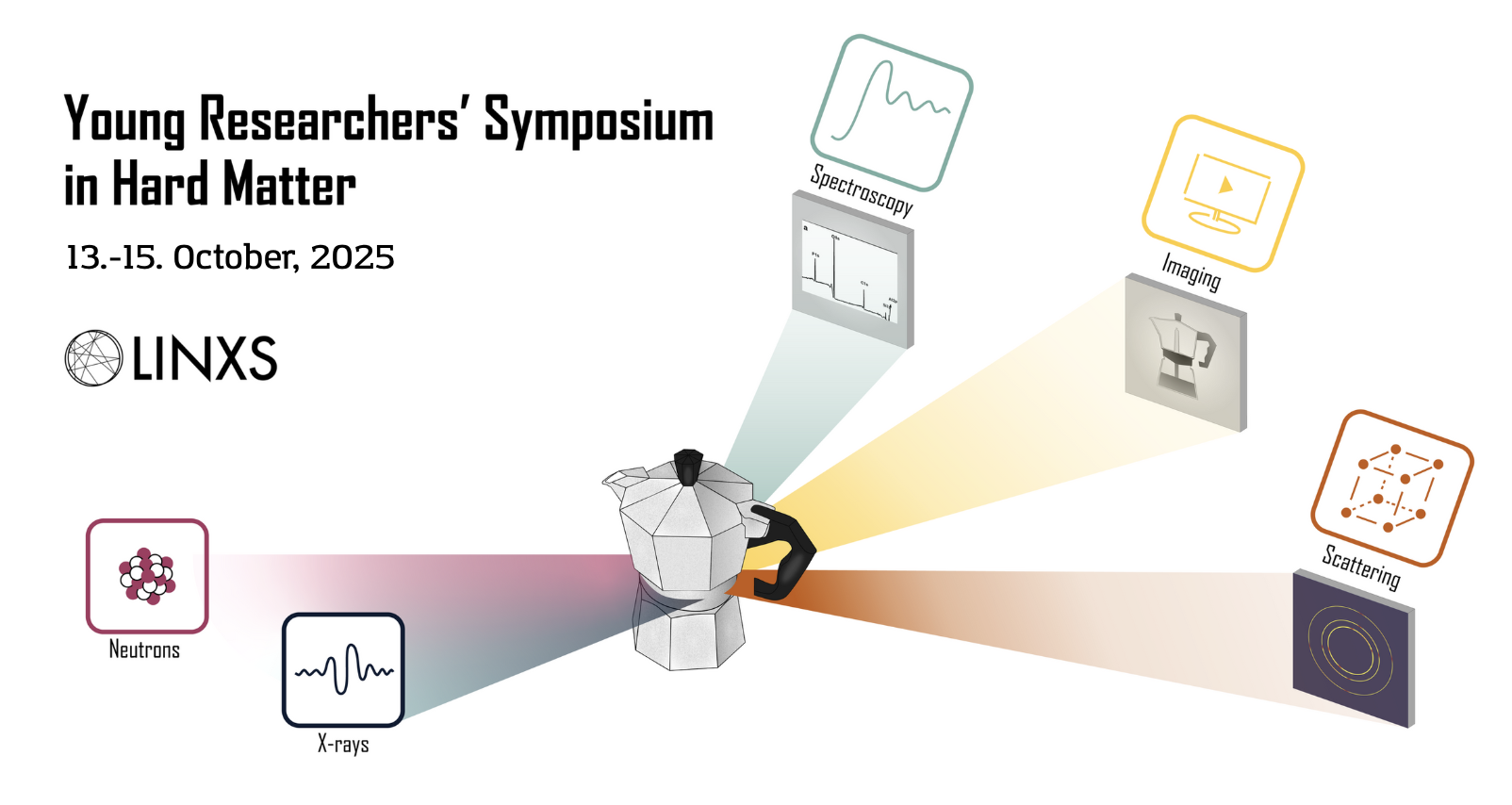
Hosted at LINXS in Lund, this year's symposium features a rich mix of keynote talks, panel discussions, a poster session, and interactive formats tailored to provide participants with both scientific insights and practical career guidance.
The first day is dedicated to career development, featuring speakers from both academia and industry who will share their professional journeys, offer insights on navigating career transitions, and provide practical strategies for securing research funding. Day 2 focuses on beamline experiments with a special emphasis on multimodal approaches to research questions by exploring the integration of complementary techniques and theoretical methods. Furthermore, practicalities of conducting successful experiments will be addressed by beamline scientists, highlighting common challenges in preparation, beamtime execution, and data analysis. The symposium concludes with a tour of MAX IV in the morning of Day 3.
3D ED/microED short course
| - |
In New York

EMBO Practical Course on ?In-situ structural biology by Cryo-FIB and Cryo-ET
| - |
In Frankfurt am Main
The course is aimed at early-career researchers and facility staff with experience in cryo-EM who are interested in expanding their practical and theoretical knowledge of cryo-FIB/SEM and cryo-ET. The program includes focused lectures and intensive hands-on sessions covering:
- Sample vitrification and lamella thinningÂ
- Plasma FIB milling and cryo-lift-outÂ
- Tomographic data acquisition and analysis
EMBO Practical Course on Volume EM by automated serial SEM
| - |
In Heidelberg
Learn cutting-edge vEM workflows from leading experts. This hands-on course covers all aspects of volume EM from sample prep to image acquisition, reconstruction, and analysis.
Introduction to Single-Particle Cryo-EM 2025
| - |
In Leeds
This in-person beginners? course is aimed at PhD students and postdoctoral researchers who are new to cryo-EM and plan to incorporate it into their research. The programme will combine core theoretical lectures with practical training in single-particle cryo-EM, covering:

 * Negative stain grid preparation and screening
 * Cryo-EM sample preparation (including sample preparation for time-resolved cryo-EM)
 * Grid screening and data collection using EPU on a Titan Krios microscope
 * Demonstration of single-particle data processing using RELION
CECAM/ALC/CCP9 Spectroscopy Masterclass
| - |
In Didcot
National X-ray School (NX School)
| - |
In Lemont, IL
3rd CryoNET
| - |
In Copenhagen
Course Objectives
- To provide training in state-of-the-art techniques for high resolution structure determination by cryoEM, including hands-on practical training in latest software suites for image processing
- Discuss data collection strategies
- Training in basic principles of structure determination using cryoEM
- Develop problem solving skills through discussions and practical sessions in the presence of international experts in the field
- Networking with experts, software developers, and researchers in cryoEM and learn not only the latest but also upcoming developments
I2PC Course on Single Particle analysis and modelling by Cryo-EM
| - |
In Madrid
EMBO Practical Course: Image processing for cryo-electron microscopy
| - |
In London
The course is aimed at researchers who want to learn cryo-em at a deep level, it will combine theoretical lectures and practical image processing sessions using various software, both for single particle and tomography.

To be considered you should have some basic background and some previous/preliminary experience with cryo-em, and you should be in a position to benefit from the course and be able to ?spread the knowledge? as much as possible.
Registration deadline is the 25th April 2025.
Cold Spring Harbor Macromolecular Crystallography Course
|
In Cold Spring Harbor
Seventh ESRF-INSTRUCT course on sample preparation for cryo-EM
| - |
In Grenoble
The seventh of the series practical hands-on course on sample preparation for single particle cryo-EM. It is aimed at PhDs, Postdocs and young scientists new to the field of single particle cryo-EM.
The course offers theoretical and practical aspects of sample preparation for single particle cryo-EM including the basics of grid screening and evaluation using Glacios and Krios microscopes.
Data Quality Workshop with application examples and what we can learn from error analysis: Day 2
|
In Online
Program Day 2
Some new and established metrics in greater detail: mean value of weighted residuals, agreement factor gap for small molecules, errors caused by SHELXL-like weighting scheme, software dependent errors.
at 14:00 CET
Data Quality Workshop with application examples and what we can learn from error analysis
|
In Online
Program Day 1 (12th of March 2025)
Basic concepts and principles of data quality evaluation. Mathematical background. New metrics and their applications; The need to evaluate evaluation processes as well, rewarding errors with practical examples, established misconceptions, metrics as an environment for survival of the fittest data sets, adaptions and evolution processes in data quality evaluation. Challenges for overall progress in the field. Influence of metrics on decision making in crystallographic experiments.
There will be a follow workshop:
Program Day 2 (19th of March 2025)
Some new and established metrics in greater detail: mean value of weighted residuals, agreement factor gap for small molecules, errors caused by SHELXL-like weighting scheme, software dependent errors.
On both days at at 14:00 CET.
Cryo-Electron Microscopy: CSHL Course
| - |
In Cold Spring Harbor, NY
Departure: March 19, 2025 around 12 pm EST
Free Virtual Workshop: Introduction to Mercury and ConQuest Software To Investigate Crystal Structures With a Focus on Powder Diffraction
|
In Online
Structural databases such as the CSD contain a wealth of information that can be used to derive new knowledge and gain deeper insights into your own crystal structures. In particular, functionality from the CSD Portfolio is designed to help you search, visualize and analyse structures. In the field of powder diffraction, accurately matching and optimizing crystal structures is a critical task. CSD Portfolio tools can help you with the process of comparing experimental patterns with predicted ones, which can help identify the most likely structure of a material.
You will learn hands-on how to search and visualise structures in the CSD using ConQuest and Mercury with a focus on structures determined by powder diffraction, and how to use functionality to calculate powder patterns.
What we will cover In this workshop you will explore the basics of searching and visualising structures using the CSD Portfolio, and advanced analysis features for powder patterns. The session will include presentations and demonstrations by CCDC expert tutors and a hands-on part for you to try the software, with the tutors available to help you and answer your questions.
You will learn: - How to search structures in the CSD, in particular finding structures determined by powder diffraction. - How to visualize crystal data. - How to simulate powder patterns from over 1.3 million structures in the CSD and from your own cif files in Mercury. - How to match and optimize experimental powder patterns with simulated ones using functionality based on AutoFIDEL algorithms. - The workshop will be recorded and all registered participants will have access to the recording.
Who should attend? - Crystallographers and structural scientists. - Academic and industrial chemists interested in exploring molecules in the solid form. - PhD and post-doc researchers in the field of crystallography and materials science. - Researchers and scientists who work with the CSD or their own structural databases. - Researchers and scientists who work with powder diffraction. - Industrial scientists using structural informatics to design new materials. - Educators looking to incorporate the CSD into their teaching.
Free Virtual Workshop: Validate Molecular Conformations With Informatics Software Mogul
|
In Online
Mogul enables you to assess the geometry of your molecule through comparison with data from the over 1.3 million expertly curated structures in the Cambridge Structural Database (CSD).
You will learn hands-on how to run a Mogul geometry check in Mercury and how to interpret the results.
What we will cover You will explore how to assess the geometry of a molecule against the structures in the CSD and how to interpret the results. The session will include presentations and demonstrations by CCDC expert tutors and a hands-on part for you to try the software, with the tutors available to help you and answer your questions.
You will learn: - How to run a Mogul geometry check in Mercury. - How to interpret the results obtained. - How to restrict the geometry check to a specific feature of a loaded molecule and how to filter the results. - How Mogul has been used by scientists globally through case studies. - How to use CSD Conformer Generator (built from Mogul data) to generate plausible conformers of compounds of interest. - The workshop will be recorded and all registered participants will have access to the recording.
Who should attend? - Crystallographers and structural scientists. - Discovery scientists. - Academic and industrial chemists interested in exploring molecules in the solid form. - Research scientists working in drug discovery. - PhD and post-doc researchers in the field of crystallography and materials science. - PhD and post-doc level scientists in academia interested in drug discovery. - Researchers and scientists who work with the CSD or their own structural databases. - Industrial scientists using structural informatics to design new materials and new pharmaceutical products. - Scientists using computational methods in solid form science and drug discovery. - Educators looking to incorporate the CSD into their teaching.
Free Virtual Workshop: Search and Access Structural Chemistry Data With the CSD Python API
|
In Online
The CSD Python API (Application Programming Interface) enables you to use many capabilities of the CSD Portfolio programmatically. It can be used to control complex analysis processes, including automated workflows, and it can be integrated with your specialist routines. You can use the CSD Python API to create tailored scripts using the entire CSD functionality to answer your targeted research questions or integrate access to crystal data and CSD functionality into your workflows.
You will learn hands-on how to access and search over 1.3 million organic and metal-organic crystal structures in the CSD using the CSD Python API.
What we will cover In this workshop, you will explore the CSD using the CSD Python API. The session will include presentations and demonstrations by CCDC expert tutors and a hands-on part for you to try the software, with the tutors available to help you and answer your questions.
You will learn: - How CSD entries are represented in the CSD Python API. - How to access CSD entries using the CSD Python API. - How to set up and run a search in the CSD Python API. - How to output results. - How to access and run Python scripts in Mercury. - About case studies demonstrating how the CSD Python API can be used. - The workshop will be recorded and all registered participants will have access to the recording.
Who should attend? - Crystallographers, structural scientists and cheminformaticians. - Academic and industrial chemists interested in exploring molecules in the solid form. - PhD and post-doc researchers in the field of crystallography and materials science. - Researchers and scientists who work with the CSD or their own structural databases. - Industrial scientists using structural informatics to design new materials. - Educators looking to incorporate the CSD into their teaching, and educators in informatics and coding areas looking for more real life examples for their classes.
Wellcome-MRC Cryo-EM in Structural Biology 2025
| - |
In Oxford and Leeds and online
To provide more spaces on this course, this year we will host in-person participants at two venues (Diamond Light Source in Oxford and The Astbury Centre in Leeds) with lectures also being broadcast online via Zoom.