Topics
Synchrotron radiation
MEDSI 2025 13th International Conference on Mechanical Engineering Design of Synchrotron Radiation Equipment and Instrumentation
| - |
In Lund
2025 Synchrotron Powder Diffraction School at PSI
|
In PSI, Villigen
Advancements in High-Resolution Imaging Using Next-Generation Light Sources
| - |
In Trieste
FUNLAYERS Summer School: On the Characterization of 2D-Materials using Synchrotron Light
| - |
In Barcelona
1st edition of the MANACÃ Workshop: Protein structure determination with Sirius
| - |
In Campinas, SP
Fundamentals and Practices of Macromolecule Crystallography Using Synchrotron Light: From Protein Crystallization to Structural Determination
This four-day workshop aims to provide theoretical and practical training in the foundations and advanced techniques of protein crystallography. Among the main topics covered are protein crystallization, macromolecular X-ray crystallography (MX), data collection and processing, and new emerging trends in structural biology.
LACA-ABCr 2025
| - |
In Fortaleza
Our diverse scientific program includes plenary lectures, keynote talks, thematic microsymposia, and poster sessions covering topics such as structural biology, materials science, pharmaceuticals, quantum crystallography, synchrotron and neutron techniques, and more. A highlight of the event is the LACA-ABCr School from October 13â€"14, 2025, a pre-meeting initiative designed to provide young scientists with hands-on training and theoretical insights into essential crystallographic methods, fostering the development of the next generation of crystallographers in Latin America.
Set in the vibrant coastal city of Fortalezaâ€"with its stunning beaches, rich culture, and warm hospitalityâ€"this meeting offers the perfect backdrop for scientific exchange, networking, and collaboration.
Join us for an inspiring week of science, innovation, and collaboration in one of Brazil’s most beautiful destinations!
Cold Spring Harbor Macromolecular Crystallography Course
|
In Cold Spring Harbor
66th Polish Crystallographic Meeting - Konwersatorium Krystalograficzne
| - |
In WrocÃ...‚aw
The Polish Crystallographic Meeting, Scientific Workshop and Session of the Young Crystallographers Sections of PCrA will be held at the Institute of Low Temperature and Structure Research of the Polish Academy of Sciences, ul. Okólna 2 in Wrocław.
The Workshop is devoted to selected issues and problems of modern crystallography.
The Scientific Session of the Young Crystallographers Section of PCrAÂ is a forum for exchanging experiences addressed primarily to students, PhD students and young doctors (maximum 5 years after defense).
The topics of the Meeting include basic and applied research on the ideal and real structure of crystals carried out with the use of X-ray radiation obtained both with traditional methods and in synchrotrons, research with the use of neutrons and electrons, problems of symmetry, phase transformations and crystal growth, new research and computational methods and all other aspects of crystallography. The conference is an annual meeting place and a forum for exchanging ideas of all Polish crystallographers.
During the inauguration of the 66th Polish Crystallography Meeting, the winners of the 6th National Crystallography Olympiad will be decorated: http://olimpiadakrystalograficzna.pl.

19th Conference of AsCA
| - |
In Taipei, Taiwan
On behalf of the Asian Crystallographic Association (AsCA), the Local Organizing Committee (LOC), and the International Program Committee (IPC), we are pleased to announce the 19th Conference of AsCA (AsCA 2025) in Taipei, Taiwan, co-hosted by Taiwan and Japan. The conference will take place at the Taipei International Conference Center (TICC) on December 1â€"5, 2025, jointly with the Symposium on Crystallography of Taiwan and the Crystallographic Society of Japan (CrSJ) Meeting.
AsCA, a regional associate of the International Union of Crystallography (IUCr), is the largest association in the field of structural science within the Asia-Oceania region. This conference, held when there is no IUCr congress, gathers participants not only from Asia and Oceania but also from other regions to share the latest research and advancements. It serves as a valuable platform for exchanging knowledge and strengthening international crystallographic networks among global researchers.
The LOC, formed by the Taiwan and Japan crystallographic societies, and the IPC, composed of international representatives of six major area including biology, physics, chemistry, materials science, and database/data science, are arranging a rich program featuring plenary lectures, keynotes, invited talks, oral and poster presentations, and microsymposia on hot-topic subjects. Additionally, there will be multiple workshops in Taiwan and Japan, commercial exhibitions, council meetings, local association meetings, a half-day synchrotron tour at NSRRC, and social events, including a welcome reception, a young scientist mixer, and a conference dinner.
Taiwan is renowned for its safety, vibrant high-tech industry, diverse cuisine, and natural beauty. Taipei, with its blend of tradition and modernity, offers iconic landmarks like Taipei 101 and night markets, all conveniently close to the conference venue TICC, ensuring a memorable experience.
We look forward to welcoming you to AsCA2025!
AsCA2025 Co-OrganizersÂ
35 European Crystallographic Meeting
|
In PoznaÃ...„
 At the XXV Congress and General Assembly of the International Union of Crystallography in Prague, it was decided that the 35th edition of the European Crystallographic Meeting would be held in Lviv, Ukraine, in 2025.
 Unfortunately, there is a war in Ukraine, and it is not reasonable to organize a great scientific event in Lviv in 2025. An alternative was thus elaborated where, thanks to a collaboration between the Ukrainian Crystallographic Committee and the Polish Crystallographic Association, the conference site will be Poznan, a city in neighbouring Poland.
International School on Quantum Crystallography
| - |
In Erice
International School on Quantum Crystallography 2025 â€" Erice, Italy
| - |
In Erice, Italy
During this school, we will provide an accessible and in-depth education in quantum mechanics and related semi-empirical methods, tailored to provide a solid foundation in understanding materials structure, physicochemical properties, and the response of materials to physical changes and experimental probes. The theoretical foundations of crystallographic experiments will be briefly recalled, and the methodology of data collection and analysis for quantum crystallography methods will be presented and trained in detail. Speakers at this school will go beyond just theoretical calculations, to demonstrate the deep interplay between theory and experiment: for example, by showing how experimental observations could be used to restrain or constrain first-principles calculations or otherwise showing how calculations could improve the interpretation of an experimental result.
In keeping with this overall aim, the synergy between theoretical and experimental areas will be highlighted to provide a holistic view of the different fields in Quantum Crystallography. This area of knowledge is going through an important boost in the last years, thanks to new coupled approaches and new communities getting in touch with each other. This school will bring together students from these two communities, feeding this new area of knowledge and letting interdisciplinary grow among the students.
Workshops will provide hands-on tutorials on the use and development of software related to the topics, including the development of required input data, and using case studies.
Additionally, the school will benefit from the synergy with the Electron Crystallography School running in parallel, with several lectures shared between the two schools. This will offer a unique opportunity to explore interdisciplinary applications of crystallography in quantum science and structural research.
HERCULES 2025
| - |
In Grenoble
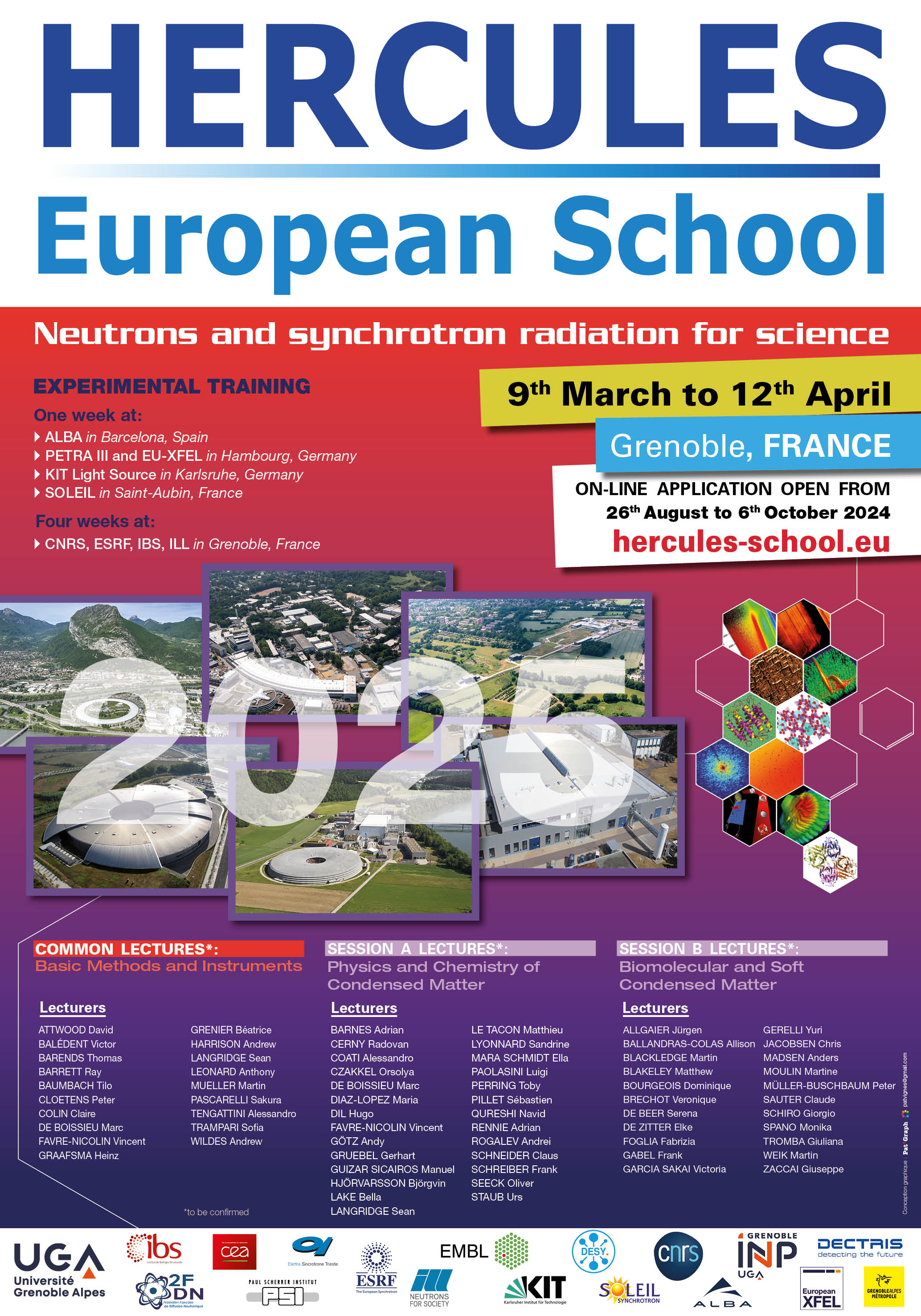
HERCULES is a European course for PhD students and young researchers using Neutrons and Synchrotron Radiation for applications in Biology, Chemistry, Physics, Hard & Soft Condensed Matter.
 The 5-week school includes lectures (60%), hands-on practicals, labs & tutorials (30%), visits, a poster session, group work sessions, ...
Participants will spend one week in a partner institution in Europe among:
- ALBAÂ in Barcelona, Spain
- PETRA III and EU-XFELÂ in Hambourg, Germany
- KIT light source in Karlsruhe, Germany
- SOLEILÂ in Saint-Aubin, France
 This comes in addition to practicals, labs, and tutorials which will take place in Grenoble at ILL, ESRF and Grenoble Laboratories (CNRS, IBS).
The school includes a common part and two parallel sessions:
-Â Physics and chemistry of condensed matter (session A)
-Â Biomolecular and soft condensed matter (session B)
DEADLINE FOR APPLICATION: 6 October 2024
65th Polish Crystallographic Meeting - Konwersatorium Krystalograficzne
| - |
In WrocÃ...‚aw
The Polish Crystallographic Meeting, Scientific Workshop and Session of the Young Crystallographers Sections of PCrA will be held at the Institute of Low Temperature and Structure Research of the Polish Academy of Sciences, ul. Okólna 2 in Wrocław.
The Workshop is devoted to selected issues and problems of modern crystallography.
The Scientific Session of the Young Crystallographers Section of PCrAÂ is a forum for exchanging experiences addressed primarily to students, PhD students and young doctors (maximum 5 years after defense).
The topics of the Meeting include basic and applied research on the ideal and real structure of crystals carried out with the use of X-ray radiation obtained both with traditional methods and in synchrotrons, research with the use of neutrons and electrons, problems of symmetry, phase transformations and crystal growth, new research and computational methods and all other aspects of crystallography. The conference is an annual meeting place and a forum for exchanging ideas of all Polish crystallographers.

Synclight 2024 - São Paulo School of Advanced Science on 4th Generation Synchrotron Techniques
|
In Campinas
Promoted by CNPEM and funded by São Paulo Research Foundation (FAPESP), SyncLight 2024 aims to gather young researchers from Brazil and around the world to discuss the recent opportunities offered by advanced experimental synchrotron techniques available at Sirius, the Brazilian 4th generation light source.
Over the past decades, synchrotron light sources have played a significant role in the development of modern natural sciences and engineering. With a wide range of experimental techniques available, synchrotron light sources have revolutionized the way scientists study and characterize materials in the fields of Physics, Chemistry, Biology, Health, Energy, New Materials, Environmental Sciences, and many others.
The interdisciplinary nature of the event, combined with the collaboration of the LNLS User Committee, which includes researchers from various institutions across Brazil, will contribute to the exchange of experiences among young researchers, professors, and experienced researchers. The event's program includes lectures, poster sessions, and guided tours at the facilities will also be organized. Tutorials on experiments conducted, demonstrations on the control of the accelerators, as well as data analysis and simulations taught by LNLS researchers, at the laboratory's beamlines, are also planned.
The theme is particularly relevant to the Brazilian scientific scenario, as Sirius is one of the most modern and brilliant synchrotron light sources in the world. Currently, ten beamlines are open to the scientific and technological community, out of a set of 14 initially planned to cover a wide range of scientific programs. One of the objectives of SyncLight 2024 is precisely to assist in the training and formation of a new generation of user-researchers, capable of benefiting from this large scientific infrastructure in operation in Brazil.
SyncLight 2024 is part of the São Paulo School of Advanced Science (SPSAS) modality, funded by FAPESP, which provides resources to promote short courses in different areas of knowledge in the State of São Paulo.

UK/Japan Symposium on Frontiers of Structural Biology
| - |
In Liverpool
The symposium celebrates the Japanâ€"UK partnership and brings together wide range of experts from Japan covering all of the frontier structural biology approaches including cryo-electron microscopy, synchrotron and free-electron laser X-ray crystallography and neutron crystallography.
The symposium will have two full days of lectures, the first day finishing with a public lecture by the Nobel Laureate Richard Henderson and the second day with lectures (open to the public) from Sir Tom Blundell and Dr Harren Jhoti, FRS (President and Chief Executive of Astex Pharmaceuticals).
The symposium is supported by the University of Liverpool and RIKEN together with BBSRC, STFC and ILL.
Registration is essential and is limited to 125 delegates. A small registration fee of £50 is being set to encourage ECR and PDRAs participation.
See the programme here.Â
EMBO course on Structural characterisation of macromolecular complexes
| - |
In Grenoble
- Protein expression and purification
- Biophysical characterisation of macromolecular complexes
- Introduction to electron microscopy
- X-ray crystallography, small angle X-ray scattering and serial crystallography using synchrotron radiation
- Application of nuclear magnetic resonance in structural biology
- Mass spectrometry in protein-protein interaction studies
- Single-molecule methods and super-resolution light microscopy
- AI-based structure prediction methods
Neutrons in Structural Biology â€" Challenges and Opportunities
| - |
In Arlington
The ORNL Neutron Sciences Directorate is organizing a workshop, Neutrons in Structural Biology â€" Challenges & Opportunities, to be held June 10-12, 2024 at the Sheraton Pentagon City Hotel, Arlington, VA. The goal of the workshop is to garner support for the construction of the macromolecular neutron diffraction beamline EWALD at ORNL’s Second Target Station. EWALD will be capable of performing biological neutron crystallography on radically smaller crystals to help meet neutron beamtime demand for challenging biological systems.
The workshop will highlight the biological scientific community’s need for access to a new generation of neutron scattering capabilities to address pressing challenges in biochemistry, structural biology, enzymology and drug design that cannot be solved with the current neutron scattering technology or other structural biology techniques such as X-ray crystallography, Nuclear Magnetic Resonance, and cryo-EM.
The workshop will also introduce the Instrument Scientific Advisory Committee for the development of a macromolecular neutron diffractometer at ORNL’s Second Target Station. The beamline will deliver orders of magnitude gains in performance for biological research and expand accessibility to larger biological systems crucial for understanding biochemistry and advancing the design of future therapeutics.Â
In addition, the Dynamic Nuclear Polarization (DNP)-enabled IMAGINE-X instrument, a capability recently funded by the Department of Energy’s Biopreparedness Research Virtual Environment (BRaVE) Initiative, will be presented at the workshop. IMAGINE-X, under construction at the High Flux Isotope Reactor, will dramatically enhance signal from hydrogen atoms, obviating the need for deuteration, and decreasing the crystal volume required for a successful experiment by one-to-two orders of magnitude. The successful development of the DNP capability and its implementation at the STS beamline will create a "quantum leap" in biological macromolecular neutron crystallography.
The workshop will be a forum for structural biology and biochemistry experts, early career researchers, and students to discuss scientific advances and collaboration opportunities. The workshop will include a 1-day satellite training workshop (June 10, 2024) to educate graduate students and postdoctoral researchers in the application of neutron crystallography and small angle scattering in structural biology.
RapiData 2024
| - |
In Menlo Park, CA
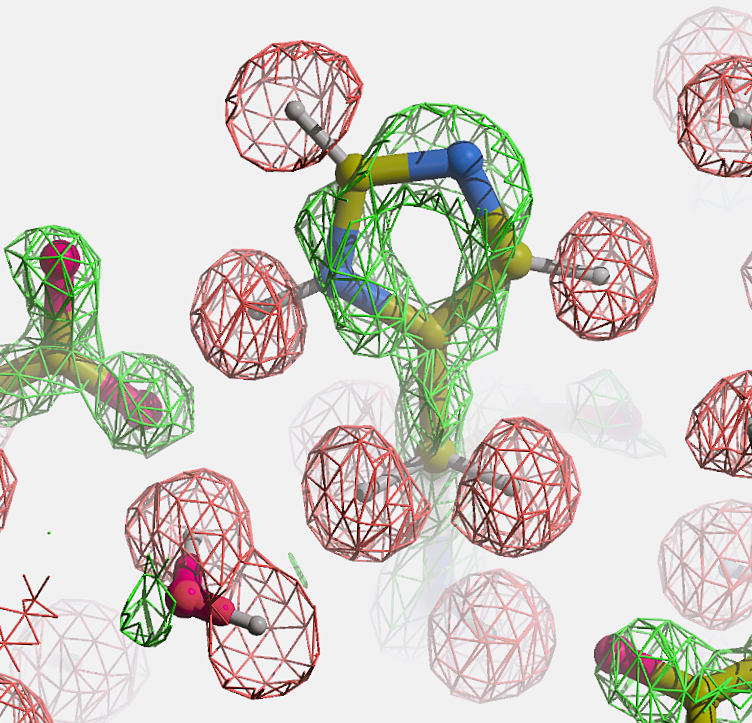
RapiData 2024 at SSRL is a practical course in macromolecular X-ray diffraction data collection, data processing and structure solution. The aim of the RapiData course is to educate and train young scientists in data collection and processing methods at synchrotron beamlines, using state-of-the-art software and instrumentation.
Â
Topics:
- Specimen preparation, tactics in data collection
- X-ray light sources
- X-ray detectors
- Data reduction
- Structure solving by MAD, SAD and Molecular replacement
- Complementary methods (spectroscopy and small angle scattering)
Science@FELS 2024
| - |
In Paris and Synchrotron Soleil