Topics
Synchrotron radiation
MATRAC 2 School
| - |
In Garching (near Munich)
The MATRAC 2 School will provide a systematic overview of the application of neutrons and synchrotron radiation to the structural analysis of engineering materials and will focus on neutron scattering and imaging experiments. Therefore, the school consists of a two-day theoretical course in Herrsching and two days of experiments at the FRM II in Garching. The fifth day of the school offers further talks and a final discussion. All relevant experimental methods will be covered. Students and young scientists from research and industry from all of Europe interested in this field are welcome to participate.Â
Registration for the school is now open!Â
Extend registration deadline: 27th January 2019Â
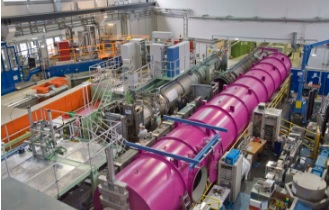
17th European Powder Diffraction Conference - EPDIC17
| - |
In Ã... ibenik
The European Powder Diffraction Conference, EPDIC, is a biannual conference dedicated to all aspects of the analysis of polycrystalline materials by diffraction methods. Each EPDIC has the aim to highlight the latest developments in powder diffraction including methodology, data analysis and instrumental advances. EPDICs traditionally bring together scientists from institutes, universities and instrumentation companies to discuss the progress in academic and industrial research related to powder diffraction. The 17th edition of EPDIC (EPDIC17) will take place in the town of Šibenik, an emerging star of the Croatian Adriatic coast.

RapiData2019
| - |
In Menlo Park, CA
RapiData is a practical course in macromolecular X-ray diffraction data collection, data processing and structure solution. The aim of the RapiData course is to educate and train young scientists in data collection and processing methods at synchrotron beamlines, using state-of-the-art software and instrumentation. The course will be held at the Stanford Synchrotron Radiation Lightsource (SSRL) located on the SLAC National Accelerator Laboratory campus in Menlo Park, CA, from May 5-10 2019. Course organizers for 2019 are Silvia Russi, Clyde Smith and Jeney Wierman.
Please visit http://smb.slac.stanford.edu/news/rapidata/rapidata-2019/ and use the links on the "registration" page to apply for the course. The application deadline is December 31 2018 Successful applicants will be notified early in January 2019 and invited to register and book accommodation at the SLAC Guesthouse at that time. A limited amount of travel support funding may be available.
Joint meeting of IX Mexican National Congress of Crystallography (SMCr), XII Mexican National Congress of Microscopy and VIII National Meeting for Synchrotron Users in Mexico
| - |
In Oaxaca City

To.Sca.Lat 1.0 (Total Scattering Analysis for NanoScience in Latin America)
| - |
In Florianópolis
The Latin America Summer School on Crystallography, Diffraction and Total Scattering Analysis for Advanced Materials and NanoScience.
Topics will cover ab initio structure solution by powder diffraction, quali- and quantitative phase analysis, microstructural analysis, total scattering techniques for nanomaterial characterization (structure, defects, size, morphology) by combining small- and wide-angle methods in reciprocal (Debye scattering equation) and real (Pair Distribution Function) space. Cases of applications to pharma and biomimetic materials, porous metal organic frameworks, nanosized metal, oxide, semi- and super-conductors will be presented.
Lectures on fundamentals, experimental, modelling and analytical aspects of the technique (2 days) will be combined with tutorial sessions (3 days) on data analysis, with the aid of the following programs: TOPAS, QUANTO, PDFGUI, DebUsSy,  PM2K e DIFFax+.
Advanced aspects of Synchrotron Radiation and its application to powder diffraction of functional materials will be introduced by Alexandre Gomes Carvalho, from the Brazilian Synchrotron in Campinas. Well renowned experts in the field of powder diffraction and programs, with high scientific reputation in the different topics and experience at European and Swiss Large Scale Faclities, will join the To.Sca.Lat, deliver lectures and take care of the tutorial sessions.
MAUD 2018
| - |
In Trento
The aim is to bring together participants from various fields of both the academic and non-academic world and give them the necessary information and tools to be able to characterize their own samples using the combined analysis method and the software MAUD.Â
XRD, XRF and electron microscopy equipment available at the Dipartimento Ingegneria Industriale (DII) and Fondazione Bruno Kessler (FBK) will be used to demonstrate technical aspects and to support the theoretical and practical issues of this course.
Cristallographie et Grands Equipements 2018
| - |
In SOLEIL, Saint-Aubin
The sixth edition of the "Crystallography and Large Equipment" school will take place at the SOLEIL synchrotron on 15th-19th October 2018, and will focus on the the possibilities offered by different crystallographic methods.
The number of places is limited to 24 applicants. Please visit the school website for more information (the only language available is French):Â
https://www.synchrotron-soleil.fr/fr/evenements/ecole-de-cristallographie
Â
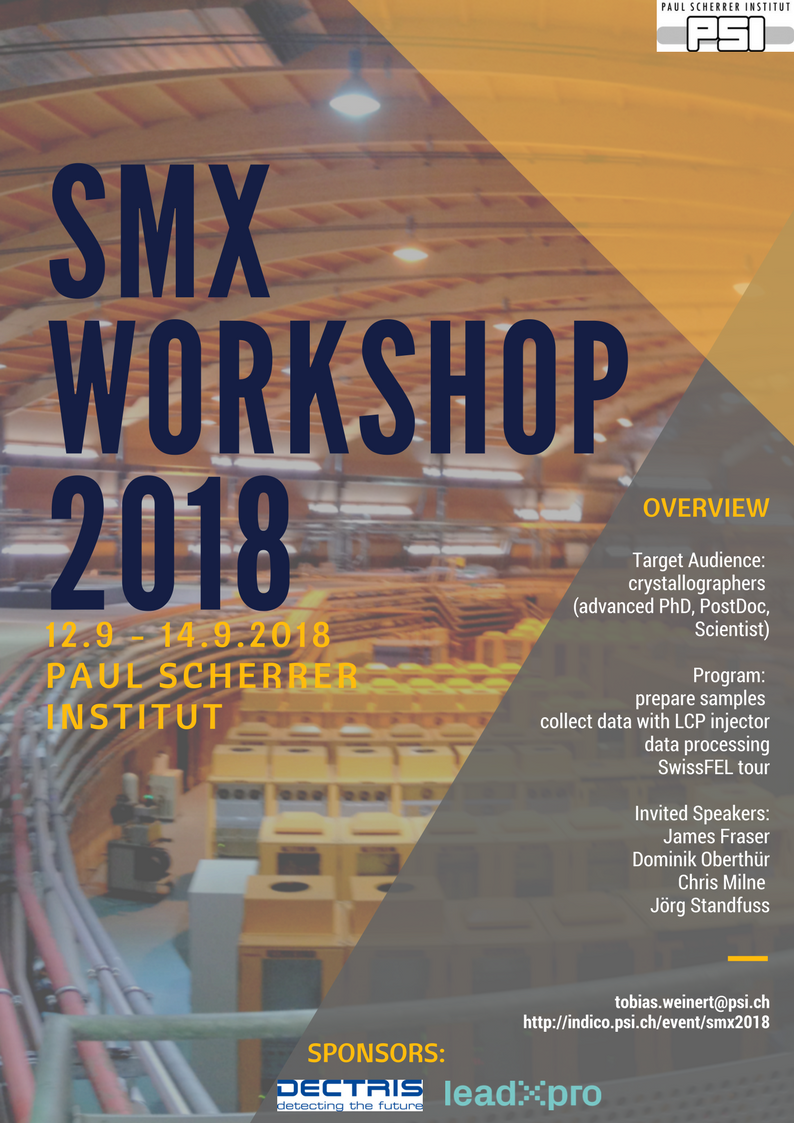
First Serial Millisecond Crystallography (SMX)
| - |
In Paul Scherrer Institut
Diffraction on Energy Materials School
| - |
In Grenoble
The event will be divided in two blocks. The first block will be a specialised Diffraction on Energy Materials School
This School will be based on selected lectures together with intensive hands-on sessions using advanced tools for diffraction data treatment either implemented in Rietveld refinement programs, such as FullProf, or available as independent refinement programs such as FAULTS (also included in the FullProf suite).
The second block will be a meeting concerned with Diffraction on Energy Materials. This meeting will be organized as a parallel event of the ILL-ESS User Meeting which will take place at the Congress Center WTC (Grenoble). The participants can share their ideas in the framework of the proposed programme.
MATRAC 1 School 'Application of Neutrons and Synchrotron Radiation in Materials Science'
| - |
In Lauenburg and Hamburg
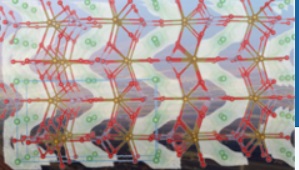
A systematic overview of the application of neutrons and synchrotron radiation to the structural analysis of engineering materials will be provided. The focus of the practical training will be on synchrotron experiments. Neutron data analysis will also be practised. Therefore, the school consists of a two-day theoretical course in Lauenburg, followed by two days of experiments at GEMS/DESY in Hamburg. The fifth day of the school offers further talks and a final discussion. All relevant experimental methods will be covered.
NSLS-II Pair Distribution Function School
| - |
In Brookhaven NL, Upton, NY
The primary objective of the school is to give a hands-on training to participants on PDF data acquisition, reduction, and analysis covering all required steps from measurement to the final model. Data acquisition training will be conducted at the newly constructed PDF and XPD beamlines at NSLS-II. All participants are expected to being their own laptop computers for data analysis; the latest python based software package, xPDFsuite, will be used for data processing and modelling.
Registration fee: $225 - this will cover the cost of the xPDFsuite software and meals. A limited number of rooms in BNL dormitories are available for a discounted price.
Registration deadline: 30th June 2018.
2nd Nordic/Baltic Summer School in Neutron Scattering
| - |
In Tartu
This school, supported by NNSP and SwedNess, is aimed as an introduction for early career researchers to a range of topics concerning neutron scattering.
The topics to be covered will include the principles of scattering and neutron instrumentation, diffraction, reflectivity and the multiple types of scattering techniques.Â
In addition there will be lectures which will highlight the use of neutrons in industrial and various scientific research fields, including at the ESS.
Nordic/Baltic participants will not be charged for attendance to the school or accommodation, and transportation costs will be reimbursed. Participants with affiliation outside of the Nordic and Baltic region will have to cover transport and accommodation costs. Â
Aimed at students outside the Physical Sciences, there is a introductory course on the mathematics and physics tool required for the school - this will be held on 8th and 9th September.
Registration deadline: 1st August 2018
30th MAX IV Laboratory User Meeting: Coherent visions
| - |
In Lund

5th NYU X-Ray Workshop
| - |
In New York, NY
The aim of this workshop is to promote many aspects of crystallography including diffraction methods, instrumentation and software (with a particular focus on the services and products provided by Bruker). Topics of the workshop will include application of X-ray diffraction in academic research and industry, synchrotron radiaiton, crystallisation methods and structure solution and refinement using TOPAS.
It will also allow networking of researchers in the field, with a confirmed line-up of speakers, and to encourage cooperation between NYU and other organisations.
The number of attendees for certain components of the workshop are limited to below the 50 places available for the general workshop lectures, so early registration is advised.
For more information about registration, please contact Dr. Tony Hu (ch98@nyu.edu).
For more general information, please visit:Â http://as.nyu.edu/chemistry/research/facilities/xray-diffraction/workshop/2018.html
Â
SNI2018 : German Conference for Research with Synchrotron Radiation, Neutrons and Ion Beams at Large Facilities
| - |
In Garching
The conference brings together users and scientists of Large Facilities for Neutron scattering, Synchrotron Radiation and Ion Beam Facilities, and it offers a unique possibility to exchange ideas across research areas and methods.
Synchrotron Radiation School (SR school 2018)
| - |
In Oxford and Diamond Light Source
The school will be co-located at Diamond and Jesus College, Oxford, with participants staying in Oxford.
The SR School provides postgraduate students and post-doctoral researchers, who have little experience of Synchrotron Radiation (SR), a broad-based introduction to many of the different types of experiments conducted using SR. It is largely aimed at physical scientists, but life scientists are welcome to apply. The school gives the attendees the opportunity to obtain hands-on practical experience of performing an experiment on several of the Diamond beamlines. At least 14 Diamond beamlines will be particpating in the school (see below for details).
 Topics covered in the course lectures
- X-ray Scattering
- Symmetry and Crystallography
- The Diamond Synchrotron
- X-ray optics and detectors
- An introduction to the data analysis program DAWN
And the synchrotron use of:
- Infrared Microspectroscopy
- Powder Diffraction
- Resonant and Magnetic Scattering
- Small-Angle Scattering
- Surface Diffraction
- X-ray Absorption Spectroscopy
- X-ray Imaging
- X-ray Photoelectron Spectrocopy
National Conference on Optics, Photonics and Synchrotron Radiation for Technological Applications
| - |
In Mumbai
Organized By Physics Group, Bhabha Atomic Research Centre, Mumbai 400 085, India
 Topics
- Science with Synchrotron Radiation
- Control & Instrumentation for Synchrotron beamlines
- Multilayers for Lasers, Neutrons and Synchrotron beam
- Spectroscopy with Lasers
- Photonics and Devices
- Optical Instruments for Nuclear & non-Nuclear applications
- Optics for Astrophysical sciences
- Optical Coherence Tomography & Holography
Hands-on-Training in EXAFS Beam Line
There will be a special programme on “Hands-on training and data analysis†for beginners and young users of the EXAFS beamlines under the umbrella of “XAFS commission of International Union of Crystallography (IUCR)â€.
Modern Methods in Rietveld Refinement for Structural Analysis
| - |
In Lemont IL
The fourth “Modern Methods in Rietveld Refinement for Structural Analysis†will be held at the Advanced Photon Source of Argonne National Laboratory in close partnership with Bruker-AXS, ANL, and the National Science Foundation. Â

Challenges in additive manufacturing industrial qualification: key solutions at large scale infrastructures
| - |
In Grenoble
From process qualification until component certification, additive manufacturing presents big challenges as a new field of material processing with multiple new parameters. Therefore, new insights concerning characterization are envisaged for process and component standards and certification, as well as for experimental benchmark input for modellings.
European large installations ILL and ESRF offer a common frame for additive manufacturing industrial investigations, where unique static (scanning) and dynamic (in situ) studies on stresses and imaging, from the nanometre until several centimetres range, are possible. To foster industrial escalation of additive manufacturing, we aim at bringing together industry and applied sciences to address key manufacturing issues regarding final quality assessment of products.
Why neutrons?
- For non-destructive and bulk characterization: neutrons can penetrate several cm into matter.
- For new information: neutrons interact in a different way with matter, hence giving another contrast, i.e. for hydrogen!
- For sample environment and in situ studies
Why Synchrotron?
- High energy X-rays, allowing higher penetration depth for real 3D imaging of high density samples.
- High intensity X-rays for non-destructive probing of material structure and devices with high spatial resolution from millimetres to nanometres.
- High intensity X-rays for real time measurements with less than a microsecond time resolution and high-throughput analysis under real manufacturing and operating conditions.

Time, Work and Function: Time-Resolved Synchrotron and Neutron Techniques for Studies of Soft, Biological and Hard Matter (TWF2018)
| - |
In Oslo
This workshop will focus on scattering techniques and in particular time-resolved and in operando studies of kinetic processes. The main topics to be covered in the workshop will include Energy Materials, Soft Matter, Biological Matter, Inorganic Functional Materials and Catalysis. Due to support from the Norwegian Research Council and ESS & MAX IV, registration for the workshop is free; however, there is a limit of 100 participants and those with connections to the local InterReg project will gain priority in obtaining a position at the workshop.Â
For further information and contact details, please visit:Â https://www.twf2018.com/
Registration deadline: 29th April 2018
Abstract deadline: 6th April 2018
To complete registration, please visit:Â https://nettskjema.uio.no/answer/93111.html;Â or sent your abstract by email (with "NNSP-TWF2018" as the subject heading) to Reider Lund at this address: reidar.lund@kjemi.uio.no