Topics
Materials
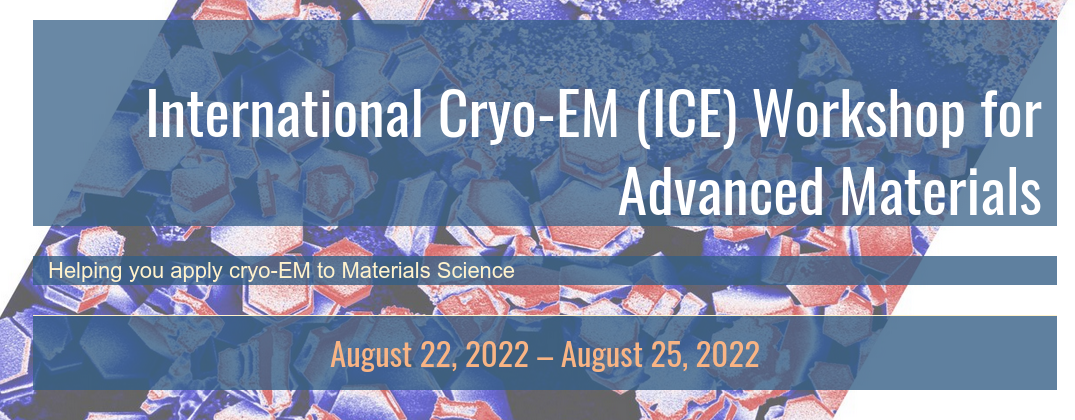
International Cryo-EM (ICE) Workshop for Advanced Materials
| - |
In Albuquerque, NM, USA
The first 'International Cryo-EM (ICE) Workshop for Advanced Materials' will take place at the Center for Integrated Nanotechnologies (CINT), Sandia National Laboratories (SNL), 1101 Eubank SE, Albuquerque, NM 87123, USA.
Â
The 'ICE Workshop for Advanced Materials' is an in person science and training workshop that combines invited lectures on current advancements and applications of cryogenic electron microscopy for materials sciences with lab demonstrations of current state-of-art cryogenic microscopy techniques.

This workshop covers each critical step of a successful cryogenic microscopy study, including specimen preparation, specimen transfer, cryogenic SEM/FIB, new cryo-EM stages, imaging and spectroscopy at low temperatures. Vendor talks will provide information on the current state-of-the-art tools and workflows for Cryo-EM experiments. In-person lab demonstrations will be performed at CINTs Core Facility at SNL, allowing participants to have live interactions with the instructors and hands-on experience. We invite participants to bring a (3' x 4') poster of their work to share during the workshop. Additional pre-recorded lab demonstrations will be provided by experts from various institutions.

This workshop aims to unify the current state-of-the-art and bring together experts in cryogenic electron microscopy for materials science.
We particularly aim to:

 * Provide a learning platform for students and early career materials scientists who are interested in recent Cryo-EM technical and scientific advancements
 * Connect scientists from international and US universities with National Laboratories to stimulate an intensive exchange of Cryo-EM knowledge
 * Accelerate the design and developments of new equipment and methods for cryo-EM research
ELDICO webinar: Application of 3D ED to research into lithium ion battery cathode materials
|
In Online
Date: 17th of May, 3 PM CETÂ
 Registration link for online event: https://us02web.zoom.us/webinar/register/1516510473839/WN_YKgaC5TES-SkAge_obtD6A

Polish Conference on Crystal Growth 2022
| - |
In Gdansk
Polish Conference on Crystal Growth 2022 is an international conference organized by Polish Society for Crystal Growth (PTWK), Gdańsk University of Technology, and the ENSEMBLE3 Centre of Excellence.
The conference will be held in Gdańsk, Poland on June 19-24th, 2022.
The program of PCCG 2022 is focused on current research and development topics in the field of crystal growth, epitaxy, nanocrystals and advanced materials, including:
- Bulk growth
- Epitaxial growth
- Photonic crystals
- Intermetallics
- Topological insulators
- Biocrystals and biogenic crystals
- Semiconductors
- Materials for photovoltaics
- 2D materials
- Characterization methods
- Optical crystals
- Novel materials
Polish Conference on Crystal 2022
| - |
In GdaÃ...„sk, Poland
Polish Conference on Crystal Growth 2022 is an international conference organized by Polish Society for Crystal Growth (PTWK), Gdańsk University of Technology, and the ENSEMBLE3 Centre of Excellence.
The conference will be held in Gdańsk, Poland on June 19-24th, 2022.
The program of PCCG 2022 is focused on current research and development topics in the field of crystal growth, epitaxy, nanocrystals and advanced materials, including:
- Bulk growth
- Epitaxial growth
- Photonic crystals
- Intermetallics
- Topological insulators
- Biocrystals and biogenic crystals
- Semiconductors
- Materials for photovoltaics
- 2D materials
- Characterization methods
- Optical crystals
- Novel materials
Â
12th International Conference on Inelastic X-ray Scattering (IXS2022)
| - |
In Oxford
Hosted by Diamond Light Source, the 12th International Conference on Inelastic X-ray Scattering (IXS2022) will be held at the Saïd Business School, Oxford, UK, from Sunday 21 to Friday 26 August 2022. It continues a series of meetings held biannually, most recently hosted by Brookhaven National Laboratory in New York, USA (2019).
This conference will bring together scientists from all over the world interested in the use and development of both resonant and non-resonant inelastic X-ray scattering to address a broad range of materials science challenges. IXS2022 is your opportunity to share new scientific discoveries and the latest developments in the instrumentation, experimental approaches and theories, and to discuss future directions in the field.
Call for abstracts
The Programme Committee welcomes abstracts for posters and/or contributed talks within the theme areas below; all abstracts must be submitted on the provided template via the Oxford Abstracts submission portal:
- Quantum and functional materials (experimental and theory)
- Energy materials, chemistry and catalysts
- Soft and liquid systems, biomaterials and extreme conditions
- Time-domain spectroscopy
- Instrumentation and novel methods
The submission deadline is Friday 1 April 2022 at 17:00 UK time. Presenters will be notified week commencing 9 May 2022 on the outcome of their submission.
Registration
Registration is open here. Standard delegates can save up to £100 when registering before the Early Bird deadline of 15 May 2022. The delegate ticket and student ticket include access to all sessions, the welcome reception, tea and coffee breaks and daily lunches.
Visit the conference website for travel and accommodation details.
Sign up here to the IXS2022 Mailing List to stay informed of conference news and updates via email.
2nd International Conference on Noncovalent Interactions
| - |
In Strasbourg
Gordon Research Conference - Crystal Engineering
|
In Sunday River, Maine (USA)
The 2022 Gordon Research Conference on Crystal Engineering (GRC-CE) is a biannual meeting. The 2022 GRC-CE will bring together organic, inorganic, physical, computational chemists, as well as pharmaceutical scientists, materials scientists, data scientists, and others in a uniquely and highly interactive environment to discuss latest results at the cutting edge of the field. The program for the 2022 GRC-CE GRC includes sessions on Order, Disorder and Defects, Crystal Assembly, Polymorphs and Mixtures, Crystals Under Pressure, Crystal Reactivity, Pharmaceuticals and Cocrystals, Big Data and Informatics, Porosity and Open Framework Materials, and Engineering Across Different Length Scales.Â
An associated Graduate Research Seminar (GRS) prior to the GRC-CE conference ensures that young scientist are well represented as attendees at the GRC-CE. The highly interactive format of both the GRC and GRS ensures it will be a valuable experience for the next generation of researchers in the field. Â
Virtual Microscopy Characterisation of Organic-Inorganic Interfaces 2022
|
In Virtual
The 6th Microscopy Characterisation of Organicâ€"Inorganic Interfaces (MCOII) meeting will again be hosted virtually, but it will keep the main goals and aspirations of all the previous editions.  We will use the advantages of the virtual format and this time not only connect experts from different branches of the microscopy community (the life sciences and materials science) but also bridge two continents in a joint discussion on the challenging but increasingly important topic of studying hybrid organicâ€"inorganic materials.
The transatlantic scientific organiser team of Nadja V. Tarakina (MPIKG, Germany) and Lena F. Kourkoutis (Cornell University, USA) have put together an exciting two-day programme. As usual, the first day will be more general, covering a broad range of microscopy approaches (correlative microscopy solutions, in-situ gas and liquid microscopy methods, low-voltage electron microscopy and many more) in the context of imaging hybrid and soft matter.
On the second day, the special Focus Lecture Series will provide an in-depth view on "Advances in Analytical Cryo-Electron Microscopy: From sample preparation to data acquisition to data analysisâ€. Cryo-electron microscopy has transformed life sciences by enabling the structure of macromolecules to be imaged down to the atomic scale. Recent developments in instrumentation and techniques have opened new opportunities for scientific discovery not only in life sciences but also in physical sciences and in areas where the two fields intersect. This lecture series will bring together world-leading experts in analytical electron microscopy, highlighting the latest achievements, new opportunities and outstanding challenges in probing beam-sensitive and hybrid materials and their interfaces.Â
Â
30th Annual Meeting of the German Crystallographic Society
| - |
In Munich
The 30th Annual Meeting of the German Crystallographic Society (DGK 30), which will take place in the historical main building of the Ludwig-Maximilians-University in Munich, will feature presentations and discussions of recent and exciting results of research on crystallographic topics.
International School of Crystallography. 46th Course, Crystallography under extreme conditions: the future is bright and very compressed
| - |
In Erice
Subjecting matter to extreme conditions reveals a multitude of fascinating phenomena, and is applicable to a wide range of disciplines. From the extremophiles that exist in the deepest depths of our oceans to the exotic new materials that are made when atoms are pushed ever closer together, understanding the structure of materials at extreme conditions affects Biology, Chemistry, Physics, Geoscience and Material Science. In order to achieve its goals, high pressure research has been always at the vanguard of technical progress. It is a discipline in which equipment plays a particularly important role. State-of-the-art diamond anvil cells can now achieve megabar ranges of pressure, millions of times atmospheric pressure, with this beaten by an order of magnitude in dynamic compression experiments. In this manner, scientists are able to mimic the conditions in the interiors of giant planets. Nature is even more ambitious, as in the stars petapascal pressures (the order of tens to hundreds billion atmospheres) are reached. In the laboratory, we can even create conditions of pressure, temperature and magnetic fields that are not found naturally, allowing us to complement nature to explore more exotic phases of matter.
Therefore, the course will cover broad ground in the application of extreme conditions crystallography. The topics will span from fundamentals of high-pressure single crystal and powder diffraction, to presenting the many flavors of static and dynamic compression, to reviews of sources for extreme conditions work (synchrotrons, neutrons and free electron lasers). Complementary experimental (Mössbauer spectroscopy, X-ray magnetic circular dichroism, X-ray absorption spectroscopy, inelastic scattering) and computational methods will also be discussed. Diffraction analysis on the structure of liquids, glasses and nanocrystalline materials as well as multigrain crystallography will also be introduced. The lectures will be harmonized with the related sessions of interactive tutorials, providing hands-on experience to the attendees. These workshops will be focused on basic laboratory skills and the elements of data processing software related to the high pressure.
2nd International School on Advanced Porous Materials (MOFschool 2021)
| - |
In Online from Como

78th Pittsburgh Diffraction Conference
| - |
In Online
The 78th Annual Pittsburgh Diffraction Conference, a free virtual event hosted by SLAC National Accelerator Laboratory from September 19th to September 21st, 2021, and concurrent with the 2021 SSRL/LCLS Users' Meeting and Workshops.
Â
The conference will feature a welcome reception on September 19th (via Kumospace) followed by two full days of lectures, poster presentations and virtual tours to the SLAC National Accelerator Laboratory facilities.

Session topics include metals in biology, computational methods in structural science, cryoEM of biomolecules and cells, scientific opportunities for remote access to user facilities, neutron diffraction, and powder diffraction in materials science research.

The best graduate student poster presentations at the conference will be awarded with the Chung Soo Yoo Award, established by the Pittsburgh Diffraction Society to honor Dr. Yoo’s memory, and a $400 cash prize. One award will be given to a poster related to biological research and one to a poster related to materials science or chemistry. All graduate students are welcome to submit a poster and be considered for the awards.

IV LACA School (Latin American Crystallogaphic Association): Phase identification and Microstructural Characterization of Materials using X-Ray powder Diffraction Techniques
| - |
In ValparaÃso
Preliminary list of Invited Instructors:
• Claudio Aguilar (UFSM, ValparaÃso, Chile)
• Tom Blanton (ICDD, USA)
• Raúl Cardoso-Gil (MPI-CPFS, Dresden, Germany)
• Miguel Delgado (ULA, Venezuela)
• Graciela DÃaz de Delgado (ULA, Venezuela)
• David Rafaja (TUB, Freiberg, Germany)
• Diego G. Lamas (UNSM, Argentina)
• Karen Tellez (UFSM, ValparaÃso, Chile)
Â
Main Topics:
- Symmetry in Crystals / The International Tables for Crystallography
- Fundamentals of X-Ray Diffraction
- The Diffraction phenomenon. The Structure Factor
- Fundamentals of XRPD / Data Collection (Practical session)
- Fundamentals of Phase-ID / (Hands-on sessions)
- Microstructural characterization using the Rietveld Method
- Microstructural characterization using LPA & WPPM / (Hands-on sessions)
- Other Techniques for the Characterization of the Microstructure.
30 participants will be selected, prioritizing graduate students and young scientists.
Based on the progress of the Covid-19 vaccination achieved in Chile, the school is
being planned to be an in-person event. However, plans for remote transmission
have been implemented for participants who cannot travel to Chile.
Additional participants could be accommodated to attend the lectures only.
Â
Applications
Virtual Workshop: How to analyse small molecules interactions with Full Interaction Maps.
|
In Virtual
Wednesday, 14th July from 12.30pm to 2pm (BST)
Â
In this workshop you will explore tools from the CSD Software to assess structural stability, in particular studying intermolecular interactions for small molecules using Full Interaction Maps (FIMs). You will:
- Learn how informatics and data-driven approaches can be used to understand the solid state.
- Familiarise yourself with what tools are available in the CSD-Materials suite and what they can be used to do.
- Learn how to use Full Interaction Maps to analyse a structure.
Â
Requirements:
- Feeling comfortable with basics of Mercury visualisation:
- Navigating the Mercury interface.
- Editing styles, and colours.
- Displaying packing diagrams.
- Displaying hydrogen bonds.
If not, consider reviewing our self-guided visualisation workshop before the event.Â
- A current, valid CSD licence - CSD-Material or above.

22nd American Conference on Crystal Growth and Epitaxy (ACCGE-22) and 20th US Workshop on Organometallic Vapor Phase Epitaxy (OMVPE-20)
|
In Virtual conference
The 22nd American Conference on Crystal Growth and Epitaxy (ACCGE-22)
will be held jointly with
The 20th U.S. Biennial Workshop on Organometallic Vapor Phase Epitaxy (OMVPE-20)
These jointly-held conferences are premier forums to discuss the modern advances in all aspects of crystal growth, both in the bulk and as epitaxial films. We will continue the tradition of numerous ACCGE and OMVPE meetings and bring together the topmost experts in the field from industry, academia, and government laboratories. Joining the two conferences affords an exceptional opportunity to present and discuss original results and provides a venue for newcomers to embrace new advances in science and technology.Â
Plenary Speakers will be Shuji Nakamura (UC, Santa Barbara) 2014 Nobel Prize in Physics and Valeria Molinero (University of  Utah)
Topics will include the following areas:
Fundamentals of Crystal Growth
Modeling of Crystal Growth Processes
Bulk Crystal Growth
Biological and Biomimetic Materials
Thin film growth, epitaxy, and superlattices
Lattice-mismatched epitaxy and alternative
epitaxial substrates
2D materials, surfaces and interfaces
Nanocrystals, quantum dots, and nanowires
Advanced Crystal Growth Technology and Equipment
Detector Materials: Scintillators and Semiconductors
Nonlinear Optical and Laser Host Materials
Advanced OMVPE: novel materials and devices
Advanced OMVPE techniques: equipment, epitaxy, and
characterization
Characterization Techniques for Bulk and Epitaxial
Crystallization
III-V Epitaxial Growth for Devices
III-V Wide Bandgap Nitride Semiconductors and Devices
III-Vs on Silicon
Narrow Bandgap Semiconductors and Devices
Silicon Carbide and Gallium Oxide Materials and
Devices
Materials for photovoltaics and other energy technologies
Symposium on Twisted Crystals
Symposium on Metal Nanoparticle Nucleation and
Growth
Symposium on Nucleation in Microfluidics
Third Symposium on Complex Oxides
Third Symposium on Ferroelectric Crystals and Textured
Ceramics
Fifth Symposium on 2D and Low Dimensional Materials
Boron Nitride Epitaxial Growth and CharacterizationÂ
#TheLightStuff: Controlling the orderliness and pore size of mesoporous silica COK-12
|
In Online
Online lectures on materials science with scattering and diffraction
#TheLightStuff: Controlling the orderliness and pore size of mesoporous silica COK-12Start: 27/11/2020 03:30 PM End: 27/11/2020 04:30 PM
Location
zoom online
see meeting join link below
Organized by: Bundesanstalt für Materialforschung und -prüfung and Diamond Light Source, UK
Please note the given time above is CET (UTC + 1).
Topic
Controlling the orderliness and pore size of mesoporous silica COK-12
Presenter: Laura M. Henning, Technische Universität Berlin, DE
Summary
Ordered mesoporous silica COK-12, such as the well-known SBA-15, is characterized by high surface areas and defined mesopores, making it interesting for a variety of applications, such as catalysis, adsorption, or drug delivery. However, in contrast to common hydrothermal synthesis pathways, COK-12 can be synthesized at atmospheric pressure and near neutral pH, utilizing inexpensive sodium silicate as a precursor. This presentation deals with the effect of an additional aging step at different temperatures during the synthesis. Its effect on the orderliness and pore size of COK-12 could be ascertained with SAXS.
Registration fee
These lectures are free and can be attended via Zoom by to up to 100 attendees.
The lectures will be recorded as well, and (with permission of the presenter) will be made available online afterwards for a broader educational reach.
To participate, use the meeting join link here.
For further questions, please contact scattering@bam.de.
Further Information
Technische Universität Berlin (TU Berlin), Institut für Werkstoffwissenschaften und -technologien / Keramische WerkstoffeSmall Angle X-ray Scattering for Materials Research at the new beamline P62 (-SAXSMAT-)
| - |
In Online
Therefore, the P62 team wants to discuss with the potential users about requirements concerning sample handling, sample environment, measurement strategies, data evaluation, etc. The contributions of participants are deeply appreciated by presenting their research plans at the future instrument and the technical requirements for these experiments to make them feasible. Postdocs and Ph.D. students are strongly encouraged to present their research as a poster contribution during the workshop.
At the workshop the main research areas of the SAXSMAT beamline will be covered:
- Anomalous SAXS/WAXS
- Mapping in reciprocal space: SAXS/WAXS computed tomography
- In situ and operando SAXS/WAXS
- High throughput SAXS
#TheLightStuff: Neutron 'Sees' Hydrogen Confined in Nanopores
|
In Online
Online lectures on materials science with scattering and diffraction
#TheLightStuff: Neutron ‘Sees’ Hydrogen Confined in NanoporesStart: 23/10/2020 03:30 PM End: 23/10/2020 04:30 PM
Location
Zoom online
see meeting join link below
Organized by: Bundesanstalt für Materialforschung und -prüfung and Diamond Light Source, UK
Please note the given time above is CEST (CEST = UTC + 2; BST = UTC + 1)
Topic
Neutron ‘Sees’ Hydrogen Confined in Nanopores
Presenter:
Dr Mi Tian, University of Exeter, GB
Summary
Nanoporous materials can adsorb large quantities of gases owing to the increased density of the gas inside the pores. Hydrogen, in its solid-state, offers far more compact energy storage density and capacity. We employed inelastic neutron scattering (INS) to prove the formation of solid-like hydrogen confined in nanopores. We identified the optimal porous structure to achieve the immobilised hydrogen with an extremely high density at mild conditions, without which we would not achieve such high hydrogen density. Then quasielastic neutron scattering (QENS) was then used to quantitatively illustrate the immobile and partially mobile H2 confined in pores at 35 K up to 130 K, indicating the population of immobile and partially mobile H2 is temperature-dependent. This confirmation of the effects of pore geometry and pore size on the confinement of molecules is essential in understanding and guiding the development and scale-up of porous adsorbents that are tailored for maximising H2 storage capacities, in particular for sustainable energy applications.
Registration fee
These lectures are free and can be attended via Zoom by to up to 100 attendees.
The lectures will be recorded as well, and (with permission of the presenter) will be made available online afterwards for a broader educational reach.
To participate, use the meeting join link here.
For further questions, please contact scattering@bam.de.
International conference on Materials Science and Engineering
| - |
In Brisbane
It is a great pleasure and honour to invite colleagues from academia and business, as well as young researchers and students from all parts of the world to attend the Materials Science Conference. The conference, scheduled from October 11-14, 2021 is organized by Prism Scientific Services in collaboration with The University of Queensland.
Â
The conference will underpin the need and importance of collaboration and cooperation by individuals from a wide range of professional backgrounds. Materials Oceania will bring together a multidisciplinary group of scientists and engineers from all over the world to present latest findings and to exchange their ideas. This in turn paves the way for further discoveries, which most often happen where disciplines and specialists meet and congregate. In fact the development of materials was, is and will be fundamental for all technological applications, and in the entire field of applied science targeting the improvement of quality of life for humanity. At the end of the materials conference, we hope that attendees will feel they have generated the most up-to-date information available.
Â
We hope that you will join us for a symphony of outstanding science, and to also take a little extra time to enjoy the spectacular and unique beauty of Brisbane City.
#TheLightStuff: The path to LoKI & SANS at the ESS
|
In Online
Start 09/10/2020 03:30 PM End 09/10/2020 04:30 PM
Location
Zoom online - see meeting join link below
Organized by
Bundesanstalt für Materialforschung und -prüfung and Diamond Light Source, UK
Please note the given time above is CEST (CEST = UTC + 2; BST = UTC + 1)
Topic: The path to LoKI & SANS at the ESS
Presenter: Dr Judith Houston, ESS, SE
Summary
As one of two small-angle neutron scattering beamlines under construction at the ESS, LoKI has been designed specifically with the needs of the soft matter, materials, and bio-science communities in mind. For example, its high flux and wide simultaneous Q-range will make it ideal for performing spatially-resolved and time-resolved studies.
In this talk, we want to take you through LoKI’s design, our progress with construction, and finally, give some highlights of the main scientific areas which are expected to benefit from this instrument.
Registration fee
These lectures are free and can be attended via Zoom by to up to 100 attendees.
The lectures will be recorded as well, and (with permission of the presenter) will be made available online afterwards for a broader educational reach.
To participate, use the meeting join link here.
For further questions, please contact scattering@bam.de.