Topics
Biological macromolecules
Intrinsically Disordered Proteins. Gordon Research Seminar
| - |
In Les Diablerets
Function Through Disorder: Intrinsically Disordered Proteins in Biology and Medicine
Three Dimensional Electron Microscopy. Gordon Research Conference
| - |
In Hong Kong
Advancing and Reshaping Structural Biology with Electron Cryo-Microscopy
First Pasteur Course on Integrative Structural Biology
| - |
In Paris
Structural Biology. Problems in structural biology today can very often
not be solved by one technique alone, but need to be solved by a
combination of methods, including NMR, X-ray crystallography, electron
microscopy, structural mass spectrometry, and SAXS. The heterogeneous
data coming from these methods need to be combined with advanced
molecular modeling techniques. The goal of the course is to provide
young scientists that have more specialized knowledge in one of the
techniques an overview over the broad range of modern structural methods
available. Special emphasis will be given to computational approaches to
integrate data (such as IMP, ARIA or HADDOCK).
The course is principally aimed at the mature graduate student /
postdoctoral level, but applications from scientists at all levels are
encouraged. The course will consist of lectures, which will give
introductions into the principles and limitations of the different
techniques, and practical work on data analysis with the major structure
refinement / modeling programs.
The course fee of € 250 (students) covers lodging and most meals.
Program and details on registration procedures will be available before
the end of the week.
A poster abstract, a short CV, and a letter of motivation will be required.
Claudine Mayer, Michael Nilges and Nicolas Wolff, Organizers

Biointerface Science. Gordon Research Conference
| - |
In Les Diablerets
Active, Adaptive, and Responsive Biointerfaces
EMBO practical course on Correlative Light Electron Microscopy
| - |
In Bristol
This EMBO Practical Course aims to train young scientists in the available techniques in the Correlative Light Electron Microscopy field of life science.
Students will be given a theoretical overview of available techniques and importantly the rationale why a particular method is applied to a specific scientific question will be discussed. Following the theoretical part students will get hands on experience of most of the techniques and they will be provided with practical tips and tricks by the experienced teaching staff.
This course aims at having a strong interaction / discussion between the students and the lecturers, where students are encouraged to challenge the techniques, propose alternatives, and discuss how CLEM can be applied to their own specific research questions. To this end a lot of the work will be performed in small groups with a high staff to student ratio (almost 1:1).
Crystallographic Computing School
| - |
In Bangalore
The School is intended for senior postgraduates and postdocs in all areas of crystallography (including macro- and small-molecule crystallography, powder diffraction, and small-angle scattering) who may want to become involved in software development, but lack experience in this.
The 2017 IUCr Crystallographic Computing School will take place at the Molecular Biophysics Unit at the Indian Institute of Science in Bangalore, India. It will introduce modern methods of programming crystallographic calculations in a series of lectures and in-depth tutorials by leading crystallographic software developers. Our teachers are drawn from across the crystallographic world and include experts in protein, small-molecule and powder crystallography. By working together, we aim to share what we know with the next generation of crystallographic developers.
25th Buffalo-Hamilton-Toronto (BHT) meeting
|
In Hamilton
The 25th Buffalo-Hamilton-Toronto (BHT) meeting will be a one-day meeting in McMaster University, Hamilton, Ontario held on November 4, 2016. BHT2016 will be hosted by Alba Guarné from McMaster University. The topic for this meeting will be protein structure determination by direct methods; the invited speaker is scheduled to be Isabel Usón from the Institute of Molecular Biology of Barcelona (IBMB, CSIC). She will cover new advancements in ab initio phasing using her program Arcimboldo-Borges.

Protein Structure, Function and Malfunction (PSFaM) Meeting
| - |
In Saskatoon
This is the 4th Annual Meeting on Protein Structure, Function and Malfunction (PSFaM). This is generally a very well attended meeting held in Western Canada and is sponsored by the Canadian Light Source (CLS), Proteomics Research in Interactions and Structure of Macromolecules (PRISM), Bruker and the University of Saskatchewan. In addition to the poster and oral presentations by graduate students and postdoctoral fellows, there are 4 keynote speakers this year. They are: Sergio Grinstein from the Hospital for Sick Children, Toronto; Susan Lees-Miller from the University of Calgary; Robert Campbell from the Chemistry Department, University of Alberta and Srirani Subramanian from the National Cancer Institute in Bethesda, Maryland. More information regarding this meeting can be found at: http://cmcf.lightsource.ca/psfam/program/.
Solution scattering from biological macromolecules
| - |
In Hamburg
SHELX Workshop
|
In Denver
This is a Workshop of the 66th Annual Meeting of the American Crystallographic Association.
Description:
- Part A: Small Molecular and Solid State Chemistry - morning session
- Part B: Macromolecules - afternoon session
SHELX is a set of programs for the determination of small (SM) and macromolecular (MM) crystal structures by single crystal X-ray and neutron diffraction. These stand-alone executables require no libraries, extra files or environment variables. They are compatible with all modern versions of Linux, Windows and MacOSX, and are free for academic use. For-profit users are expected to pay a licence fee that covers development and support for all users.
The programs may be called from a GUI such as shelXle, Olex2, Oscail or WinGX (SM refinement) or hkl2map (MM phasing), or from a command line in a terminal window (for Windows, this is called Command Prompt and may be found in Accessories). Several of the programs output an instruction summary if called without a filename. SHELX-2015 contains the following programs:
- SHELXT - New small molecule (SM) structure solution program.
- SHELXS - Classical direct methods for SM structure solution.
- SHELXL - SM and MM refinement, more or less compatible with SHELX76 and SHELXL-97.
- CIFTAB and ShredCIF - editing and processing SM CIF files from SHELXL.
- SHELXC, SHELXD and SHELXE - MM phasing. SHELXD is also useful for SM direct methods.
- AnoDe - preparation and analysis of MM anomalous density maps.
Participants may register for one or both session. The cost of each session is $25 for students and postdocs and $50 for all others.
Contact:
George Sheldrick:Â http://shelx.uni-ac.gwdg.de/~gsheldr/
Dynamic Structural Science Workshop
| - |
In Abingdon
Covering aspects of: simulations-spectroscopy-scattering-imaging.
We have a diverse programme of international speakers across four broad themes:
- time-resolved biological structures
- molecular photocrystallography
- spectroscopy of fast processes
- new science at new radiation sources
There are a limited number of places available on a first-come first-served basis; the conference is free to attend and includes lunch on all three days. Â
A book published by Wiley on “Advances in Dynamic Structural Science: Monitoring Chemical and Biological Processes Across Time Domains†will be associated with the meeting.
5th International Symposium on Diffraction Structural Biology (ISDSB2016)
| - |
In Knoxville, TN
This symposium will report on the latest discoveries in structural biology using X-ray, neutron, and electron diffraction, and complementary techniques such as small-angle scattering, nuclear magnetic resonance spectroscopy, electron microscopy, and advanced computational approaches. Scientific insights at the molecular level allow structure guided drug discovery and protein engineering for improved biocatalysis. This basic research is important for supporting applications in the pharmaceutical industry and for new, sustainable, and environmentally friendly approaches to the production of chemical reagents and biofuels.
Session topics include:
- Bioenergy Drug Design
- Enzyme Mechanism and Allostery
- Macromolecular Complexes
- Membranes
- Membrane Proteins
- New Instruments and Methods
- Sources and Facilities
The Symposium will be accompanied by two optional 1-day workshops on August 6, focused on Neutron Protein Crystallography and on Small-Angle Scattering, respectively.
CCP4/APS School in Macromolecular Crystallography: From data collection to structure refinement and beyond
| - |
In Argonne, IL
9th annual CCP4 USA Crystallography School organized jointly with the National Institute of General Medical Sciences and National Cancer Institute Structural Biology Facility at the Advanced Photon Source (GM/CA@APS).
Data collection workshop the first three days: beamline training and data collection on GM/CA@APS beamlines 23ID-B and 23ID-D. For data collection, only the participants' crystals will be used.
Crystallographic computation workshop: The rest of the time after data collection will feature many modern crystallographic software packages taught by authors and other experts. The daily schedule will be organized in three sections â€" lectures, tutorials, and hands-on, interactive trouble-shooting.
There will be model data sets available for tutorials but data, provided by participants, will have higher priority for the hands-on sessions.
Applicants: Graduate students, postdoctoral researchers and young scientists at the assistant professor level, along with commercial/industrial researchers are encouraged to apply. Only 20 applicants will be selected for participation. Participants of the workshop are strongly encouraged to bring their own problem data sets or crystals so the problems can be addressed during data collection and/or computation workshops.
Application: Application deadline is April 21.
Registration fees: The registration fee for the selected participants is $400 for the academic and $950 for the industrial researchers. The link for the on-line payments and instructions will be provided once the selection process is completed. The students will be responsible for their transportation and lodging. The workshop organizers can assist in making the reservations at economical lodging at the Argonne Guest House. The workshop will cover all other expenses.
Diffraction Data Collection Using Synchrotron Radiation
| - |
In Berlin (HZB)
This workshop is the successor to four previous successful workshops, which took place in 2007, 2009, 2011 and 2013. It is sponsored by the German Society for Crystallography (DGK) and organised in cooperation with the DGK Working Group 1 (Biological Structures).
The workshop comprises a series of basic lectures on the topic and two
extended practical sessions. It is aimed at PhD students in Biological Crystallography with little or no experience in diffraction data collection at a synchrotron. The practical sessions will take place at the MX beamlines located at the electron storage ring BESSY II.
The workshop fee is 80 EUR for DGK-members and 100 EUR for non-members. This fee covers all conference material as well as board and lodging for two nights on the campus in Berlin-Adlershof.
Registration is now open. Since the number of students will have to belimited to 20 in order to ensure that the practical sessions run efficiently, we expect that the workshop will fill up quickly. Participants are also expected to present a poster on their own work. As previously, the best poster will be awarded with an attractive prize.
21st Annual Structural Biology Symposium
|
In Galveston Island, TX
The meeting is organized by the Sealy Center for Structural Biology & Molecular Biophysics and co-sponsored by the Keck Center for Computational & Structural Biology.
This year’s speakers include:
Matthew Redinbo, Ph.D., Univ. of North Carolina “Structural and Chemical Biology of Drugging the Microbiomeâ€
Gary Ren, Ph.D., Lawrence Berkeley National Laboratory “Individual-Particle Electron Tomography (IPET): An Approach to Study Flexible Protein Structure, Dynamics, Mechanism and Aggregationâ€
Patrick Griffin, Ph.D., Scripps Research Institute Florida Campus “Differential HDX to Probe Ligand Mediated Receptor Signalingâ€
Nick Grishin Ph.D., Univ. of Texas Southwestern Medical Center “Evolutionary Classification of Protein Domainsâ€
Thomas Smith, Ph.D., Univ. of Tx Medical Branch “Glutamate Dehydrogenase: Structure, Regulation, Evolution, Insulin, Cancer, and a Cup of Teaâ€
Jun Qin, Ph.D., Cleveland Clinic/Lerner Research Institute “Structural Elucidation of Weak Protein-protein Interactions in Cell Adhesion"
OPPF - Workshop on frontiers of recombinant multi-protein complex expression in insect and mammalian cells
| - |
In Didcot (RAL)

Small-angle X-ray Scattering and Diffraction Studies (BioSAXS workshop)
| - |
In Stanford, CA
Bioorganic Chemistry. Gordon Research Conference
| - |
In Andover, NH
Chemical Approaches for Unraveling Biology
Â
Â
- Keynote Session: Diversity of Chemistry in Nature
(Michael Burkart / Michael Fischbach / Amy Wright / Craig Townsend) - Applications of Bioorthogonal Chemistry
(Kabirul Islam / Joseph Fox / Kate Carroll / Thomas Sakmar) - Illuminating Biology with Imaging
(Timothy Dore / Alice Ting / Luke Lavis / Marcel Bruchez) - Bio-Inspired Synthesis
(Daniel Appella / Jennifer Cochran / Eric Schmidt / Helma Wennemers / Michael Jewett) - Glycans in Health and Biology
(Lara Mahal / David Vocadlo / Pauline Rudd / James Paulson) - Chemoproteomics in Therapeutic Applications
(Brent Martin / Daniel Nomura / Markus Schirle / Stephan Sieber) - Drug Discovery and Therapeutics
(David Rabuka / Adam Johnson / Markus Bantscheff / David Gray) - Approaches to Tame Intractable Targets
(Emily Derbyshire / Yueming Li / Robert Garbaccio / Gabriela Chiosis) - Advances in Chemical Biology
(Seung Bum Park / Paola Castaldi / John Pezacki / Alanna Schepartz)
Bioinspired Materials. Gordon Research Conference
| - |
In Les Diablerets
Materials and Biology from Many Perspectives
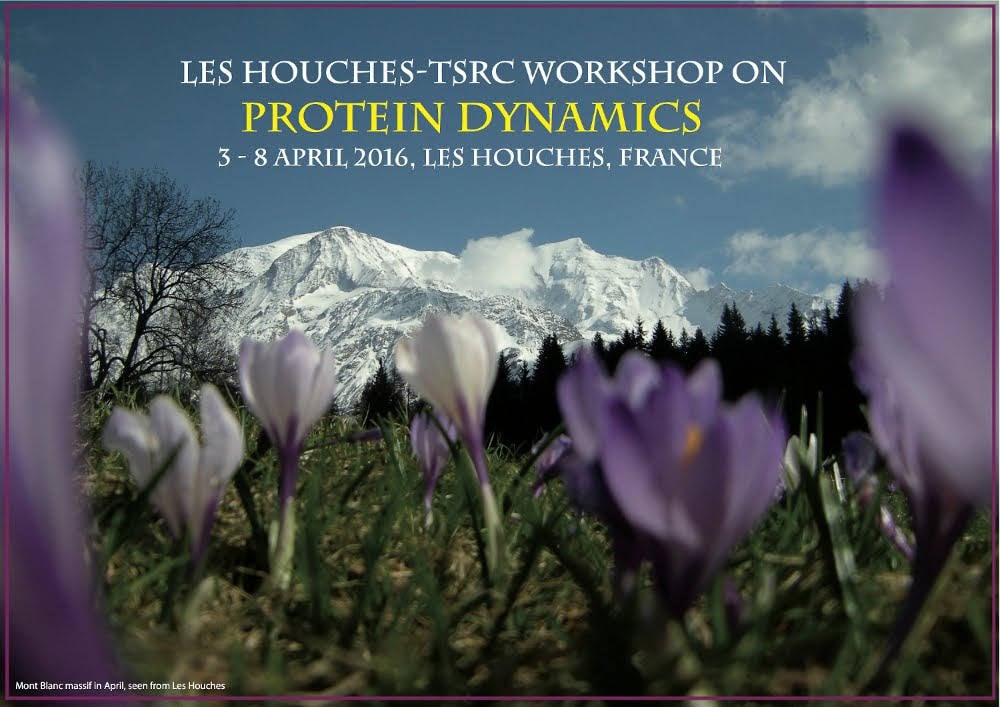
Les Houches-TSRC Workshop on Protein Dynamics
| - |
In Les Houches
This workshop is a forum for presenting, teaching and discussing results
from the application of state-of-the-art experimental and theoretical
and computational approaches to studying protein dynamics, including
optical spectroscopy, NMR spectroscopy, X-ray crystallography, XFELs,
electron microscopy, AFM and scattering methods.
 Confirmed speakers
Bai, Xiaochen (LMB Cambridge, UK)
Barends, Thomas (MPI Heidelberg, Germany)
Blackledge, Martin (Institut de Biologie Structurale, France)
Cammarata, Marco (U de Rennes, France)
Colletier, Jacques-Philippe (Institut de Biologie Structurale, France)
Fenimore, Paul (Los Alamos NL, USA)
Havenith, Martina (U Bochum, Germany)
Hilser, Vincent (Johns Hopkins University, USA)
Heyden, Matthias (MPI Mülheim, Germany)
Ishii, Kunihiko (Riken, Japan)
Katona, Gergely (U Gothenburg)
Klostermeier, Dagmar (U Münster, Germany)
Lindorff-Larsen, Kresten (U Copenhagen, Denmark)
Lewandowski, Jozef (U Warwick, UK)
Mulder, Frans (U Aarhus, Denmark)
Palmer, Arthur (Columbia University, USA)
Parrinello, Michele (ETH Lugano)
Schanda, Paul (Institut de Biologie Structurale, France)
Schirò, Giorgio (Institut de Biologie Structurale, France)
Sprangers, Remco (MPI Tübingen, Germany)
Stock, Gerhard (U Freiburg, Germany)
Uchihashi, Takayuki (U Kanazawa, Japan)
Van den Bedem, Henry (Stanford University, USA)
Van Thor, Jasper (Imperial College London, UK)
Wand, Josh (U Pennsylvania, USA)