Topics
XAFS studies
X-ray Absorption Fine Structure (XAFS) Workshop
|
In Calgary
Twenty-Seventh Congress and General Assembly (IUCr2026)
-
In Calgary
On behalf of the International Union of Crystallography (IUCr), it is with immense excitement and joy that we cordially extend our warmest invitation to you to join the IUCr for the Twenty-Seventh Congress and General Assembly, set to be held in the magnificent city of Calgary, located in the heart of Alberta, Canada from August 11th-18th, 2026.
Calgary, a city renowned for its breathtaking natural beauty and warm hospitality, has been chosen as the host for this remarkable occasion. Nestled amidst stunning landscapes and boasting a rich cultural heritage, this vibrant metropolis promises to provide an unforgettable experience for all attendees.
19th International Conference on X-ray Absorption Fine Structure (XAFS2026)
| - |
In Chiang Mai
The 19th International Conference on X-ray Absorption Fine Structure (XAFS2026) will be held in Chiang Mai, Thailand, from 21 to 26 June 2026. Organized under the auspices of the International X-ray Absorption Society (IXAS), this triennial event serves as the foremost global forum for researchers and practitioners in the field of X-ray absorption spectroscopy.
XAFS2026 will bring together scientists, beamline specialists, and interdisciplinary experts to exchange knowledge, foster collaboration, and explore emerging frontiers in XAFS-related research. The scientific program will encompass eleven main topics:
-
Advanced X-ray spectroscopies
-
Computational and theoretical methods
-
Materials science
-
Catalysis
-
Environmental sciences
-
Biological systems
-
Geosciences
-
Energy-related applications
-
Industrial and applied research
-
Instrumentation and beamline development
-
Cultural heritage and archaeology
Hosted in one of Southeast Asia's most culturally vibrant cities, XAFS2026 is committed to promoting inclusivity, accessibility, and international engagement. The conference welcomes participation from all career stages and geographic regions.
For further details, please visit the official conference website: https://xafs2026.org/XAFS2026/
35 European Crystallographic Meeting
|
In PoznaÃ...„
 At the XXV Congress and General Assembly of the International Union of Crystallography in Prague, it was decided that the 35th edition of the European Crystallographic Meeting would be held in Lviv, Ukraine, in 2025.
 Unfortunately, there is a war in Ukraine, and it is not reasonable to organize a great scientific event in Lviv in 2025. An alternative was thus elaborated where, thanks to a collaboration between the Ukrainian Crystallographic Committee and the Polish Crystallographic Association, the conference site will be Poznan, a city in neighbouring Poland.
Synclight 2024 - São Paulo School of Advanced Science on 4th Generation Synchrotron Techniques
|
In Campinas
Promoted by CNPEM and funded by São Paulo Research Foundation (FAPESP), SyncLight 2024 aims to gather young researchers from Brazil and around the world to discuss the recent opportunities offered by advanced experimental synchrotron techniques available at Sirius, the Brazilian 4th generation light source.
Over the past decades, synchrotron light sources have played a significant role in the development of modern natural sciences and engineering. With a wide range of experimental techniques available, synchrotron light sources have revolutionized the way scientists study and characterize materials in the fields of Physics, Chemistry, Biology, Health, Energy, New Materials, Environmental Sciences, and many others.
The interdisciplinary nature of the event, combined with the collaboration of the LNLS User Committee, which includes researchers from various institutions across Brazil, will contribute to the exchange of experiences among young researchers, professors, and experienced researchers. The event's program includes lectures, poster sessions, and guided tours at the facilities will also be organized. Tutorials on experiments conducted, demonstrations on the control of the accelerators, as well as data analysis and simulations taught by LNLS researchers, at the laboratory's beamlines, are also planned.
The theme is particularly relevant to the Brazilian scientific scenario, as Sirius is one of the most modern and brilliant synchrotron light sources in the world. Currently, ten beamlines are open to the scientific and technological community, out of a set of 14 initially planned to cover a wide range of scientific programs. One of the objectives of SyncLight 2024 is precisely to assist in the training and formation of a new generation of user-researchers, capable of benefiting from this large scientific infrastructure in operation in Brazil.
SyncLight 2024 is part of the São Paulo School of Advanced Science (SPSAS) modality, funded by FAPESP, which provides resources to promote short courses in different areas of knowledge in the State of São Paulo.

ECM-34. European Crystallographic Meeting
| - |
In Padova
The flagship of the European Crystallographic Association (ECA) activities is the European Crystallographic Meeting (ECM), held every year, except when there is an IUCr Congress. The ECMs are the main meeting point for crystallographers in the ECA area to show their recent research. Microsymposia at ECMs are proposed and organized by ECA SIGs.
ECM 34 will be organized at the Padova Congress Centre on behalf of ECA and AIC. It will include all topics of interest to crystallography and it will be organized in synergy with EPIDC 18, which will follow ECM 34 in the same location.
10th Anniversary Meeting of the Young Crystallographers
|
In Hamburg, Germany
The Young Crystallographers are a working group within the German Society for Crystallography (DGK). For 10 years, we meet regularly in autumn at different universities or the STOE facilities.
These meetings specifically aim to provide a platform for networking and scientific exchange for young scientists with an interest in crystallography, as well as to establish contacts with industry and research institutions.
We want to give young scientists the opportunity to gain early experience in scientific presentation in a relaxed atmosphere and without the stress of a larger conference.
For our grand anniversary, we are happy to meet at the DESY facilities! We are working hard to allow you deep insights as well as a great overview of the possibilities at this large-scale facility.
During the 3-day meeting, you willÂ
- present your own work as a poster (A0 portrait) and lightning talk (~5 min.)
- have the DESY campus tour
- participate in an experiment and get a hands-on experience at a beamline of your choice at PETRA III (see The Experiments)
- hear academic talks from senior scientists
- hear industry talks from our sponsors/partners
At the end of the meeting, you will also have the chance to join a tour of the European XFEL Campus. If you intend to participate, please indicate so during registration. Note that you will need to get to the XFEL facilities by public transport as it is a bit outside the main DESY campus.
The registration fee of 60 € includes the tours and experiments at DESY, coffee breaks as well as lunch and BBQ on Thursday.
Deadline for registration is 22.08.23.
International Workshop on Improving Data Quality and Quantity in XAFS Spectroscopy (Q2XAFS2023)
| - |
In Australian Synchrotron, Melbourne
The International Workshop on Improving Data Quality and Quantity in XAFS Spectroscopy (Q2XAFS2023) will be held at the Australian Synchrotron in Melbourne (Australia), August 17-19, 2023. This is a Satellite Meeting of the IUCr Congress. The workshop aims to bring together experts in the field of X-ray Absorption Spectroscopy to discuss aspects of the technique that affect data quality in XAFS experiments.
Q2XAFS2023 will provide a forum for discussions with the goal of reviewing international standards and protocols and developing revised recommendations for best practice when performing XAFS experiments. The workshop will be attended by scientists working at international facilities as well as academics.
The event aims to cover the following elements:
- Portability of XAFS data and scientific content between beamlines and facilities (e.g. data formats, traceability and data provenance)
- Data repositories and access to data
- Precision and reproducibility of data and data treatment
- XAFS data and analyses for industry (e.g. standards, quality control)
- New analytical methods
- Discipline-specific data standardisation
- Fluorescence XAFS data
- Theory development underscoring data quality and quantity
International Programme Committee
- Sofia Diaz-Moreno (Diamond Light Source, United Kingdom)Â
- Christopher T. Chantler (The University of Melbourne, Australia)
- Matthew Newville (Advanced Photon Source, USA)Â
- Edmund Welter (Desy, Germany)
- Simon Bare (SLAC, USA)
- Giuliana Aquilanti (Elettra, Italy)
- Wantana Klysubun (SLRI, Thailand)
- Kiyotaka Asakura (Japan)
- Ritimukta Sarangi (SLAC, USA)
Local Organising Committee
- Christopher T. Chantler (The University of Melbourne, Australia)
- Chanh Q. Tran (La Trobe University, Australia)
- Peter Kappen (Australian Synchrotron, Australia)
- Richard Garrett (ANSTO, Australia)
- Rosalie Hocking (Swinburne University of Technology, Australia)
- Claire Weekley (The University of Adelaide, Australia)
Session outline
Session 1: Sharing and re-using XAS data
- Data formats (plain text, XDI, xasCIF, NeXus/HDF5, CIF)
- Metadata (Essential meta data, ontology of XAFS related terminology)
- XAFS databases
- Comparability of XAFS data (Round Robin)
Session 2: Improving the interpretation of XAS data
- Quantification of uncertainties during EXAFS data evaluation and propagation of uncertainties
- Quantification and correction of experimental uncertainties (dark currents, dead time etc.)
- Quantifying uncertainties in XANES evaluation methods (PCA etc.)
- Novel methods (Machine Learning, AI...)
Session 3: Improving the quality of XAS measurements
- Bio and other fragile samples (beam damage)
- Extreme conditions (ultrafast, high-pressure, in-operando)
- Fast measurements (Q-XAFS, dispersive XAFS)
Session 4: Improving the reporting of XAS results
- General reporting guidelines for XAS publications
- IUCr and CXAFS reports
- Assessing experimental data quality
- Including uncertainties in pre-processed data and reported results
- Specific challenges and reporting for photon in/photon out spectroscopies
- Specific challenges and reporting for lab-based XAFS
Programme
Note: each presentation is 20+5 minutes in length.
Day 1: Thursday 17th August 2023
08.45hRegistration09.00hWelcome 09.10hSession 1: Sharing and re-using of XAFS data 1.1: First experiences and results from an interlaboratory round robin test of XAFS spectroscopy measurements.Edmund Welter, DESY     1.2: XAS Reference Database under DAPHNE4NFDI.Abhijeet Gaur, KIT     1.3: Sharing XAFS data and repositories: where to go?Giannantonio Cibin, Diamond LS10.25hMorning tea10.55h1.4: Trends in X-ray absorption data sharing, reproducibility, and measurement and interpretation challenges.Shelly Kelly, APS     1.5: Quantity yields quality, using and building XAFS database.Hitoshi Abe, KEK     1.6: Making a comprehensive XAFS data standard actually happen.James Hester, ANSTO12.10hSession 1 - discussion and conclusion12.30hLunch 13.15hSession 2: Improving the interpretation of XAFS data 2.1: Notes from another world: Precise and accurate X-ray attenuation measurements in the vicinity of the absorption edge.Martin de Jonge, ANSTO     2.2: A 20-year journey hunting down uncertainties and extracting physical information in Absorption and Fluorescence X-ray Spectroscopy.Chanh Tran, La Trobe University     2.3: Improving the interpretation of XAS data using artificial neural networks.Janis Timoshenko, FHI Berlin     2.4: Multivariate Curve Resolution - Alternating Least Squares (MCR-ALS) Analysis applied to XAS data: Principles, Strength, Weakness and Strategies to overcome intrinsic limitations.Valérie Briois, SOLEIL14.55hSession 2 - discussion and conclusion 15.15hTour to the Australian Synchrotron (focus on XAS beamlines)16.00-18.00hAfternoon tea and poster session
Day 2: Friday 18th August 2023
09.00hWelcome - Day 2 09.05hSession 3 - Improving the quality of XAS measurements 3.1: A new protocol for monitoring radiation damage of XAS data, multiple datasets and fitting of XAS measurements with propagated uncertainties.Ruwini Ekanayake, KIT     3.2: Comparing the quality of XAFS data collected with different acquisition rates.Diego Gianolio, Diamond LS     3.3: tba     3.4: Winds of change at the XAS beamline in Melbourne.Bernt Johannessen, ANSTO10.45hMorning tea11.15hSession 3 - discussion and conclusions11.35hSession 4: Improving the reporting of XAFS results 4.1: Formats for Sharing XAFS Data, Metadata, and Analysis Results.Matthew Newville, University of Chicago     4.2: From data collection to reporting in photon-in/photon-out spectroscopies.Sofia Diaz-Moreno, Diamond LS12.25hLunch13.15h4.3: tbaRitimukta Sarangi, SLAC     4.4: Best Practice for High Data Quality in Laboratory-Based X-ray Absorption Spectroscopy.Gerald Seidler, University of Washington     4.5: Addressing Rigor and Reproducibility in Heterogeneous Catalysis: XAS.Simon Bare, SLAC14.30hAfternoon tea15.00h4.6: Assessing data quality and experimental challenges at medium-energy K-edge absorption (1.5-4 keV) for dilute samples.Wantana Klysubun, SLRI     4.7: IUCr, ITC I, IXAS, XERT, Hybrid, Measurement Standards, Reporting Guidelines and Soliloquy on Q2XAFS 2023.Chris Chantler, University of Melbourne15.50hSession 4 - discussion 16.20hPoster Awards presentationWrap-up and Q2XAFS-23 Close 17.00hDeparture to Melbourne CBDeveningWorkshop dinner (venue TBA)Â
Location: Australian Synchrotron (Melbourne)
Call for Poster AwardÂ
Q2XAFS2023 will include a poster session for early career scientists, including students and post-docs. Please present your achievements and your own problems concerning XAFS data quality including, experimental and theoretical efforts. To promote your participation, the IXAS has created poster awards based on the kind donation from Dr Matthew Newville and Dr Bruce Ravel who received the Edward Stern Prize in XAFS2022 in Sydney. We need all young powers to blow in a new wind. Please join the Q2XAFS and get the prize!!X-Ray Absorption Fine Structure (XAFS) Workshop
|
In Melbourne
This workshop is intended to be an introduction to X-ray Absorption Spectroscopy principles and techniques for crystallographers with tutorials and hand-on-training session on data analysis. The talks will be delivered by experienced XAFS professionals from all over the world and will include basic principles of the technique, basic and advanced data analysis techniques and examples of application of XAFS technique in several cutting-edge research areas of physical science, material and chemical sciences.
Chairs
- Dr Dibyendu Bhattacharyya (BARC, India)
- Dr Sofia Diaz-Moreno (Diamond, UK)
- Dr Giuliana Aquilanti (Elettra, Italy)
- Dr Christopher Chantler (Melbourne University, Australia)
Local Organising Committee
- Dr Chanh Tran (La Trobe University, Melbourne, Australia)
- Dr Christopher Chantler (University of Melbourne, Australia)
- Dr Ruwini Ekanayake (University of Melbourne, Australia)
- Ms Madeline van Dongen (Swinburne University, Australia)
 Session Topic Time Speaker 1 Introduction to XAS theory and basic experimental techniques for beginners 8:30-9:00 Christopher Chantler 2 Application of XAS in nano materials 9:00-9:30 Federico Boscherini 3 Application of XAS in catalysis 9:30-10:00 Diego Gianolio Coffee break 4 Application of XAS in energy materials 10:30-11:00 Giuliana Aquilanti 5 MCR-ALS methods 11:00-11:30 Valérie Briois 6 Pump-probe studies 11:30-12:00 Xiaoyi Zhang 7 Photon in-Photon out spectroscopies 12:00-12:30 Lecturer to be confirmed Lunch Break 8 Hands-on training on basic EXAFS data analysis 13:30-14:30 Matt Newville and Dibyendu Bhattacharyya Coffee break 9 Hands-on training on MCR-ALS techniques 15:00-16:00 Valérie Briois
SESAME-Africa Online Workshop
|
In virtual
2022 IUCr High Pressure Workshop â€Å"Advanced High Pressure Crystallographyâ€Â
| - |
In Chicago
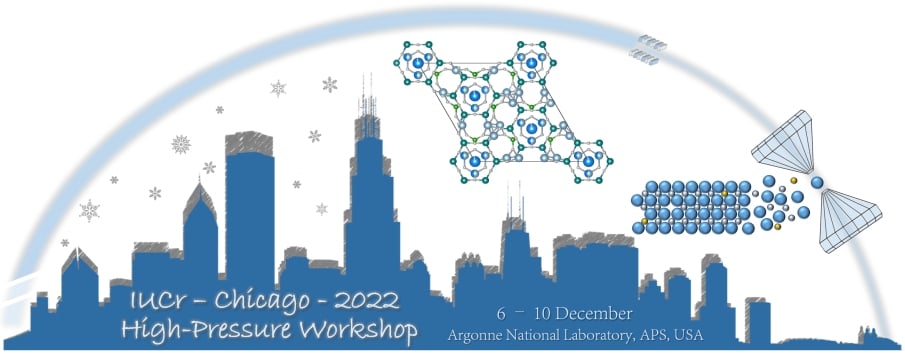
For the past three decades high pressure research has made breakthrough progress in many fields of science mainly due to the significant improvements in the high-pressure apparatus and developments of advanced static and dynamic probes. Most of the experiments at extreme conditions are very challenging and require dedicated techniques to collect crystallographic data with unprecedented speed and resolution to quantitatively characterize pressure/temperature induced transformations in the crystalline lattice. The tunability, brilliance, and collimation of synchrotron X-ray sources provides scientists with unique capabilities for probing the structural, chemical, and physical properties of various types of materials in-situ at extreme pressure, temperature, and strain with ultra-high spatial, temporal and energy resolution. However, in many cases the complex energy landscapes of multicomponent chemical systems require the use of the predictive power of computational methods that play an essential role in extreme-conditions crystallography coupled with physical experiments.
The purpose of the 2022 workshop of the International Union of Crystallography (IUCr) Commission on High Pressure is to bring together researchers who apply extreme-conditions crystallography in combination with other experimental and computational methods to study a wide range of material properties covering various fields of science, including condensed-matter physics, solid-state chemistry, geophysics, materials science, biology, nanotechnology etc. The workshop aims to facilitate extensive discussion and interdisciplinary collaboration.
Students, postdocs and early carrier scientists in particular will find this workshop helpful in gaining improved familiarity with available state-of-the-art methods and how they can be applied to their research.
We plan to organize a tour to the relevant APS beamlines for workshop attendees (pandemic permits) and a half-day tutorial with hands on examples.
IEEE Around-the-Clock Around-the-Globe (AtC-AtG) Magnetics Conference 2022
|
In Worlwide
Dear Colleagues,
It is our great pleasure to announce the 'IEEE Around-the-Clock Around-the-Globe (AtC-AtG) Magnetics Conference 2022', a virtual event hosted by the IEEE Magnetics Society covering the vast field of magnetism. Following the great success of the previous editions, this unique 24-hour non-stop virtual conference will take place on August 31st, 2022, with contributions from speakers spanning six continents.
The AtC-AtG Magnetics Conference offers a diverse and inclusive virtual environment that foments collaboration between junior and senior researchers across the many subfields of magnetism. The invited speaker lineup includes both junior and senior scientists with outstanding research contributions. More information can be found on the dedicated conference website.
Join us by registering through our website before 24th August!Â
Highlights:
 - Invited talks from leading experts in magnetism
 - Covers all continents and time zones
 - Interactive online broadcasting with questions and discussions
 - Student presentation and poster awards
 - NO REGISTRATION FEE
Call for Abstracts:
Abstract submission for the contributed talks at AtC-AtG Conference is now open! Young researchers are encouraged to submit abstracts (oral and poster) and join us on this fantastic platform to meet researchers worldwide!
The abstract template and submission form are available on our website. Submissions close on June 12th!
Looking forward to seeing you all connected!
Best Regards,
On behalf of the AtC-AtG Organization Committee (2022)
XAFS2022
| - |
In Sydney (and online)

International School of Crystallography. 46th Course, Crystallography under extreme conditions: the future is bright and very compressed
| - |
In Erice
Subjecting matter to extreme conditions reveals a multitude of fascinating phenomena, and is applicable to a wide range of disciplines. From the extremophiles that exist in the deepest depths of our oceans to the exotic new materials that are made when atoms are pushed ever closer together, understanding the structure of materials at extreme conditions affects Biology, Chemistry, Physics, Geoscience and Material Science. In order to achieve its goals, high pressure research has been always at the vanguard of technical progress. It is a discipline in which equipment plays a particularly important role. State-of-the-art diamond anvil cells can now achieve megabar ranges of pressure, millions of times atmospheric pressure, with this beaten by an order of magnitude in dynamic compression experiments. In this manner, scientists are able to mimic the conditions in the interiors of giant planets. Nature is even more ambitious, as in the stars petapascal pressures (the order of tens to hundreds billion atmospheres) are reached. In the laboratory, we can even create conditions of pressure, temperature and magnetic fields that are not found naturally, allowing us to complement nature to explore more exotic phases of matter.
Therefore, the course will cover broad ground in the application of extreme conditions crystallography. The topics will span from fundamentals of high-pressure single crystal and powder diffraction, to presenting the many flavors of static and dynamic compression, to reviews of sources for extreme conditions work (synchrotrons, neutrons and free electron lasers). Complementary experimental (Mössbauer spectroscopy, X-ray magnetic circular dichroism, X-ray absorption spectroscopy, inelastic scattering) and computational methods will also be discussed. Diffraction analysis on the structure of liquids, glasses and nanocrystalline materials as well as multigrain crystallography will also be introduced. The lectures will be harmonized with the related sessions of interactive tutorials, providing hands-on experience to the attendees. These workshops will be focused on basic laboratory skills and the elements of data processing software related to the high pressure.
1st on-line edition of the International School on Synchrotron Radiation, Fundamentals, Methods and Applications
| - |
In Online (from Muggia, Trieste)
Topics
The main topics will be:
- Production and properties of Synchrotron Radiation;
- Basics of the interaction between matter and radiation;
- X-ray Absorption Spectroscopy (EXAFS and XANES);
- X-ray Diffraction (single crystal and powder diffraction, anomalous scattering);
- Small angle X-ray scattering;
- Photoemission (from valence and from core levels; angular, time and spin resolved);
- IR spectroscopy and microscopy;
- Imaging;
- Data analysis on X-ray Absorption, Powder Diffraction and Core Level Photoemission Spectroscopy experiments
- Applications in many fields (materials, nanoscience, catalysis, earth science, environmental science, cultural heritage, biology and medicine).

XAFS2021 Virtual
| - |
In Online from Sydney, Australia
WORKSHOP
Larch for XAFS data processing and Analysis
XAFS 2021 Virtual is offering a Virtual Hands-on Tutorial /Demo using Larch for XAFS data processing and analysis. Please note, this is not included in your XAFS 2021 Virtual registration fee, an additional cost of $50 will be added to your invoice.
To be able to cater for all time zones, the same workshop will be offered twice on Sunday 11 July during the following timeslots:
- 10:00AM â€" 1:00PM AEST
- 3:00PM â€" 6:00PM AEST
Larch provides a full range of tools for processing, visualizing, and analysing XAFS Data. In this workshop, we'll demonstrate basic data processing of XANES and XAFS data, including the fitting of pre-edge peaks, principal component analysis, and linear combination analytic methods. For analysis of the extended EXAFS, background subtraction and Fourier transforms will be demonstrated and discussed.  Simple examples of fitting one and two paths from Feff calculations will also be demonstrated.  The analyses shown will be a combination of Graphical User Interface and scripting and programming with the Larch Python library will be discussed.

XAFS spectroscopy in a lab: a HAPG von Hamos laboratory spectrometer
|
In Webinar
2 pm CEST
The investigation of the chemical bond state by measuring the fine structure of absorption edges (XANES, EXAFS) has so far been a domain of synchrotron radiation. In this webinar, Dr. Wolfgang Malzer, a research scientist at the Berlin Laboratory for Innovative X-ray technologies, is presenting a modified Von Hamos laboratory spectrometer, based on pyrolytic graphite crystals and 2D hybrid photon counting detector. This new spectrometer makes it possible to achieve high-energy resolutions and large solid angles of the detection. Results of demonstration experiments and of applications in chemical research are shown. Prospects and possible use cases of laboratory XANES and EXAFS are discussed.
XXIV School of Pure and Applied Biophysics. Applications of X-rays and Neutron Scattering in Biology
| - |
In Venice

CONEXS conference: Emerging Trends in X-Ray Spectroscopy
| - |
In Newcastle (U.K.)
CONEXS Conference
Emerging Trends in X-Ray Spectroscopy
Â
The Collaborative Network for X-Ray Spectroscopy (CONEXS) is an EPSRC-funded network in partnership between Newcastle University and Diamond Light Source. The first CONEXS Conference will be taking place at Newcastle University on the 18-20 February 2020, bringing together leading national and international experts to discuss emerging trends in X-ray Spectroscopy and examine the intersection of experiment and theory.
Â
Date: 18-20 February 2020
Venue: Newcastle University, UK
Call for Abstracts
We are now welcoming submissions for abstracts for both oral presentations and posters, the abstract guidance and the submission form are available here:Â https://research.ncl.ac.uk/conexs/conference/abstractsubmission/.
Â
Registration (https://research.ncl.ac.uk/conexs/conference/registration/)
Registration for the conference is now open, at a rate of £150 (standard) or £75 (students/ECRs). This price includes attendance at the conference dinner.
Keynote speakers
•            Prof. Serena DeBeer, Professor and Director, Max Planck Institute for Chemical Energy Conversion
•            Prof. John Rehr, Professor Emeritus of Physics, University of Washington
•            Prof. Sonia Coraini, Professor in Physical Chemistry, University of Denmark
•            Dr. Anna Regoutz, Lecturer in Materials Chemistry, University College London
•            Prof. Matthias Bauer, Professor in Inorganic Chemistry, University of Paderborn
•            Prof. Neil Hyatt, Professor of Nuclear Materials Chemistry, University of Sheffield
•            Dr. Marius Retegan, Scientist, European Synchrotron Radiation Facility
•            Dr. Olga Safonova, Senior Scientist, Paul Scherrer Institute
•            Dr. Mihaela Gorgoi, Beamline Scientist, EMIL Berlin
•            Prof. Jakub Szlachetko, Associate Professor, Institute of Nuclear Physics PAS
Â
Conference website: https://research.ncl.ac.uk/conexs/conference/
Normal 0 false false false EN-GB X-NONE X-NONE MicrosoftInternetExplorer4 /* Style Definitions */ table.MsoNormalTable {mso-style-name:"Table Normal"; mso-tstyle-rowband-size:0; mso-tstyle-colband-size:0; mso-style-noshow:yes; mso-style-priority:99; mso-style-parent:""; mso-padding-alt:0cm 5.4pt 0cm 5.4pt; mso-para-margin:0cm; mso-para-margin-bottom:.0001pt; mso-pagination:widow-orphan; font-size:10.0pt; font-family:"Times New Roman",serif;}
School on Advanced Light Sources: Principles, Methods and Multidisciplinary Applications | (smr 3439)
| - |
In Trieste
The School targets young scientists to introduce them to the exceptional research opportunities offered by synchrotron and free-electron-laser (FEL) facilities worldwide for exploring the properties of all types of matter.
The school will provide an overview of the production and characteristics of synchrotron and free-electron-laser light, its interaction with matter and the numerous experimental methods enabled by these interactions that have become indispensable tools spanning over all domains of basic and applied research. The school lecturers will demonstrate the multidisciplinary applications and the most recent instrumental developments and science breakthroughs in the fields relevant to their expertise. The program will also include discussions of the lecturers with the students, talks describing the open access to these facilities based on the merits of the proposed project and possible industrial application. Demonstration sessions will be organized at the beamlines of Elettra's synchrotron and FEL facilities.
Topics:
- Production of Synchrotron and FEL Radiation
- Properties of Synchrotron and FEL Light
- Photon-Matter Interactions
- Photon Transport and Beamline Instrumentation
- X-ray Absorption and Fluorescence Spectroscopy
- Photoelectron Spectroscopy Methods
- X-ray Diffraction Methods
- X-ray Scattering Techniques - SAXS, WAXS, XPCS, RIXS
- Imaging Techniques using Synchrotron and FEL Light
- X-ray and IR Spectromicroscopy.
- Time-resolved Approaches and non-linear X-ray Optics
Grants: A limited number of grants are available to support the attendance of selected participants, with priority given to participants from developing countries. There is no registration fee.