Topics
Free-electron laser
Ultra-fast X-ray summer school (UXSS)
| - |
In Online
UXSS is an annual event jointly organized by the Center for Free-Electron Laser Science (CFEL) and the Stanford PULSE Institute at SLAC.  UXSS is intended to introduce students and postdocs to the latest science enabled by X-ray Free Electron Lasers. The program will be highly interdisciplinary, with topics ranging from materials physics to structural biology. The list of confirmed speakers can be found below. There will also be a coursework exercise involving a mock proposal for the European XFEL, with the help of experienced mentors.
Due to travel restrictions imposed by the coronavirus pandemic, UXSS 2021 will be held entirely online as a remote summer school.
ReNaFoBiS/FRISBI Webinar : Serial Femtosecond Crystallography @ XFELs
|
In Online via Zoom
ReNaFoBiS/FRISBI Webinar Series Serial Femtosecond Crystallography @ XFELs; current and future prospects for structural biology.
Â
May 12, 2021 04:00 PM (CET, France)
Jacques-Philippe Colletier (PhD, DR CNRS, Serial Nano-Crystallography team (SNaX), IBS, Grenoble, France)
11th Belgian Crystallography Symposium
|
In Online
Given the current situation and the fact that knowledge dissemination has to continue, the BCS meeting will be an 'open for all', free of charge event. Registration is required for organizational purposes.
HERCULES 2021
| - |
In Grenoble
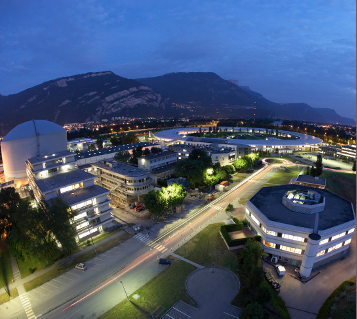
This one month course, coordinated by the Université Grenoble Alpes, is designed to provide training for students, postdoctoral and senior scientists from European and non-European universities and laboratories, in the field of Neutron and Synchrotron Radiation for condensed matter studies (Biology, Chemistry, Physics, Materials Science, Geosciences, Industrial applications). It includes lectures, practicals and tutorials, visits of Large Facilities and a poster session (each participant puts up a poster about her/his thesis or research topic for a day).
- PART I:Â BASIC METHODS AND INSTRUMENTSÂ :
(This part is common for all the participants - 1.5 weeks) - PART II is divided into two parallel specialized sessions (3.5 weeks) :
- Session A:Â PHYSICS AND CHEMISTRY OF CONDENSED MATTER
- Session B:Â BIOMOLECULAR STRUCTURE AND DYNAMICS
A special seven days programme is included , in a partner institution among European Large instruments. In 2021, one week (out of the five of the school) will be spent in one different partner institutions among 4:
- ALBA synchrotron in Barcelona, Spain
- KIT Light Source in Karlsruhe, Germany
- Elettra and FERMI in Trieste, Italy
- Swiss Light Source / Paul Scherrer Institute in Villigen, Switzerland
The language of the course is English.
2020 European XFEL Users' Meeting and DESY Photon Science Users' Meeting "Research with Synchrotron Radiation and FELs"
| - |
In Schenefeld
DESY Photon Science Users' Meeting: 30-31 January 2020
European XFEL Users' Meeting 29-31 January 2020
School on Advanced Light Sources: Principles, Methods and Multidisciplinary Applications | (smr 3439)
| - |
In Trieste
The School targets young scientists to introduce them to the exceptional research opportunities offered by synchrotron and free-electron-laser (FEL) facilities worldwide for exploring the properties of all types of matter.
The school will provide an overview of the production and characteristics of synchrotron and free-electron-laser light, its interaction with matter and the numerous experimental methods enabled by these interactions that have become indispensable tools spanning over all domains of basic and applied research. The school lecturers will demonstrate the multidisciplinary applications and the most recent instrumental developments and science breakthroughs in the fields relevant to their expertise. The program will also include discussions of the lecturers with the students, talks describing the open access to these facilities based on the merits of the proposed project and possible industrial application. Demonstration sessions will be organized at the beamlines of Elettra's synchrotron and FEL facilities.
Topics:
- Production of Synchrotron and FEL Radiation
- Properties of Synchrotron and FEL Light
- Photon-Matter Interactions
- Photon Transport and Beamline Instrumentation
- X-ray Absorption and Fluorescence Spectroscopy
- Photoelectron Spectroscopy Methods
- X-ray Diffraction Methods
- X-ray Scattering Techniques - SAXS, WAXS, XPCS, RIXS
- Imaging Techniques using Synchrotron and FEL Light
- X-ray and IR Spectromicroscopy.
- Time-resolved Approaches and non-linear X-ray Optics
Grants: A limited number of grants are available to support the attendance of selected participants, with priority given to participants from developing countries. There is no registration fee.

7th BioXFEL International Conference
| - |
In San Juan
UK XFEL & Dynamic Structural Biology Workshop
|
In London
Venue: The Francis Crick Institute, 1 Midland Road, London, NW1 1A7
The day will be structured into four sessions and attendees will hear from expert speakers in a number of respective talks, which include:
 *  Understanding the challenges in structural biology, with Professor Dave Stuart, Diamond Light Source/University of Oxford and Professor Christopher J Schofield, University of Oxford
 *  X-ray applications in dynamic structural biology, with Professor Henrike Müller-Werkmeister, University of Potsdam and Dr Aina Cohen, SLAC National Accelerator Laboratory
 *  Emerging methods in studying protein dynamics, with Dr Chris Russo, University of Cambridge and Dr Adrian Mancuso, European XFEL
 *  Outlook and horizon view, with Professor James Naismith, Rosalind Franklin Institute/University of Oxford
The workshop will provide a platform for all life scientists to discuss the frontiers in structural biology, using various methods that include X-ray-based methods from synchrotrons and XFELs, as well as cryo-electron microscopy and NMR. The day will finish with a drinks reception to allow for further networking opportunities.
Symposium on Structure Biology for Drug Discovery@SwissFEL
| - |
In Villigen
Workshop on Perspectives and Applications of Deep Learning for Accelerated Scientific Discovery at Next Generation X-ray and Neutron Sources
| - |
In The Niels Bohr Institute, Copenhagen
Breakthroughs in deep learning (DL) technology are revolutionising the amount, rate and nature of information that can be extracted from data, creating new opportunities to accelerate scientific discovery in ways that have never been imagined before.
The scientific information generated at large scale facilities, such as Synchrotrons, Free Electron Lasers and neutron sources, presents a novel and challenging platform to explore the boundaries of DL technology. Here both the volume of high quality scientific data as well as the high speed of experiments, specifically those that monitor and track fast real-time physical processes, place high demands on both state of the art instruments and software as well as in experimenters themselves. DL can potentially enhance the scientific value and insight that can be gained from experiments in these large-scale scientific infrastructures.
In this workshop we shall focus on two topical themes on DL Accelerated Discovery:
- The use of DL architectures to generate unbiased and objective models for analysis of scattering data from X-ray and neutron sources.
- The use of DL methods for optimising data collection protocols in real time and for discovering anomalies in experimental data and enhancing the efficiency of the scientific workflow.
These intersections of scientific discovery and DL science are unique and the workshop will explore potential research avenues to understand how to best develop these technologies to accelerate discovery using these facilities.
The program for the workshop will consist of plenary sessions followed by working groups, and final close-out.Â
On Thursday the 26th, plenary seminars will review the state of the art in DL and how it is currently used in X-ray and neutron scattering experiments, as well as on the challenges that these experimental techniques face that can be addressed by DL. Afternoon working groups, led by a convener, will explore and report in how DL methods can become more generically applicable to a wide range of scattering experiments, including data analysis, bias-free modelling and optimization of experimental protocols.
On Friday, 27th, conveners will present the outcomes of the previous day’s working-groups and the meeting will close with a discussion and presentation of an overall summary. A tentative roadmap on how to make progress in the application of DL for Accelerated Scientific Discovery at next generation X-ray and Neutron Sources will also be proposed.
There is no registration fee for the workshop, but attendance is limited to 20 participants. Further announcements regarding the program and speakers will be made available shortly.
6th International Symposium on Diffraction Structural Biology (ISDSB2019)
| - |
In Osaka
Gordon Conference on Research at High Pressure
| - |
In Holderness, NH, US
The 77th Annual Pittsburgh Diffraction Conference
| - |
In Oak Ridge, TN
You’re invited to the 77th Annual Pittsburgh Diffraction Conference at Oak Ridge National Laboratory (ORNL), which is located in Oak Ridge, Tennessee (near Knoxville). The conference will take place over three days and feature sessions focused on all areas of diffraction, from powders to protein crystals. Topics will include emerging technologies/techniques, Total scattering, Magnetic scattering, and Integrative Structural Biology. The Chung Soo Yoo Award, established by the Pittsburgh Diffraction Society to honor Dr. Yoo’s memory, and a $400 cash prize will be given to the graduate student having the best poster presentation at the conference.
UXSS2019. Ultrafast X-ray Summer School
| - |
In Hamburg
UXSS is an annual event jointly organized by the Center for
Free-Electron Laser Science (CFEL) in Hamburg and the Stanford PULSE
Institute. UXSS is intended to introduce students and postdocs to the
latest science that is enabled by novel X-ray Free Electron Lasers. The
program will be highly interdisciplinary, with topics ranging from
materials physics to structural biology. The list of confirmed speakers
can be found below. There will also be a coursework exercise involving
a mock proposal for European XFEL, with the help of experienced mentors.
Â
The lectures cover the following topics:
- introduction to X-ray sources
- atomic and molecular physics
- condensed matter physics with X-rays
- theory of X-ray matter interaction
- structural biology
- matter in extreme conditions
- chemical dynamics
- coherent diffractive imaging
- inelastic X-ray scattering
Â

4th International Summer School of Crystallography
| - |
In Hamburg
Hot Topics in Contemporary Crystallography 4 Structural Biology
| - |
In Dubrovnik, Mlini
HTCC4 will entirely be dedicated to structural biology. Over four intense working days, we shall cover techniques which go beyond classical crystallography, yet which complement it so smoothly: XFEL â€" X-ray free electron laser, cryo electron microscopy NMR in macromolecular structural research biomolecular in silico simulations. The lecturers and tutors shall explain fundamentals of these methodologies, give examples on their practical applications, tutor the practical and interactive sessions, and moderate round table discussions on how to apply these methods to your own research. The examples of particular systems studied with the presented methods shall emphasize intertwist between the four chosen hot topics in contemporary research. The complementarity of each of the hot topics with classical crystallography shall be discussed.
The principal HTCC target audiences are, apparently, young(ish) crystallographers, electron microscopists, NMRists and researchers in in silico simulations dealing with biomacromolecular systems. Nonetheless, we count on researchers from the domains of (bio)chemistry, physics, biology and life sciences from both industry and academia, who appreciate and take advantage of the structural studies, want to spice up their research with an additional hint of interdisciplinarity, or, simply learn what’s new in the dynamic world of structural research.
BioXFEL. 6th International Conference
| - |
In San Diego
- Structure from Single Particles, Fibrils, and Nanocrystals
- New Visionary Methods in SPI and Nanocrystal Imaging
- Time-Resolved Serial Femtosecond Crystallography
- Serial Synchotron Crystallography and CryoEM
- Serial Crystallography Data Analysis Developments
- Serial Crystallography Instrumental Developments

76th Annual Pittsburgh Diffraction Conference
| - |
In Cleveland, OH
Biomolecular topics include:
X-ray Crystallography
Cryo-EM
X-ray tomography
Cryo -ET
X-ray free electron lasers
Please submit abstracts to pxk258@case.edu (Deadline September 14, 2018)
Conference Registration (Deadline August 27, 2018)
Â
Progress in instrumentation for X-ray diffraction and CryoEM
|
In Oviedo
This satellite meeting will present an overview of a wide range of new
laboratory instrumentation available from different companies, as well
as new developments at several large scale facilities. The meeting will
cover information on the newest laboratory instruments from Bruker and
Rigaku as well as on new instrumental solutions such as the Lyncean
Compact Light Source (CLS) and Sigrey’s newest X-ray sources and optics,
and focus on bringing world-class structural and analytical synchrotron
type capabilities back to our labs. We will have sessions focused on new
photon sources to be installed at major European synchrotrons as well as
X-ray Free Electron Laser facilities including ESRF, DESY, MAXIV, and
the Swiss and European X-FELs.
The organisers are also particularly proud to advertise some of the
first experimental results taken at European X-FEL. The program of this
satellite will also be complemented by news from the neutron ISIS
facility and from the cryo-EM equipment producers to provide a forum to
discuss the future of instrumentation for X-ray, neutron diffraction and
CryoEM.
Chairmen:
Prof. Dr hab. Krzysztof Woźniak ( University of Warsaw, Poland)
Prof. Dr. Ullrich Pietsch, (Universität Siegen, Germany)
Dr. Michele Cianci, (Università Politecnica delle Marche, Ancona, Italy)
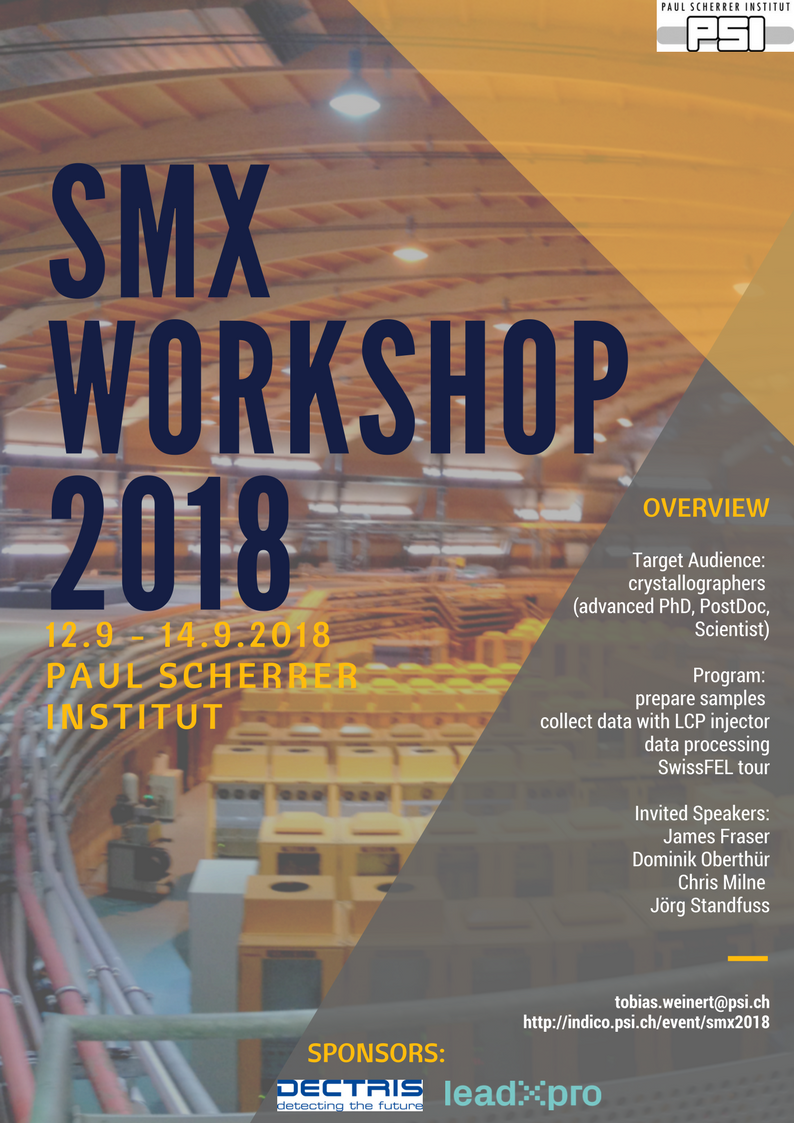
First Serial Millisecond Crystallography (SMX)
| - |
In Paul Scherrer Institut