Topics
Electron crystallography
Advances in Photovoltaics
|
In London

Electron Crystallography. 51st Erice Course.
| - |
In Erice
In the era of nanoscience, the size of particles to be investigated gets smaller and smaller, and traditional techniques used to characterise materials are being stretched beyond their limit. Electron Crystallography (EC) is a powerful tool to study crystal structure and properties of nano-sized materials and fills the void of information left when other methods struggle to provide convincing data for nanoscale objects.
Exciting developments such as aberration correctors, dedicated specimen-holders, highly sensitive cameras, new data acquisition techniques, automated routines for data collection and new data processing software and methods allow electron crystallographers to determine crystal structures from micro- and nanocrystals with increasing accuracy and astonishing level of detail. The Course intends to review the traditional as well as the modern methods of electron crystallography; it will be divided into three major fields:
- provide a strong background on crystallography in general and electron crystallography in particular.
- introduce students to state-of-art techniques of electron crystallography including experimental techniques, data acquisition and data processing as well as to supporting techniques such as spectroscopy.
- cover different approaches for structure analysis and derive structure-property relationship.
The course will cover a range of materials, from organic molecules like pigments and drugs through complicated inorganic and metallic materials and minerals to protein structures. In addition to the standard crystalline materials it will focus also on amorphous, nano- and meso-crystalline state.
 Registration is open (will close on 30 November 2017)
Â
Â
Â
3D Electron Crystallography for Macromolecular Compounds
| - |
In Paul Scherrer Institute
who want to expand their field of possibilities to electron crystallography.
Â
The list of speakers encompasses experts in sample preparation, electron
microscopy hardware, electron detectors, and methods from data processing via
structure solution to model building. They will present recent results from
the field of electron crystallography.
Â
Participants will have the possibility of vivid discussions and get answers
for their open questions in a very young field.
Tutorials include data processing with DIALS and XDS, as well as Molecular
Replacement and Refinement at the characteristics of electron diffraction
data.
XIV School on Synchrotron Radiation: Fundamentals, Methods and Applications
| - |
In Muggia
The main topics will be:
- Production and properties of synchrotron radiation;
- Free electron lasers;
- Basics of the interaction between matter and radiation;
- X-ray absorption spectroscopy (EXAFS and XANES);
- X-ray diffraction (single crystal and powder diffraction, anomalous scattering);
- Small angle X-ray scattering;
- X-ray microscopy;
- Photoemission (from valence and from core levels; angular, time and spin resolved);
- IR spectroscopy and microscopy;
- Imaging;
- Resonant spectroscopy and diffraction;
- Inelastic X-ray scattering.
- Applications in the fields of materials, nanoscience, magnetism, catalysis, earth science, environmental science, cultural heritage, biology and medicine will be presented.
Bridging Solution Methods: From NMR to X-ray Scattering and Biophysics (iNEXT course)
| - |
In Patras

International Frontiers of Electron Microscopy in Materials Science (FEMMS 2017)
| - |
In Johannesburg

CCP4 Protein Structure Workshop 2017
| - |
In Carlisle
Plenary Speakers
Allen Orville - Diamond Light Source Ltd
"Dynamic structural biology at XFELs with less sample, over longer reactions, and including complementary methods"
Neil Ranson - University of Leeds
"Cryo-EM as a tool in modern biomedical research"
Advanced TEM workshop
| - |
In Trondheim
Confirmed invited speakers
- Prof. Jian Min Zuo, University of Illinois at Urbana-Champaign, Illinois, USA
- Prof. Joanne Etheridge, Monash University, Victoria, Australia
- Prof. Christophe Koch, Humboldt-Universität, Berlin, Germany
- Duncan Johnstone, University of Cambridge, UK.
High-Accuracy CLEM: Applications at Room Temperature and in cryo
| - |
In Heidelberg
EMBL Conference: Revolutions in Structural Biology: Celebrating the 100th Anniversary of Sir John Kendrew
| - |
In Heidelberg
Topics
- X-ray crystallography
- Electron microscopy
- Modelling, bridging scales to systems biology
- Structural biology in health and disease
- Radiation - photons, neutrons and electrons
PROTEINS IN ACTION biophysical techniques for protein research
| - |
In Ceske Budejovice
Advanced Electron Microscopy for Cell Biology
| - |
In EMBL Heidelberg
The Francis Crick Electron Microscopy Opening Symposium
| - |
In London
Southern California Society for Microscopy and Microanalysis (SCSMM) Spring Symposium
|
In Los Angeles

CCP-EM Icknield Workshop for High Resolution Model Building 2017
| - |
In Harwell
at structural biologists with high resolution EM maps ready for / in the
process of modelling building and refinement. This three day course will
host some of the leading software developers and provide ample contact time
to allow delegates to discuss their data in detail alongside traditional
lectures and tutorials.
The course will be held at the RAL / Diamond campus, Harwell, UK.
Registration is free and we will provide food and two nights accommodation
at the Bear Hotel in nearby Wantage (5th & 6th April). Delegates are asked
to meet their own travel costs.
The course is limited to 20 delegates which will be selected from all
applicants. A maximum of 40 applicants can register interest.
Applications will close on Sunday 12th March and the 20 successful
applicants will be by Tuesday 14th March. (Please note the short
registration time as we would like to work on 'live' datasets).

Advanced Topics in EM Structure Determination: Challenges and Opportunities
| - |
In New York, NY
The instructors for the workshop will include: John Briggs (EMBL), Anchi Cheng (TSRI), Yifan Cheng (UCSF), Wah Chiu (Baylor), Rado Danev (MPI), Joachim Frank (Columbia), Bob Glaeser (LBL), Steve Ludtke (Baylor), Chris Russo (MRC), John Rubinstein (Toronto), Sjors Scheres (MRC), Henning Stahlberg (U. Basel), Elizabeth Villa (UCSD), Tom Walz (Harvard).
The workshop is aimed at participants that already have some experience practicing cryoEM. We can accommodate a total of 100 participants. The workshop will be held at CUNY Advanced Science Research Center, 85 Saint Nicholas Terrace, New York, NY 10031, which is immediately adjacent to NYSBC where NRAMM is located.
A registration fee of $750 will be charged to participants from non-profit institutions. Most meals will be provided as part of the workshop registration fee but participants will be expected to cover their own travel and lodging expenses. Cost of housing is estimated to be less than $150/night for a shared room and transportation from hotels to the venue can be either by walking or using public transport ($2.75 each way). Further details on these and other matters will be provided at the Participants Guide
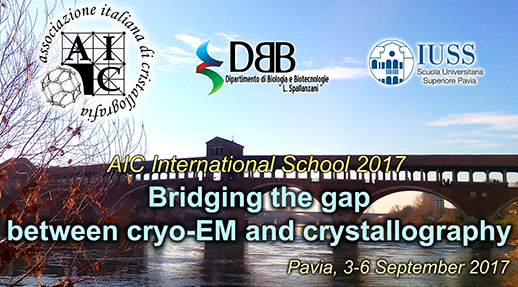
AIC International Crystallography School (AICS2017)
| - |
In Pavia
Bridging the gap between cryo-EM and crystallography
AICS2017 "Bridging the gap between cryo-EM and crystallography" will offer
the opportunity to young researchers in biochemistry or structural biology
at the PhD/postdoctoral level to approach the fundamental questions arising
from the cryo-EM experiment setup. Central topics will include evaluation of
sample suitability for analysis and its preparation, choice of appropriate
instrumentation for single particle, tomography or electron diffraction
approaches, data processing and interpretation of results. A showcase of
recent results will contour the tutorial sessions.
Deadline for registration: 15 June 2017
21st National Seminar on Crystal Growth and Applications
| - |
In Tiruchichirappalli
Correlative light, electron, and X-ray microscopy
| - |
In Harwell

Correlative light, electron, and X-ray microscopy
| - |
In Harwell
The symposium consists of lectures from world-leading scientists working in the area of correlative microscopy with light, electrons, and X-rays. The aim is to inform the community of the latest developments in correlative microscopy, and for the community to discuss and feed back its requirements for correlative microscopy development and provision in the UK.
To be followed by a three-day workshop.