Events
Schools
Circular and Linear Dichroism Summer School 2016
| - |
In Coventry
The school and workshop is targeted at postgraduate students. PDRAs, academic staff and industrial participants are welcome if places are available.
 Sessions to include:
- Introduction to absorbance, fluorescence and circular dichroism spectroscopy
- Principles of CD spectroscopy
- Linear dichroism
- Good practice
- Data bases for biomacromolecules
- CD of membrane proteins
- What is inside a CD spectrometer
- DNA-metalcomplex interactions
- Applications of SRCD and CD to structural and functional genomics
- CD theory & Dichrocalc
School on Synchrotron and Free-Electron-Laser Based Methods
| - |
In Trieste
Multidisciplinary Applications and Perspectives
Â
The following specific topics will be included:
• Fundamentals of Synchrotron & FEL Radiation
• X-ray Absorption, Scattering, and Diffraction with Synchrotrons & FELs;
and Applications
• Soft and hard X-ray Photoemission with Synchrotrons & FELs;
and Applications
• X-ray Microscopy and Imaging with Synchrotrons & FELs;
and Applications
• Multicolor Experiments, Transient States of Matter under Extreme Conditions and Ultrafast Dynamics
Crystallographic Computing School
| - |
In Bangalore
The School is intended for senior postgraduates and postdocs in all areas of crystallography (including macro- and small-molecule crystallography, powder diffraction, and small-angle scattering) who may want to become involved in software development, but lack experience in this.
The 2017 IUCr Crystallographic Computing School will take place at the Molecular Biophysics Unit at the Indian Institute of Science in Bangalore, India. It will introduce modern methods of programming crystallographic calculations in a series of lectures and in-depth tutorials by leading crystallographic software developers. Our teachers are drawn from across the crystallographic world and include experts in protein, small-molecule and powder crystallography. By working together, we aim to share what we know with the next generation of crystallographic developers.
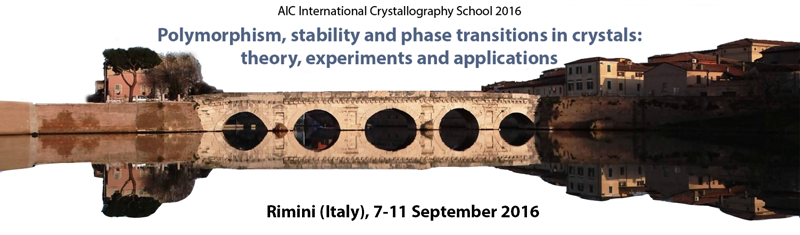
Polymorphism, stability and phase transitions in crystals. AIC International Crystallography School 2016
| - |
In Rimini
The School will address all aspects of crystallographic analysis of structural phase transitions, including basics of thermodynamics, kinetics and atomistic mechanisms ruling the processes. These concepts will be presented along with phenomenological theories for the treatment of phase transitions, with emphasis on the application of general theory to experimental data.Â
Phase transformations occur in most types of materials, including minerals, diverse organic, inorganic and hybrid compounds, pharmaceuticals, foods, ceramics and even crystalline viruses, and have been studied in almost all branches of science. Perovskites will be the teaching tool of AICS2016, with examples spanning from mineralogical to hybrid organic-inorganic samples. Therefore, the School is mainly directed to students working in the fields of chemistry, Earth sciences, mineral physics and materials science, and is as well of interest for metal-organic chemists and molecular crystallographers.
Ambition of the School is to give the attendees a unitary view, despite the many and apparently diverse materials such phenomena occur in, and the sometimes different terminologies used in the different fields.
Confirmed speakers Mois I. Aroyo (Universidad del PaÃs Vasco, Bilbao, Spain), Tiziana Boffa Ballaran (Bayerisches Geoinstitut, Bayreuth, Germany), Michael A. Carpenter (University of Cambridge, UK), Angelo Gavezzotti (University of Milan, Italy), A. Mike Glazer (University of Oxford, UK), Lucia Maini (University of Bologna, Italy), Marcus Müller (Dectris Ltd., Switzerland), Massimo Nespolo (University of Lorraine, Nancy, France), Emanuela Schingaro (University of Bari, Italy), Serena C. Tarantino (University of Pavia, Italy), Ian D. Williams (Hong Kong University of Science and Technology, Hong Kong)
Deadlines:
Bursary request: 15 May 2016
Registration and payment: 12 June 2016Â
Combined Topological and DFT Methods for Prediction of New Materials II
| - |
In Samara
Prof. Vladislav A. Blatov
Samara Center for Theoretical Materials Science (SCTMS), Samara State Aerospace University
Prof. Davide M. Proserpio
Università degli Studi di Milano (Italy)
Samara Center for Theoretical Materials Science (SCTMS), Samara State Aerospace University
Prof. Vladimir A. Saleev
Samara Center for Theoretical Materials Science (SCTMS), Samara State Aerospace University
School on Lattice and Molecular Dynamics Simulation in Materials
| - |
In Perpignan
20th JCNS Laboratory Course - Neutron Scattering
| - |
In Jülich/Garching
The course consists of two parts: a series of lectures, combined with the opportunity to take part in neutron scattering experiments. The lectures encompass an introduction to neutron sources, along with scattering theory and instrumentation. Furthermore, selected topics of condensed matter research are be presented.
The aim of the course to give a realistic insight into the experimental technique of neutron scattering and its scientific potential. Forschungszentrum Jülich supports students from outside the area with free accommodation and half-board. Travel expenses will be reimbursed within reasonable limits.

Mantid training at ISIS April 2016
| - |
In ISIS, Didcot
Following the success of our previous sessions of these training courses we would like to offer them again in April 2016. These courses are open to both facility staff and any interested people from other institutions.
CCP4/APS School in Macromolecular Crystallography: From data collection to structure refinement and beyond
| - |
In Argonne, IL
9th annual CCP4 USA Crystallography School organized jointly with the National Institute of General Medical Sciences and National Cancer Institute Structural Biology Facility at the Advanced Photon Source (GM/CA@APS).
Data collection workshop the first three days: beamline training and data collection on GM/CA@APS beamlines 23ID-B and 23ID-D. For data collection, only the participants' crystals will be used.
Crystallographic computation workshop: The rest of the time after data collection will feature many modern crystallographic software packages taught by authors and other experts. The daily schedule will be organized in three sections â€" lectures, tutorials, and hands-on, interactive trouble-shooting.
There will be model data sets available for tutorials but data, provided by participants, will have higher priority for the hands-on sessions.
Applicants: Graduate students, postdoctoral researchers and young scientists at the assistant professor level, along with commercial/industrial researchers are encouraged to apply. Only 20 applicants will be selected for participation. Participants of the workshop are strongly encouraged to bring their own problem data sets or crystals so the problems can be addressed during data collection and/or computation workshops.
Application: Application deadline is April 21.
Registration fees: The registration fee for the selected participants is $400 for the academic and $950 for the industrial researchers. The link for the on-line payments and instructions will be provided once the selection process is completed. The students will be responsible for their transportation and lodging. The workshop organizers can assist in making the reservations at economical lodging at the Argonne Guest House. The workshop will cover all other expenses.
Scattering Methods Applied to Soft Condensed Matter. 13th European Summer Schoo "Bombannes"
| - |
In Carcans-Maubuisson
The Bombannes summer school is devoted to the practical «state-of-art» approach to scattering methods, using neutrons, as well as X-ray and light sources - today’s key techniques to study structure and dynamics in systems containing colloids, polymers, surfactants and biological macromolecules.
Since 1990 the Bombannes school series introduces, on a fundamental level, the current methodology of static and dynamic scattering techniques and their applicaiton to soft matter systems. It provides with a period of 2 years advanced training for young researchers with a working place in European laboratories at post-graduate and post-doctoral level.

Summer School on nanoscience@Surfaces
| - |
In Cambridge
The School is primarily aimed at PhD students carrying out research involving the study of surfaces and interfaces at the atomic and molecular scale, including Condensed Matter Physics, Material Science and Physical Chemistry.
Topics will include:
- Nanophotonics
- Astrochemistry at surfaces
- Biological surfaces
- Oxide surfaces
- Nanoparticulate surfaces
- Thin-film growth
- Computational methods at surfaces
- Vacuum techniques
- Advances and novel techniques for surface and nanoscience
- Careers session
There will be a choice of hands-on workshops in:
- CasaXPS analysis
- Image analysis
- An introduction to CASTEP DFT modelling for surfaces
Science Summer School in Grenoble
| - |
In Grenoble
We are organizing, for the fifth consecutive year, a science summer school to attract more undergraduate students in science especially in subjects related to large scale facilities.
This school will take place in Grenoble-France within the Université Grenoble Alpes (previously Université Joseph Fourier)
The program is six weeks long, with a 45 hours French course including cultural visits and a 60 hours scientific course taught in English.
Three scientific courses are available among which ''Introduction to large scale facilities: probing matter with synchrotron and neutron radiation''.Â
This course will consist of lectures, tutorials and practicals, as well as visits of ILL and ESRF. Students are welcome to participate.
For partner universities, the tuition fees are only 500 €.
Grants associated with a research institute in Grenoble may also be available for the best students willing to spend a couple of weeks until the end of July in a research environment.
Application deadline: 16th of March
10th Central European Training School on Neutron Techniques (CETS2016)
| - |
In Budapest
Location: Budapest KFKI Campus of Hungarian Academy of Sciences
Application deadline: 20th March
We are welcoming PhD and master students, post-doc scientists as well as newcomers to the neutron research from the field of structural research in physics, chemistry, biology, material science etc.
The training consists of 5 days of lectures and experimental works.
Available instruments:- Small Angle Neutron Scattering (YS)Â
- Reflectometer (GINA)
- Triple Axis Spectrometer (TAS)
- Neutron Diffractometer (ND)Â
- Prompt Gamma Activation Analysis and Neutron Induced Prompt Gamma-ray Spectroscopy Station (PGAA/NIPS-NORMA)
Grants are available.

Macromolecular Crystallography School 2016 (MCS2016)
| - |
In Madrid
The Seventh edition is to be held at the Institute QuÃmica-FÃsica Rocasolano- CSIC
Invited speakers and tutors:
Paul Adams, Berkeley, USA
Pavel Afonine, Berkeley, USA
Armando Albert, Madrid, Spain
Kay Diederichs, Konstanz, Germany
Paul Emsley, Cambridge, UK
Carmelo Giacovazzo, Bari, Italy
Xavier Gomis-Ruth, Barcelona, Spain
Juan Hermoso, Madrid, Spain
Eugene Krissinel, Oxford, UK
Rob Nicholls, Cambridge, UK
Maria Solá, Barcelona, Spain
Isabel Usón, Barcelona, Spain
The workshop has been designed for postgraduate, postdoctoral and research scientists that deal with macromolecular crystallography but need further knowledge on the routine uses, the state of the art and fundamentals that underlie the modern techniques for macromolecular crystallography. The topics will cover crystallographic computing and fundamentals using XDS, CCP4 and Phenix, as well as the state of the art on topics such as the strategies for protein production, phasing with ARCIMBOLDO, SHELX and SIR2014, modeling with COOT and low resolution techniques. MCS2016 will provide five days of lectures and workshops. The course is designed for 25 highly motivated students.
Requests to participate must be sent by a free-formated E-mail, before March 28, 2016 to the following address: cursos@fgua.es, indicating the motivation to participate and experience on macromolecular crystallography and including a letter of recommendation from PhD Director (only for PhD students). Accepted participants will be notified by e-mail before April 4, 2016.

3rd International Summer School of Crystallography (ISSC16)
| - |
In Hamburg
The school will be held at the Centre for Free-Electron Laser Science at DESY
Prof. Carmelo Giacovazzo will give a full week of lectures on the basics
of crystallography and modern phasing methods in protein crystallography.
The course will cover mathematical understanding of crystallographic point
and space groups, systematic absences, diffraction experiments, structure
factor calculations, and other related topics. Besides the lectures, there
will be talks on applications of protein crystallography using advanced
light sources, such as 3rd generation synchrotron and X-ray Free Electron
Lasers (FELs). The course is aimed at PhD students working in the field of
crystallography, but exceptions can be made for motivated PostDocs and MSc
students. This will NOT be a workshop covering protein crystallographic
programs.
Speakers: Prof. Carmelo Giacovazzo (University of Bari), Prof. Henry Chapman (CFEL / DESY, University of Hamburg), Prof. Arwen Pearson (CUI, University of Hamburg), Dr Thomas White (CFEL / DESY), Dr Adrian Mancuso (XFEL.eu), Dr Thomas Schneider (EMBL), Gleb Bourenkov (EMBL), more TBA
Besides the lessons there will be guided tours of PETRAIII/European XFEL, a BBQ and a harbor boat trip scheduled.
The registration fee is 100 EUR per person, and includes coffee breaks and
lunch.
Applicants must(!) provide a motivation letter and a CV, directly to the
organizer Max Wiedorn (max.wiedorn@cfel.de). The number of participants is
limited to 35. Accommodations can be made at the DESY Guest House: 70 EUR per person for 7 nights (28.05 - 04.06.2016).
6th Annual CLS Mx Data Collection School
| - |
In Saskatoon

NIST Summer School on Methods and Applications of Small Angle Neutron Scattering and Neutron Reflectometry
| - |
In Gaithersburg, MD
This school provides participants the opportunity to learn about small angle neutron scattering (SANS) and neutron reflectometry (NR) at the NCNR. Â
These powerful experimental techniques are used by researchers in a variety of scientific disciplines to probe the microstructure of materials at length scales ranging from 1nm to 20 mm.ÂThe NCNR is home to world class SANS, USANS (Ultra Small Angle Neutron Scattering), and NR instruments that are available to qualified researchers through the NCNR’s peer review proposal system. Â
The school emphasizes hands-on training in the use of SANS, USANS, and NR instruments in addition to a thorough theoretical overview of these measurement techniques.
Applications of SANS and NR will be illustrated by specific examples drawn from recent cutting-edge research in polymer science, complex fluids, microporous media, and so on. ÂThe course will enable attendees to assess the applicability of the techniques to their own research, and will provide technical information needed to prepare effective experiment proposals.
The Summer School is sponsored in part by the National Science Foundation, and limited support for graduate students, postdocs and junior faculty will be available.  Attendance will be limited to 35 participants, and only applicants from North American institutions will be accepted.  For further information, and/or to apply, please go to: https://www.ncnr.nist.gov/summerschool/ss16/index.html  Early application is advised since attendance is strictly limited: typically we receive many more applications than the maximum number of participants.  Deadline: April 3, 2016.  Yamali Hernandez and Yiming Qiu National Institute of Standards and Technology 100 Bureau Drive, Stop 6102 Gaithersburg, MD 20899-6102 Tel: (301)975-5295 (YH), (301)975-3274 (YQ)
Molecular basis of human diseases: 50 years anniversary of Spetses summer schools.
| - |
In Spetses
FEBS/IUBMB Advanced Lecture Course
Virus Structure and Assembly
| - |
In Steamboat Springs, CO
9th COST School on Surface Analytical Techniques
| - |
In Regensburg
In Regensburg lectures and workshops will be given byÂ
Ger Koper (TU Delft), Yan Lu (HZB, Berlin), Wuge Briscoe (University of Bristol), Ali Zarbakhsh (Queen Mary London), Stephan Roth (DESY, Hamburg), Janina Kneipp (HU Berlin), Colin Bain (Durham University) and Hans-Jürgen Butt (MPI Mainz).Â
About 40-50 participants from all over Europe are expected to attend the school. The school is highly welcomed by the students with usual more requests to attend as can be handled to keep the school and the workshops on an effective level.Â
Information on previous schools can be found on the school archive webpage at http://cost2014.stfca.nl/Â