Topics
Synchrotron radiation
New User Symposium 2014
|
In Clayton, Victoria
The New User Symposium offers an introduction to the services offered across the facilities under the operation of ANSTO, including synchrotron, accelerator and neutron based techniques. The annual one-day event is tailored to novice potential users of these techniques, and is to be held this year at the Australian Synchrotron’s National Centre for Synchrotron Science (NCSS). Aspects of the event include access arrangements, including available support, and some of the typical applications of techniques across biomedical research, materials and physical sciences and environmental fields.
For the first time in 2014, the New User Symposium will be held immediately before the Australian Synchrotron's annual User Meeting, 20-21 November, also at the NCSS.  Prospective users can take advantage of this co-location to learn more about the leading research being undertaken at the Australian Synchrotron, and latest advances in the fields of synchrotron science and techniques. Separate registration is required for the User Meeting.
International Workshop on Advances in X-ray Imaging
| - |
In ICT, Trieste
The coherent light of synchrotrons and FEL sources has opened multiple opportunities for exploring the structure and properties of matter with lateral and time resolution that was not possible a decade ago. The workshop will be focused on recent advances and future prospects in imaging technologies and their applications. The main topics that will be tackled are phase-sensitive X-ray imaging, synchrotron X-ray tomography, coherent X-ray imaging methods (with X-ray optics and/or lensless) and ultrafast time resolved imaging using FELs. Special attention will be paid on progress in image analysis (reconstruction of 3D images and phase-retrieval algorithms) with reference to applications in different research fields, from medicine and biology to material science. Relevant topics, such as low-dose phase-contrast computed tomography and 3D coherent diffraction imaging, are in common with the European research network EXTREMA (Enhanced X-ray Tomographic Reconstruction: Experiment, Modeling, and Algorithms) MP1207 COST Action aimed at facilitating collaboration between X-ray tomography experimentalists and the mathematical image reconstruction community. In this joint event, presentations from experts in the field and topical round table sessions will illustrate current achievements and future developments.
Workshop topics
- Phase-sensitive X-ray imaging- X-ray tomography
- Coherent Diffraction Imaging
- Image reconstruction and phase-retrieval algorithms
- Applications
Topics of the round tables
- Low-dose phase
- contrast computed tomography
- From 2D to 3D Coherent Diffraction Imaging Â
SCSR2014. novel SuperConductors and Synchrotron Radiation: state of the art and perspectives
| - |
In Trieste
Invited Speakers
- Sergey Borisenko (IFW Dresden, Germany)
- Andrea Damascelli (University of British Columbia, Canada) abstract
- Donglai Feng (Fudan University, China) abstract
- Atsushi Fujimori (University of Tokyo, Japan) abstract
- Antoine Georges (Collége de France, France)
- Giacomo Ghiringhelli (Politecnico di Milano, Italy) abstract
- Makoto Hashimoto (SLAC National Accelerator Laboratory, USA) abstract
- Bernhard Keimer (Max Planck Institut für Festkörperforschung, Germany)
- Dragan D. Mihailovic (Jožef Stefan Institute, Slovenia)
- Luca Perfetti (École Polytechnique, France) - abstract
- Kosmas Prassides (Durham University, UK & Tohoku University, Japan) abstract
- George Sawatzky (University of British Columbia, Canada)
- Dirk van der Marel (Université de Genève, Switzerland)

School for Synchrotron Crystallography: Introduction and Experimental Methods
| - |
In Argonne, IL
Course Description
Aimed at senior undergraduate students, graduate students and post-docs, this workshop will offer a combination of classroom and experimental work to introduce participants to the single crystal structure determination techniques that can be applied to synchrotron-based single crystal X-ray diffraction. The program includes two hands-on activity sessions that will highlight the major techniques and introduce participants to the single crystal diffraction instrumentation at ChemMatCARS, Sector 15 of the Advanced Photon Source.ÂThe school is limited to 20 participants for hands-on activities. In addition, a limited number of auditors may be accepted at the organizers’ discretion.
Â
Lecturers
- Charles Campana, Bruker AXS Inc.
- Josh Chen, Indiana University
- Yu-Sheng Chen, The University of Chicago
- Mati Meron, The University of Chicago
- Maren Pink, Indiana University
- Amy Sarjeant, Northwestern University
- Shao-Liang Zheng, Harvard University
Â

CCP4 Study Weekend
| - |
In Nottingham
Â
Scientific Organisers
Dr Thomas Schneider (EMBL Hamburg, Germany)Dr Airlie McCoy (University of Cambridge, UK)

ANKA Users' Meeting
|
In Karlsruhe

Joint SSRL/LCLS Annual Users' Meeting
| - |
In Menlo Park, CA
Oct. 1
- Exploring an Inverse Compton Source (ICS) at SLAC.
- Integrating Synchrotron Techniques into Environmental Carbon Science
- X-ray Spectroscopy for Chemical Catalysis
- New Directions for High-Energy Density (HED) Physics at the LCLS Matter in Extreme Conditions (MEC) Instrument
- Toward a Modular Framework for Lightsource Experiment Simulation
- Don't Fade Away: Saving the Vivid Yellows of Matisse and Van Gogh, Jennifer Mass (Winterthur Museum) (7:30 pm, ROB/Kavli Auditorium)
Oct. 2
- AMO Instrument Update: Opportunities for New Science
- LCLS Detectors
- LCLS Data Collection, Diagnostics, Analysis & Interpretation
- MicroXAS Imaging with SSRL's New 2-5 keV Beam Line 14-3
- Synchrotron Techniques in Metal Biogeochemistry:Â Across Time and Spatial Scales.
- Photon Sciences Seminar
- Science Challenges & Opportunities for an Advanced X-ray Free-electron laser - Robert Schoenlein (LBNL)(Bldg. 51, Kavli 3rd Floor Conference Room)
Oct. 3
Plenary Session, SSRL & LCLS Parallel SessionsKEYNOTE TALKS
- Towards a Sustainable Energy Future - Arun Majumdar (Google)
- Exploring Matter in Extreme Conditions - Siegfried Glenzer (SLAC Photon Sciences)
- Science Case for Diffraction Limited Storage Ring - Oleg Shpyrko (University of California San Diego)
- Science Case for Short-Pulse Time-Resolved Studies at SSRL - Aaron Lindenberg (Stanford PULSE Institute, and Stanford Materials Science and Engineering)
- Novel Short Pulses at LCLS - Ryan Coffee (SLAC LCLS)
AWARD PRESENTATIONS & TALKS
- Spicer Young Investigator Award - Disorder, defects and charge transport in organic electronics - Jonathan Rivnay (Centre Microelectronique de Provence)
- Utilizing Non-equilibrium Polymorphism as an Avenue to High Performance Organic Semiconductors - Gaurav Giri (Stanford University/MIT)
- Oct. 4 Frontiers in Quantum Solids: Combining Soft X-rays and Ultra-fast Techniques - - Moved to Kavli Auditorium
- Oct. 4 Scientific Opportunities using High Repetition Rate X-ray Sources with 1-10 ps Bunch Length -- ROB A/B
- Oct. 4 Software for Serial Crystallography Data Analysis -- ROB C/D.
- Oct. 4 Early Career Scientist Forum -- Bldg. 40 Cypress Conference Room
SATELLITE EVENTS (Separate registration required)
- Oct. 1-2 Using X-rays to Study Cultural Heritage. Organizers: Marc Walton (The Getty Conservation Institute), Apurva Mehta (SSRL). Register at: http://ceramics.org/meetings/aacs-workshop
- Oct. 1-2Â High Power Laser Workshop: Part I-New Directions for High-Energy Density Physics at the Matter in Extreme Conditions Instrument (Joint with Users' Conference)
- Part II-Frontiers of High-Power Laser-Matter Interactions
- Organizers: Siegfried Glenzer (SIMES), Roger Falcone (LBNL), Stefan Hau-Riege (LLNL). Register at http://conf-slac.stanford.edu/hpl-2013/
HSC17: Dynamical properties investigated by neutrons and synchrotron X-rays
| - |
In ESRF, Grenoble
The objective of the Hercules Specialized Course is to combine theoretical and tutorial courses with practical lessons performed using neutrons and/or synchrotron radiation on state of the art instruments/beamlines. The practicals will take place at the European neutron (ILL) and synchrotron radiation (ESRF) facilities located in Grenoble.
The attendance will be limited to twenty participants (mainly PhD students and Post-Doc scientists) to allow an actual participation in the tutorials and practicals, and the interaction between the participants and the lecturers, as well as among the participants themselves.
MEDSI 2014. Mechanical Engineering Design of Synchrotron Radiation Equipment
| - |
In Melbourne
MEDSI 2014 will showcase international leading-edge developments in design and research on high end accelerator engineering and technology.
This vibrant event is to be hosted by the world class Australian Synchrotron and held in the dynamic and internationally recognised scientific hub of Melbourne.
The Australian Synchrotron has world class beamlines, of which three are considered world best. Beamline needs constantly challenge the mechanical engineering (ME) team to exceed current world standards. The expertise and enthusiasm of our ME team is attracting great interest for an exciting program, highlighting innovations in:
- Next generation light sources
- Accelerator and beamline design
- Insertion devices
- CryogenicsÂ
- UHV vacuum technology
- Magnet design and technology
- Endstation design
To be held at the elegant Hilton on the Park, just ten minutes from the centre of Melbourne, this event will be an outstanding and memorable MEDSI.

AsCA2015. The 13th Conference of the Asian Crystallographic Association
| - |
In Science City, Kolkata
The meeting will cover diverse aspects of crystallographic research ranging from life sciences, drug development, crystal engineering to theory, instrumentation, synchrotron and neutron studies.
The International Program Committee is working very hard to bring together a stimulating program that covers all aspects of crystallography with research talks on progress at the forefront of our subject. 2015 marks a very special anniversary in our discipline marking 100 years since the Nobel Prize in Physics was awarded to Sir William Henry Bragg and his son William Lawrence Bragg.
Canadian Synchrotron Summer School (CS³) - Medical Imaging at CLS
| - |
In Saskatoon, SK
The 2014 summer school will focus on providing theory and practical experience for researchers interested in improving their imaging capabilities. This school will provide background theory and practical experience from proposal writing to sample prep through data collection, reconstruction and visualization. We invite scientists who have some experience with synchrotron based imaging to apply. Participation is limited at 20 to ensure everyone is able to gain hands-on experience. Sessions will include:
- An insider’s view of the CLS peer review process with hints and tips on writing a killer proposal
- Sample preparation â€" what to consider prior to beamtime
- Computed Tomography â€" reconstruction and visualization
- Diffraction Enhanced Imaging
- K-edge Subtraction Imaging
- Phase Contrast Image Retrieval
- Introduction to and practical experience with various software packages
- Full day workshop using Paraview, a visualization software package
- Introduction to other CLS techniques and beamlines that may be useful
- Ample opportunity for socializing and networkingÂ
Confirmed speakers: L. Dean Chapman, Canada Research Chair in X-ray Imaging and Nuclear Initiative Special Advisor and Professor, Anatomy & Cell Biology, College of Medicine, University of Saskatchewan;Â David Cooper, Canada Research Chair in Synchrotron Bone Imaging and Assistant Professor, Anatomy and Cell Biology, College of Medicine, University of Saskatchewan; Tomasz Wysokinski, CLS Staff Scientist, BMIT; George Belev, CLS Staff Scientist, BMIT.

Latin American Summit Meeting on Biological Crystallography and Complementary Methods
| - |
In CNPEM, Campinas
Structural Biology has been chosen as the theme for the Latin American summit. Under the auspices of UNESCO and the IUCr, the summit meeting intends to provide a forum for stimulating the application of crystallography to complex biological phenomena. The meeting will consist of a series of scientific presentations by invited scientists from the region and will serve as a showcase for the progress which has been made in protein crystallography and related subjects over the course of the last 25 years. The relatively small number of participants (around 100) should guarantee a friendly environment conducive to discussing the scientific future of the region and specifically the contribution that crystallography can make to that future. It is hoped to have representatives from Brazil, Argentina, Uruguay, Paraguay, Peru, Venezuela and Mexico amongst others. The importance of creating greater integration with the wider scientific community will be emphasized by the participation of world-class Latin American scientists who have had successful careers outside of the region as well as by the opening lecture to be given by Nobel Laureate Ada Yonath.
Scope and objectives
2014 has been designated the International Year of Crystallography (IYCr2014) under the auspices of UNESCO and the International Union of Crystallography. The major objectives of the IYCr2014 are:
- To increase public awareness of the science of crystallography and how it underpins most technological developments in our modern society;
- To inspire young people through public exhibitions, conferences and hands-on demonstrations in schools;
- To illustrate the universality of science;
- To intensify the programme Crystallography in Africa and create similar programmes in Asia and Latin America;
- To foster international collaboration between scientists worldwide, especially Northâ€"South cooperation;
- To promote education and research in crystallography and its links to other sciences;
- To involve the large synchrotron and neutron radiation facilities worldwide in the celebrations of IYCr2014, including the SESAME project set up under UNESCO auspices.

ALS Annual Users' Meeting
| - |
In Berkeley, CA
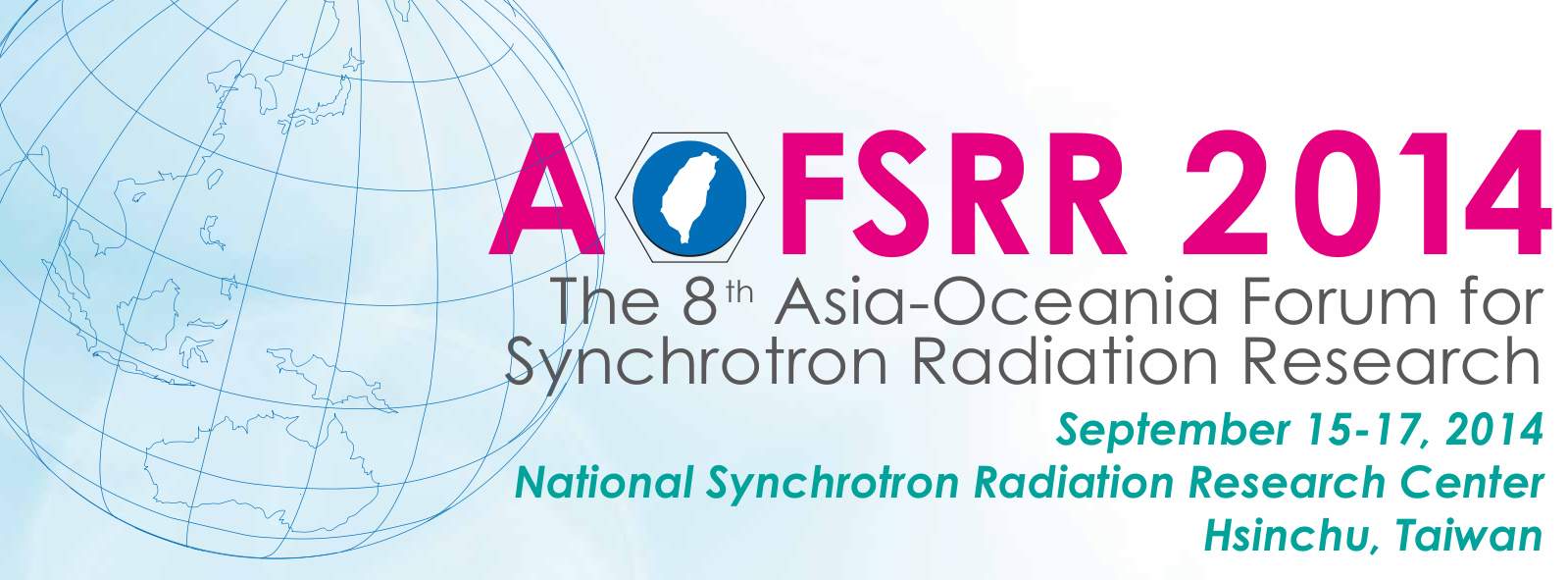
2014 Asia-Oceania Forum for Synchrotron Radiation Research. AOFSRR 2014
| - |
In NSRRC Hsinchu
The aim of the Asia Oceania Forum for Synchrotron Radiation Research (AOFSRR) is to establish a general framework of collaboration, as well as information exchange, for the development of science and technology among the synchrotron radiation facilities in Asian Oceania region.
Topics
- Perspectives and recent development of synchrotron and FEL light sources in Asia-Oceania,
- Outstanding research and innovation
- International Year of Crystallography, IYCr 2014
- Life science research
- Physical science research
Synchrotron Environmental Science VI
| - |
In Argonne, IL
Consistent with previous SES Conferences, we hope to bring together and promote dialogue between Synchrotron Science experts and Environmental Science experts. Building on the recent excitement of science that would be enabled by diffraction limited X-ray sources, as well as by Free Electron Laser (FEL) X-ray sources, the emphasis of the meeting will be identification of new opportunities in Environmental Science afforded by new or soon-to-be-available X-ray sources.Â
The conference will include presentations from synchrotron scientists who will explain the projected qualities of these new sources (X-ray spot and/or illumination size, coherence/spectral qualities, timing capabilities, etc.). It will also include presentations from scientists who have used synchrotron radiation sources in their research who will describe their work and their vision for how these new sources will benefit their research in the future. Program managers that fund enviromental science research will also be invited to give presentations and answer questions.
Scientific themes highlighted will include the following:
♦ Biogeochemistry
♦ Fate and transport of trace, nutrient, and heavy metal elements
♦ Mesoscale science

20th NSRRC Users' Meeting & Workshops
| - |
In NSRRC Hsinchu
- Workshop 1: High-Resolution RIXS and NanoARPES
- Workshop II: Coherent X-ray Scattering
- Workshop III: Applications of Synchrotron Radiation to Structural Biology
- Workshop IV X-ray Nano-analysis on Condensed Matter Physics and Materials Science
Structural Biology: Using Synchrotron Radiation to Visualize Biological Molecules
| - |
In Trieste
The Advanced Workshop is organized by the Abdus Salam International centre for Theoretical Physics (ICTP).
The objective of this Workshop is to expose the participants to the methodologies used to solve macromolecular structures, using synchrotron radiation X-ray diffraction and scattering techniques. Structural biology is an interdisciplinary research area, requiring expertises from both the life sciences and the physical sciences, so it is often difficult to educate and train young scientists with the necessary breath of experience. The Workshop is meant to provide a comprehensive overview of the state of the art in the fields of macromolecular crystallography and small-angle X-ray scattering, and aims to bridge the gap between physics and biology by covering the entire process, starting from the gene to obtain the atomic structure. A few practical sessions will provide thestudents with some hands-on experience in some of the subjects covered by the lectures
This event is part of a joint initiative between ICTP, IAEA, Elettra and SESAME, the Middle East Synchrotron Radiation facility in Jordan.
Topics will include:
- Protein production
- Crystallization
- MX data collection and processing
- MX structure determination
- Refinement
- Model building
- SAXS data collection and structure determination
- Complementary techniques.
Hands-on sessions will include:
- Crystallization
- Synchrotron data collection
- Data processing
- Refinement Model building
Participation:
Scientists and students from all countries that are members of the United Nations, UNESCO or IAEA may attend the Workshop, with particular emphasis on scientists coming from countries that are active members of the SESAME consortium. As it will be conducted in English, participants should have an adequate working knowledge of this language. Although the main purpose of the Centre is to help research workers from developing countries , through a programme of training activities within a framework of international cooperation, a limited number of students and post-doctoral scientists from developed countries are also welcome to attend.
Joint ICTP-IAEA School on Novel Experimental Methodologies for Synchrotron Radiation Applications in Nano-science and Environmental Monitoring
| - |
In Trieste
SCHOOL PURPOSES AND TOPICS:
The purpose of the Synchrotron Radiation School is to introduce and demonstrate advanced analytical methodologies based on X-ray spectrometry with application in the fields of Nano-Science and Environmental monitoring. The introduction of environment-friendly energy sources and the diagnosis, monitoring and understanding of environmental problems are issues of high concern for developing countries due to the destructive impact of the growing industrialization. These problems in many cases can be tackled by novel technologies based on the development of nano-structured materials that can be fully characterized due to the remarkable properties of synchrotron radiation.
This two-week School is addressed to young motivated scientists with a Ph.D., or at least several years of research activity. It will offer a balanced program composed by lectures, tutorials and practical hands-on training sessions at different Elettra beamlines including the newly developed XRF beamline and the IAEA multipurpose endstation. The School aims to enhance the skills of participants in applying synchrotron radiation based on X-ray spectrometry techniques. It will also represent an opportunity for young researchers from developing countries to utilize in a competitive manner the access mechanisms offered by Elettra, the IAEA and the ICTP.
The following specific topics will be included:
- Synchrotron Radiation Instrumentation: X-ray optics, UHV instrumentation, Advanced sample manipulator systems, trends and developments
- Theory and analytical applications of X-ray Absorption Fine Structure (XAFS) techniques
- Synchrotron Radiation based X-Ray Fluorescence (XRF) analysis Methodologies: Grazing Incidence XRF (GI-XRF), Total Reflection XRF (TR-XRF), 2D-3D Micro-XRF analysis, Quantification methodology and Monte Carlo Methods
- Tutorials on XRF/GIXRF and XAFS data analysis and on Monte Carlo Methods
- Experimental hands on sessions at Elettra XRF, TwinMic and XAFS beamlines
PARTICIPATION:
Young scientists with a PhD, or at least several years of research activity, who are from countries that are members of the UN, UNESCO or IAEA, may attend the School. The Organizers will select participants upon evaluation of the application forms. The main purpose of the Centre is to help researchers from developing countries through a programme of training activities within the framework of international cooperation, however, scientists from developed countries are also most welcome to participate. Please note that, due to organizational reasons, the total number of participants to the School is LIMITED. All candidates wishing to participate in the school are kindly invited to apply through the online application system (see link below). This applies to ICTP Associates and Affiliates too. As the School will be conducted in English, participants must have an adequate working knowledge of that language.
There is no registration fee to attend this School. As a rule, travel and subsistence expenses of the participants are borne by their home institutions. Limited funds are available for a limited number of applicants who are nationals of, and working in, developing countries, and who will be attending the entire School. As scarcity of funds allows travel to be granted only in a few exceptional cases, every effort should be made by candidates to secure support for their fare from their home country. Funds from external co-sponsors will allow limited support of a few participants from developed countries, to be selected by Organizers.
12th International Workshop on Synchrotron Radiation in Nanomaterials Research
| - |
In El-Gouna, Hurghada, Red Sea
Workshop in celebrating the International Year of Crystallography (IYCr2014), aims to provide a forum for exchange of knowledge in order to get the latest developments in structure determination and characterization of nanomaterials. The main objective is to highlight the powerful capabilities of Synchrotron radiation (SR) in nanomaterials research aspects. During this occasion, Nanomaterials fabrication methods will be demonstrated and combined with the advanced SR applications covering different techniques such as X-ray Diffraction (XRD), Small Angle Scattering (SAXS) and Extended X-ray Absorption Fine Structure (EXAFS). Hands-on computer training on some programs in the field will be also arranged.
- Synchrotron Radiation Concepts and Applications.
- Synchrotron applications in Nanomagnetic Materials
- High-Performance Computing for Synchrotron Applications
- Small Angle X-ray Scattering of Nanomaterials
- EXAF: From Theory to Applications
- Nanomaterials ab initio Structure Determination
- Microstructure Determination
- RDF Applications in Amorphous and Nanocrystalline Materials
- Synthesis Techniques for Nanomaterials Preparation
SSRL School on Synchrotron X-ray Microscale Imaging Techniques
| - |
In Menlo Park, CA
2014 SMB Imaging Summer School
The 1st SSRL SXRMI (Synchrotron X-ray MicroXAS Imaging) School will provide a practical users' guide to planning and conducting microXAS imaging experiments at SSRL beam lines. Students will participate in hands-on sessions at the beam lines, including on the following facilities: hard x-ray microXAS imaging (BL2-3), hard X-ray mesoprobe XAS imaging (BL10-2), and the newest microXAS imaging "tender" energy beam line (BL14-3). The hands-on sessions will be paired with several sessions of data analysis and data mining of imaging data. The School will also cover new instrumentation and techniques at SSRL microXAS imaging beam lines and will include topics that can only be learned by direct access and experience at the facility through on-the-experiment training.
This school will provide a practical users' guide to planning and conducting microscale imaging and spectroscopy measurements at SSRL beam lines, and will cover important techniques including X-ray fluorescence imaging, microscale and mesoscale X-ray absorption spectroscopy, as well as hard and tender X-ray experimental ranges. The school will address topics that are not commonly included in text books or class lectures, and typically obtained only through on-the-experiment training. There will be:
- Introductory session to SSRL imaging beam lines
- Sessions of sample preparation tips, tricks and experimental planning
- Hands-on sessions at SSRL beam lines
- Sessions of data processing and analysis
- Sessions of spectroscopy theory
The school will also cover new instrumentation at SSRL imaging beam lines.
This school has been made possible with support from the DOE-BES.