Education is integral to scientific work, so the organization of scientific schools is crucial. While one expects students to raise their level of knowledge, even experts gain new perspectives—especially when programmes move beyond narrow specialties to include emerging approaches and cross‑disciplinary ideas. The Erice crystallographic schools have long exemplified this, setting a high standard for both teaching and organization.
In 2025, a school on electron crystallography was held in Erice (Sicily) under the direction of Alexander Eggeman, Mauro Gemmi and Tatiana Gorelik. The school was planned for 40 participants but ultimately admitted 43; more than 80 applications were received, leaving many applicants unplaced and demonstrating strong demand for additional training in the field.
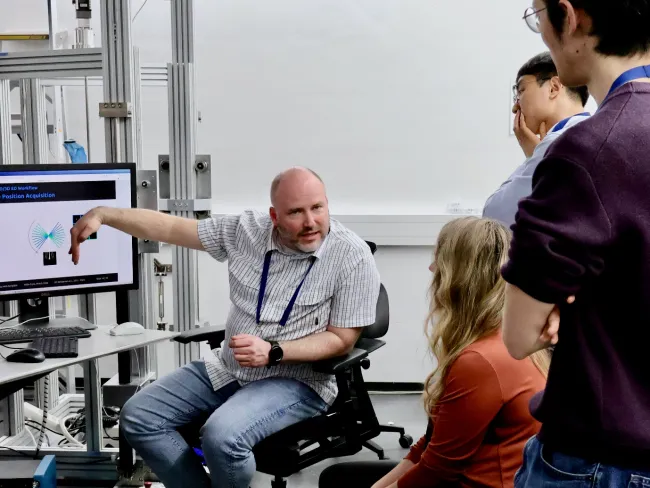
While the Erice atmosphere is unique and not easily replicated, we sought complementary strengths when organizing a winter school in Germany. Held on the campus of Forschungszentrum Jülich at the Ernst Ruska Centre for Microscopy and Spectroscopy with Electrons (ER-C), the obvious advantage was direct access to TEMs. We therefore designed the programme around extensive hands‑on sessions at TEMs, showcasing different experimental setups available at ER‑C and their possible adaptation for 3D electron diffraction (3D ED) data collection.
The lecture programme covered the core of electron crystallography: fundamentals of electron scattering and symmetry determination, and crystallographic approaches to the phase problem (direct methods, global optimization, iterative algorithms, molecular replacement). We deliberately presented a spectrum of structure‑solution approaches to emphasize the field’s interdisciplinary nature, addressing organic and inorganic chemistry, mineralogy and macromolecules. Emerging topics and neighbouring areas included ultra‑low and ultra‑high energy electrons, machine learning in crystallography, crystal structure prediction, coherent diffraction imaging, 4D STEM techniques, defect analysis, and more.
Nearly half the programme was devoted to demonstrations and tutorials, giving attendees practical experience with various experimental setups and 3D ED data‑collection strategies. Commercial and academic solutions were presented side by side; we gratefully acknowledge the active contributions of our industry partners Thermo Fisher Scientific, Rigaku, Tescan, Dectris, Nanomegas and Gatan. Their support—both financial and programmatic—was particularly valuable given the current global climate.
Academic sponsors included HiDA, IUCr, ECA, EMS, DGE and DGK. IUCr support was used to reimburse travel costs for seven participants from Europe and beyond.
The winter school ran successfully: over 70 people attended in total, including 52 registered participants (40 external and 12 from FZJ) and 21 lecturers and demonstrators, representing three continents. More than one third of the participants were from Germany, with strong contingents from Belgium, Switzerland and the Czech Republic.
We are grateful to IUCr and all sponsors and partners, and we look forward to continued collaboration and further training opportunities in electron crystallography.
Author Information
Tatiana Gorelik
Related content