In our previous essay on cubic packings of spheres (Dauter & Jaskolski, 2026), we introduced the loosest Heesch-Laves (HL, 1933) packing and analyzed its symmetry. This time, we will view the HL packing as a consequence of polyhedral arrangements of equal spheres in 3D.
It is well known now that any regular packing of spheres in 3D, in which the spheres are equivalent by space-group symmetry, must have a density (i.e. the fraction of space covered by the spheres) in the range between 5.5% and 74.5%. The densest packing (more precisely, its cubic variant), discovered by Harriot (Kahr, 2011) and Kepler (1611, 1966), has each sphere surrounded by 12 other spheres. In fact, there are infinitely many such packings, in which layers of hexagonally arranged spheres are stacked with various relative shifts (Jaskolski et al., 2025). The 74.5% limit, regarded as the absolute limit for any sphere packing regardless of symmetry, was held as the Kepler conjecture for nearly four centuries, until it was rigorously proven to be true by Hales (2005, 2006) and Hales & Ferguson (2006).
The loosest regular sphere packing with the density of 5.5%, presented by Heesch & Laves (HL, 1933), has the cubic symmetry I4132 and consists of triangles of spheres arranged helically around the 41 and 43 axes of this space group, Fig. 1. It is possible to pack spheres with arbitrarily low (i.e. approaching zero) density (e.g. Dorozinski & Fischer, 2006), but this is only possible when the condition of symmetry equivalence is dropped.
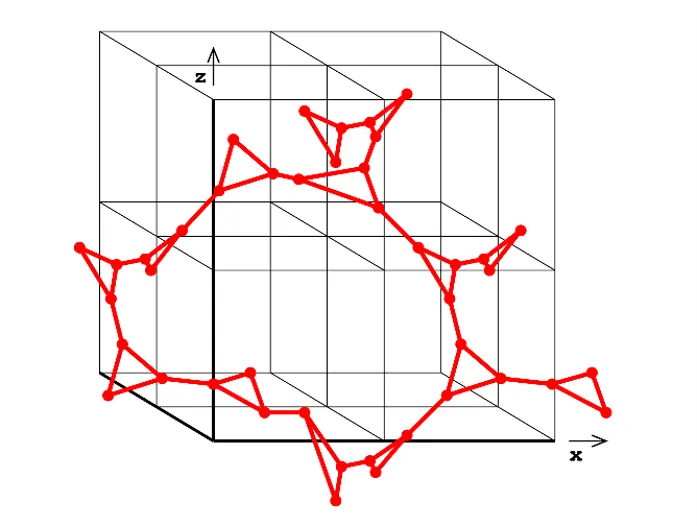
Fig. 1. The arrangement of spheres in their Heesch-Laves loosest packing in the unit cell of the I4132 space group. The sphere positions are marked by dots and their connections by line segments joining pairs of “kissing” spheres.
It is possible to derive the HL packing as a step-by-step modification of some simpler, easier-to-visualise sphere arrangements. We start with packing spheres arranged into icosahedra at the nodes of a primitive cubic lattice, as in Fig. 2.
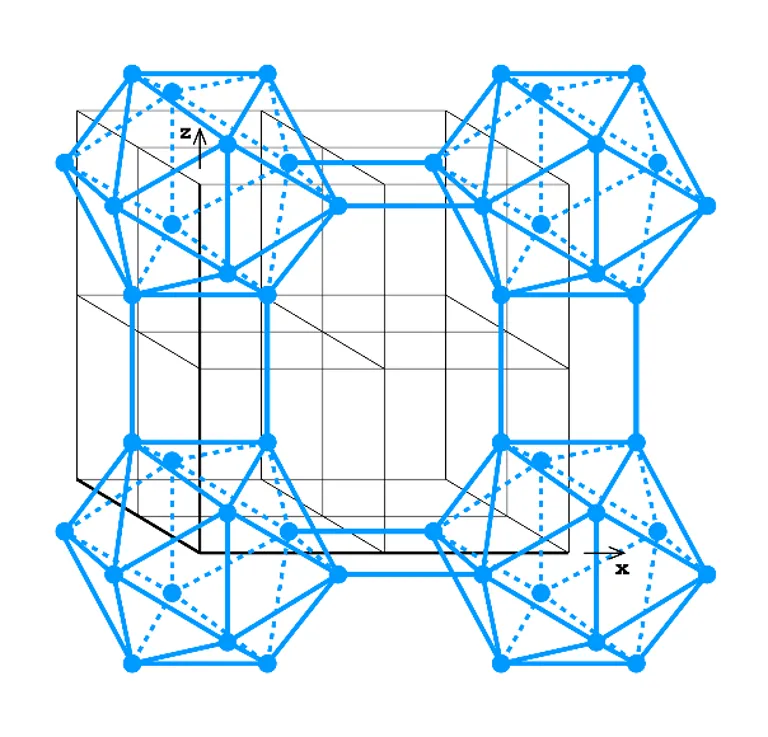
Fig. 2. Packing of spheres in the cubic space group Pm, with icosahedral clusters centred at the unit cell corners.
This arrangement has Pm3̅ space-group symmetry, with the sphere centres at the special Wyckoff position j [x, y, 0 with x=(√5-1)/4≈0.3090, y=(3-√5)/4≈0.1910] and all symmetry equivalents (Int. Tables for Crystallography, Vol. A, 2016). Each sphere is surrounded by six other spheres at a distance (equal to the sphere diameter) of d=(3-√5)/2≈0.3820. At the Wyckoff position j, the spheres lie on the mirror planes of the Pm3̅ space group.
This setup can also be presented in the space group P23, a subgroup of Pm3̅ . In this case, the spheres lie at the general Wyckoff positions j (x,y,z) of this space group. The sphere positions in this space group can be shifted by an arbitrary amount while preserving the P23 symmetry and the packing condition that requires the spheres to touch each other. A shift of the sphere location to x=(2√3-3)/4≈0.1160, y=(5-2√3)/4≈0.3840, z=0.125, leads to a distorted icosahedron at the lattice node, as in Fig. 3.
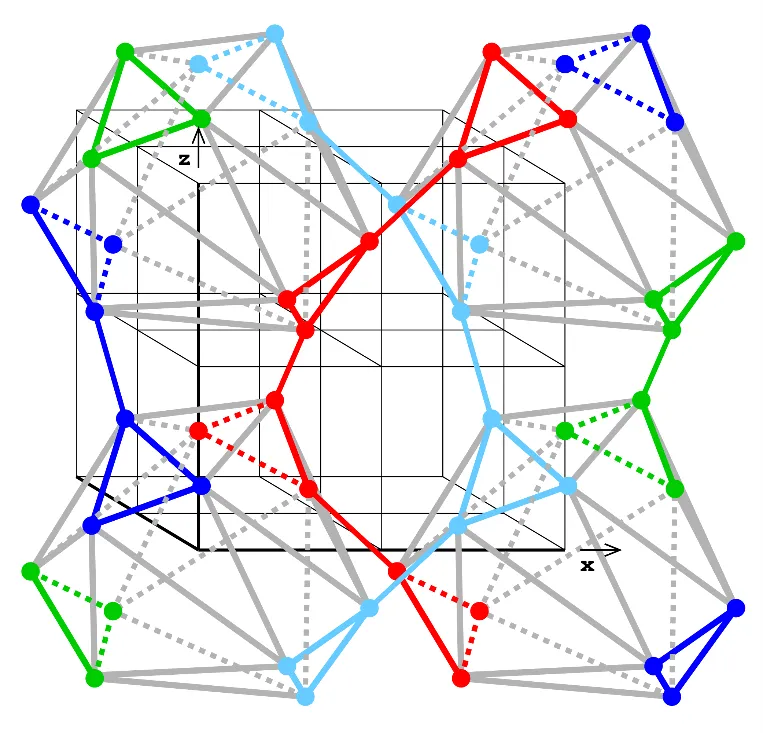
Fig. 3. Distorted icosahedra of 23 symmetry, whose triangular faces (marked in different colours) are in contact with corresponding triangles of the neighbouring polyhedra. Grey lines mark distances between unconnected spheres within the icosahedra.
The spheres at the corners of these distorted icosahedra form four equilateral triangles around the threefold axes of symmetry and are also at the same distance of d=√2*(2√3-3)/4≈0.3282 to a sphere from the neighbouring polyhedron. This whole arrangement of touching spheres is presented in Fig. 4.
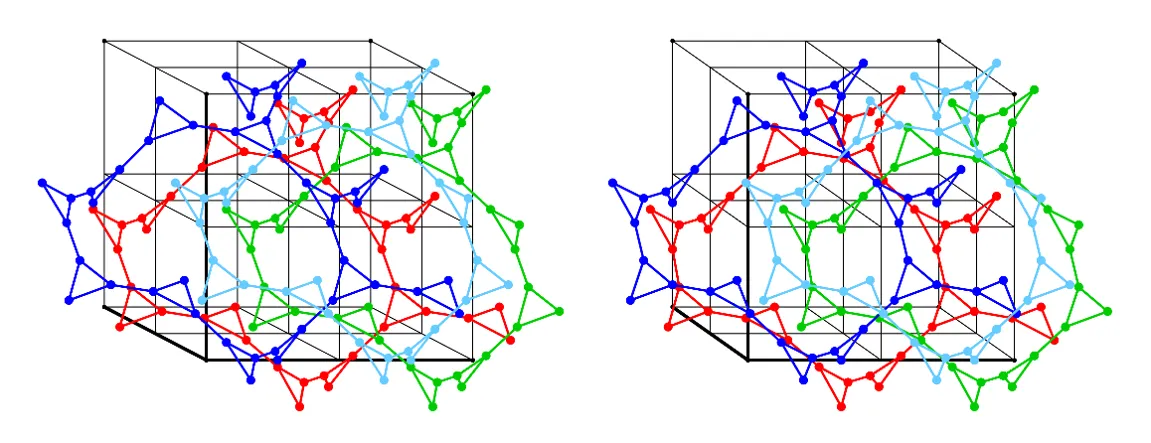
Fig. 4. Stereoview of the arrangement of touching spheres resulting from a distortion of the icosahedral packing, shown within eight unit cells of the P23 space group. Four separate sets of touching spheres are presented in different colours.
This arrangement consists of four separate interpenetrating systems of touching spheres, which are shifted in relation to each other by one P23 unit cell in the three axial directions. In fact, such an arrangement does not constitute proper packing, since there is no path of touching spheres between spheres from different colour systems.
However, an individual system from Fig. 4, containing spheres of one, e.g., red colour, corresponds to sphere packing in the space group I4132 with doubled unit-cell constant, identical to the Heesch-Laves packing presented in Fig. 1.
Author Information
Zbigniew Dauter
Mariusz Jaskólski
References
Dorozinski, T. E. & Fischer, W. (2006). “A novel series of sphere packings with arbitrarily low density.” Z. Krist. 221, 563–566.
Dauter, Z. & Jaskolski, M. (2026). “Interesting packings of spheres in cubic space groups. A case of an unobvious arrangement of space-filling rhombohedra.” IUCr Newsletter 34, No. 2. https://www.iucr.org/news/newsletter/etc/articles?issue=162387&result_138339_result_page=4
International Tables for Crystallography, Vol. A: Space-group Symmetry (2016). 6th ed., Aroyo, M. I., ed. Chichester: Wiley.
Hales, T. C. (2005). “A proof of the Kepler conjecture.” Am. Math. 162, 1065–1185.
Hales, T. C. (2006). “Historical overview of the Kepler conjecture.” Discrete Comput. Geom. 36, 5–20.
Hales, T. C. & Ferguson, S. P. (2006). “A formulation of the Kepler conjecture.” Discrete Comput. Geom. 36, 21–70.
Heesch, H. & Laves, F. (1933). “Uber dunne Kugelpackungen.” Z. Krist. 85, 443–453.
Jaskolski, M., Naskrecki, B. & Dauter, Z. (2025). “Periodic arrangements of closely packed spheres.” ChemTexts 11:2.
Kahr, B. (2011). “Et Tu, Crystallographer? Murder Charges Against Close-Packing Pioneers Evaluated.” Cryst. Growth Des. 11, 4–11.
Kepler, J. (1611). Strena Seu De Nive Sexangula. G. Tampach, Francofurti ad Moenum.
Kepler, J. (1966). The Six-Cornered Snowflake. Clarendon Press, Oxford.
Related content