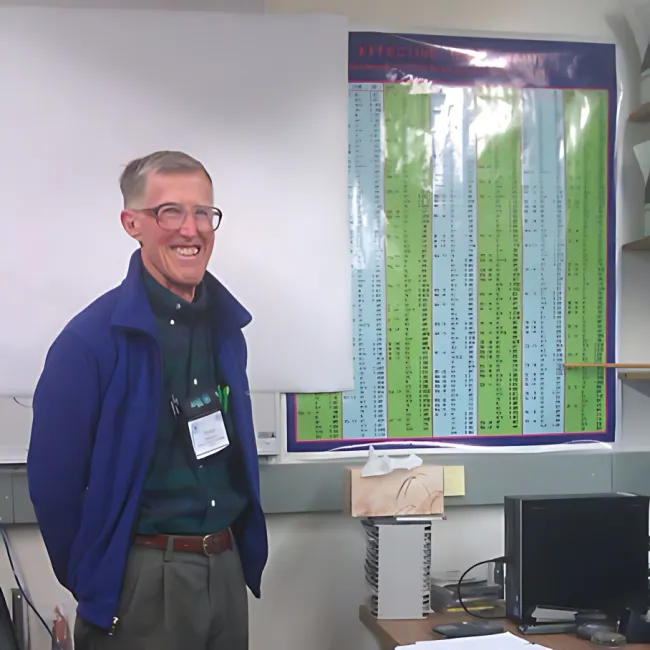
It is with great sadness that I share the news that Robert Day Shannon passed away peacefully at home on Sunday, May 31, at the age of 90, with his family at his side. Bob was a leading scientist in the area of solid-state chemistry and crystal chemistry with a strong background in mineralogy. As a research chemist at the Experimental Station of E.I. Du Pont de Nemours in Wilmington, Delaware, USA, he was responsible for various research projects, resulting in many patents and publications which attracted worldwide attention. He has more than 140 publications that have been cited nearly 90,000 times according to the Web of Science (June 2026). His research on the crystal chemistry of oxides and chalcogenides culminated in a comprehensive compilation and evaluation of effective ionic radii. This systematisation of interatomic bond distances resulted in a universal set of parameters correlated with many physical properties of solids. This tabulation is a standard work, used in chemistry, physics, and mineralogy. His paper on ionic radii has been cited more than 65,000 times (Acta Cryst. (1976). A32, 751-767).
Bob was born on August 28, 1935, in Highland Park, Michigan, USA. He received his Master's degree in Ceramic Engineering from the University of Illinois in 1959, and his PhD in 1964 from the University of California at Berkeley. In the same year, he started as a research chemist at Du Pont in Wilmington, Delaware, where he retired in 1992. In this period, he spent a sabbatical leave in 1971-1972 at McMaster University studying crystal structures of vanadates and bond-strength relations in oxides, continuing these studies in 1972-1973 at the University of Grenoble, France. In 1980, Bob started his research on zeolites. The project comprised studies of small-pore zeolites as possible candidates as catalysts for the selective synthesis of dimethylamine. Out of a variety of zeolitic materials, the zeolites ZK-5 and Rho proved to be extraordinary catalysts. Bob invented methods for synthesis routes to obtain extremely pure material. From 1982 to 1983, he worked at the Institut de Recherches sur la Catalyse in Lyon, France, studying the crystal chemistry of zeolites. When he returned to Wilmington, it was my pleasure to join his group doing research on zeolites. I got to know an exceptionally hardworking scientist and a wonderful, kind person who was always willing to help in any situation.
Bob was a member of various scientific societies and a fellow of the Mineralogical Society of America. In 1993, he received the Humboldt Research Award, which is one of the highest-ranked awards in Germany. He spent a full year at the Universities of Mainz and Bremen to study the electronic polarizabilities of cations and anions to predict refractive indices of minerals and inorganic compounds. This work will be continued and brought to completion in his spirit.
The mineral bobshannonite, Na2KBa(Mn,Na)8(Nb,Ti)4(Si2O7)4O4(OH)4(O,F)2 from Mont Saint-Hilaire, Québec, Canada, was named in his honour.
After retiring, he moved with his wife Cookie to Boulder, Colorado, where they settled into a house high up in the mountains. He lived there until he passed away. We will always keep him in our memories.
Author Information
Reinhard Fischer