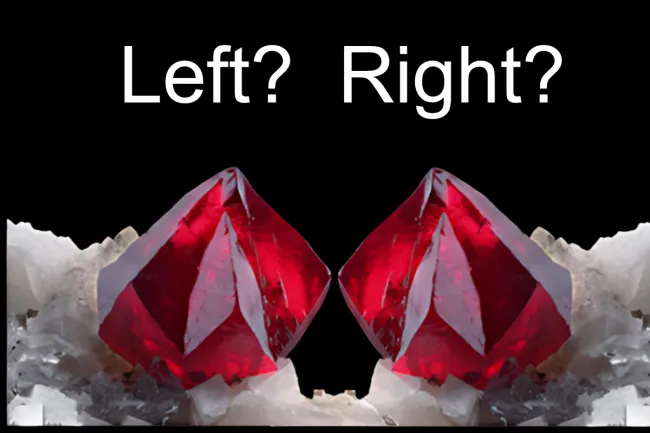
About 600 minerals, that is, about 10% of all known minerals, are chiral, which means that they appear in nature in two versions, left-handed and its counter right-handed forms. Surprisingly, except for the well-studied (chiral) quartz, that key structural feature has been unexplored in minerals research, in museum displays and as a feature for collectors. Here I summarise some of the main aspects of chiral minerals.
For what comes next, we recall some properties of chirality (from Greek χειρ (kheir), "hand”), which are relevant for this article:
- The left- and right-handed forms are generally termed enantiomorphs (Greek: opposite forms), or, when molecules are discussed – enantiomers.
- The pair of enantiomorphs are mirror images of each other, which cannot be brought to coincide with each other. That non-superimposability of the mirror images is a standard definition of chirality.
- Enantiomorphs are distinctly different objects, but they look very similar: The similarity is because they are mirror images of each other; the difference is manifested by their inability to coincide.
- The main identifier of the molecular-level chirality of a crystal is its space-group symmetry, and specifically one of the 65 Söhncke space groups, which are characterised by containing only proper symmetry elements (including the helical roto-glide and the identity).
- 22 of the Söhncke space groups are enantiomorphic, which translates to the fact that they have specific space-group symmetry labels for each of the two enantiomorphs (based on the 31–32, 41-43, 61–65 and 62–64 enantiomorphic helical right-left handed terminology, respectively). The other 43 Söhncke space groups are non-enantiomorphic, and do not distinguish between the two enantiomorphs.
- The inability to label handedness is part of a more general problem of the lack of a systematic methodology for such labelling of the molecular-level handedness of crystals. The CIP rules work quite well for organic molecules, but are by far less applicable to inorganic minerals. However, crystallographic methods for determining the absolute configuration exist, mainly using the Flack parameter methodology, which are then followed by ad-hoc handedness assignment (looking at possible helicity, etc).
- Another identifier of the molecular chirality of a crystal is its crystal class: The crystal is chiral if its class contains only rotational point-group symmetry elements, including the identity. 11 out of the 32 crystallographic point groups are of that category. We use, however, the more informative space-group symmetry.
The missing glove situation:
Where many crystals of the same chiral mineral appear at the same location, they should be at a ratio of 1:1 of both enantiomorphs – a conglomerate. Ideally, each of the two enantiomorphs should be identified, as they are distinctly different mineral species (and therefore there are actually not 600 but about 1200 different chiral minerals). The handedness characterisation is needed even more so for the common situation where only a single crystal is located at the site of its finding. In practice, however, we have been currently facing the “missing-glove” situation: The majority of reports on minerals and most of the entries in mineral listing websites either ignore the fact that there are two different forms - the enantiomorphs, or report arbitrarily only one enantiomorph; and more often than not, the fact that the mineral is chiral and should appear in two forms is not mentioned at all, even if the space-group symmetry is indicated.
Chirality on all scales:
The chirality of a mineral can be expressed on all scales, from the molecular scale, to the nanocrystal, and up to the large macroscopic scale (Figure 1). However, in order to be consistent, the chirality of a mineral is defined by its molecular structure, not by the macroscopic habit, which may or may not follow the molecular chirality. This is so because, whereas the molecular structure is an inherent property of that crystalline material, the habit reflects the growth conditions of the crystal, expressing or closing any of the faces of the 48 crystal forms and their endless combinations – see, for instance the collection of habits - both chiral and achiral - for the molecularly chiral epsomite, MgSO₄⋅7H₂O, space group P2₁2₁2₁ [Fortes, 2005] and for quartz, P3121/P3221 [The Quartz Page].
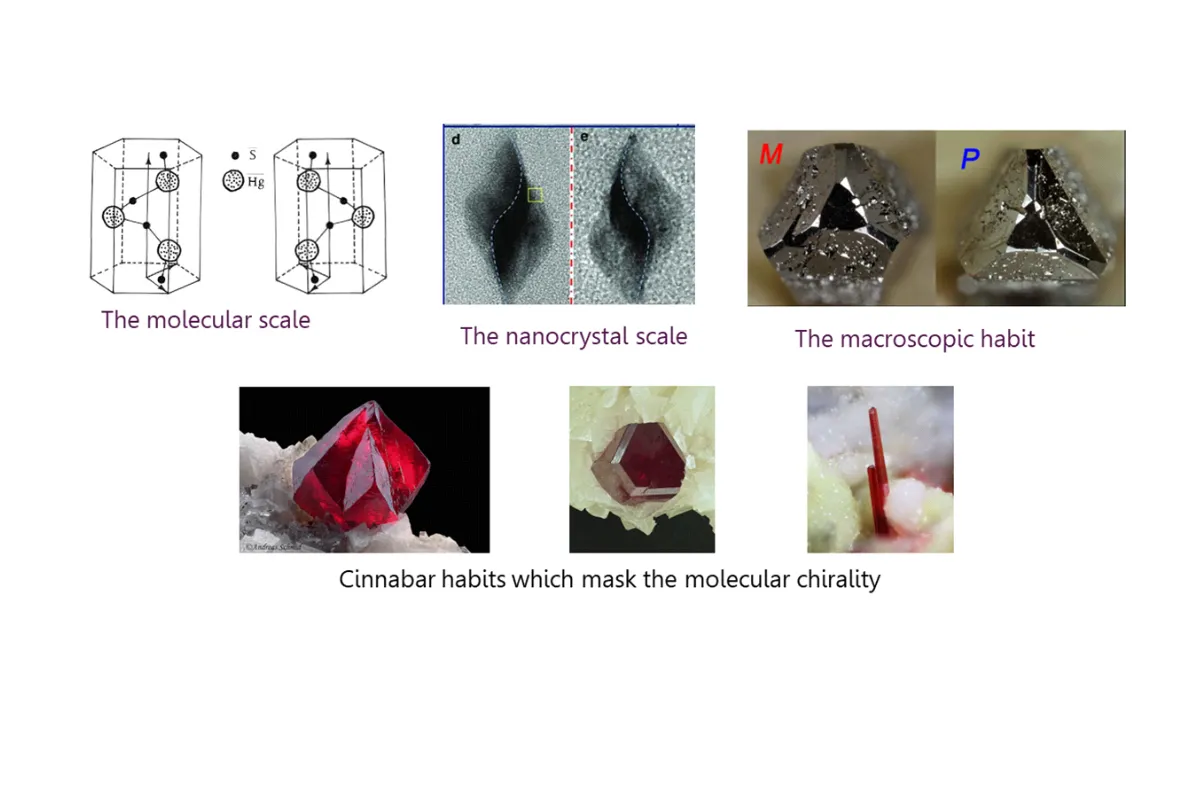
Figure 1. Cinnabar, HgS, P3121/P3221. Top: Chirality on all scales – both enantiomorphs are shown. Bottom: Cinnabar habits which conceal the chirality (https://www.mindat.org/search.php?search=334001)
Going back to the molecular level chirality, that structural property appears not only in the collection of atoms within the unit cell, but in other selected molecular blocks (although not necessarily, down to the asymmetric unit). In quartz, for instance, the chirality appears in the unit cell, in the “infinite” helices of the siloxane chains, in the Si(OSi)4 building block, in the SiSi4 tetrahedron, and even the elementary SiO4 unit is slightly chirally distorted into C2 symmetry [Yogev-Einot and Avnir, 2003]. Another example is in the various molecular building blocks of the chiral mineral Goosecreekite, an aluminosilicate zeolite, Ca(Al2Si6O16)*5H2O, P21 [Dryzun et al, 2009], shown in Figure 2.

Figure 2: Top left: The chiral aluminosilicate zeolite minerals. Top right: The chiral skeletal structures of three of these zeolites, showing the enantiomorphs of nabesite. Bottom: Chirality of minerals shows up in the various presentations of their molecular building blocks, shown here for goosecreekite, Ca(Al2Si6O16)*5H2O, space group P21
Chirality appears everywhere in minerals:
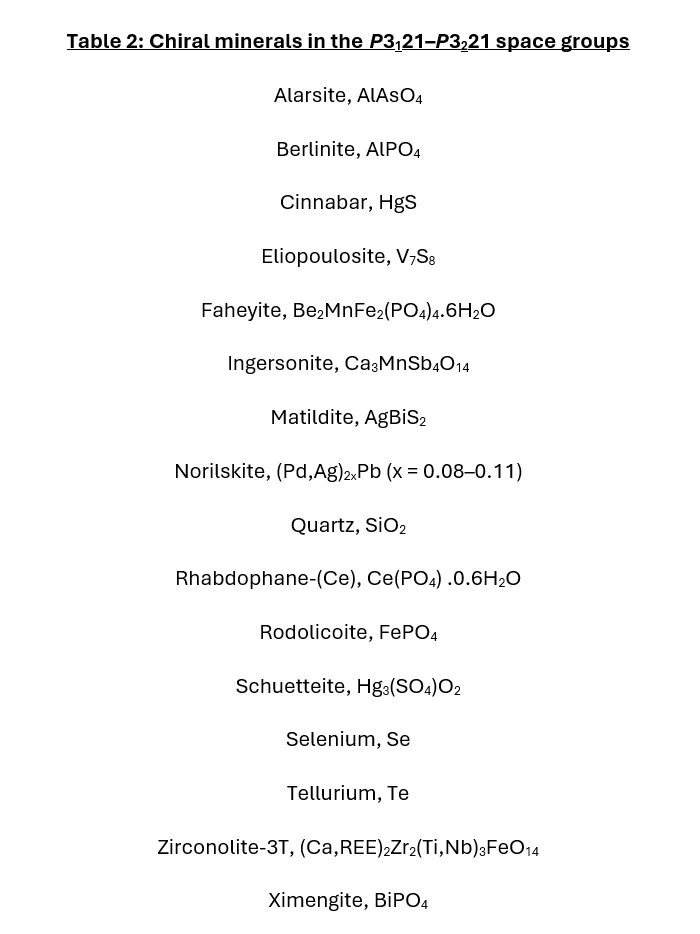
The structural property of chirality appears all across the world of minerals [Avnir, 2024], and they are represented in all major sub-families of minerals. Examplesare the aluminosilicate zeolite minerals, for which the chiral ones are collected in the table of Fig. 2. Table 1 lists the most abundant space-group symmetries of the chiral minerals. The most common one is space group P1 (80 chiral minerals), that is, lack of molecular symmetry of the unit cell content altogether. The next most common space groups are P212121 and P21 which, are also common packings of chiral crystals in general. It should be noted, however, that in the general field of chiral crystals, P212121 and P21 are more common than P1 [Flack, 2003]. The higher abundance of P1 in minerals may be attributed to the common difficulty in obtaining pristine mineral crystals, devoid of entrapped ion impurities, and to the often-reported difficulty in distinguishing P1 from (the achiral) P1̅ [The Triclinic System]. The question of why P212121 is of high frequency has occupied the literature for quite a while, and one of the proposed interpretations has been that it is less restrictive than others, allowing more conformational degrees of freedom [Wukovitz and Yeates, 1995], an explanation that holds for P1 too, as it too is devoid of the restriction of having a proper symmetry. 14 of the Söhncke space groups have no representatives in the mineral world at all, interestingly, most of which contain a four-fold rotational symmetry axis [Avnir, 2024].
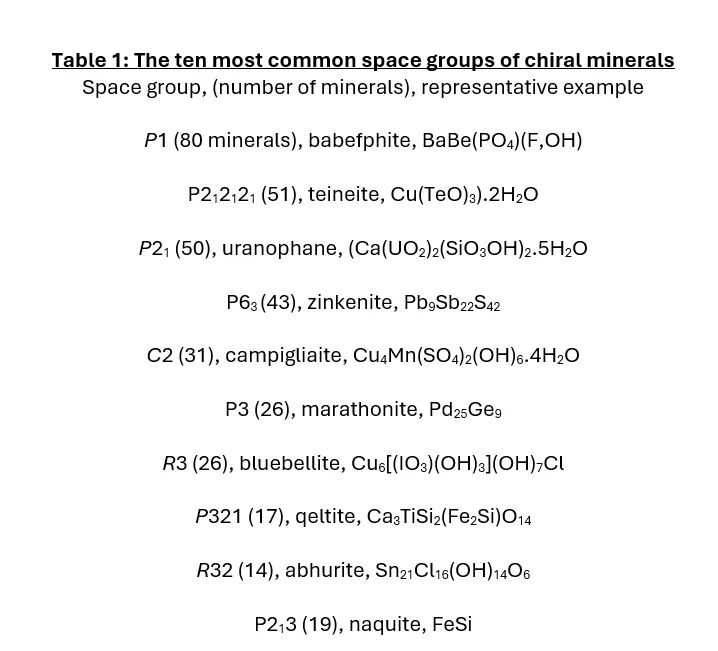
Table 2 presents the library of chiral minerals from another perspective, namely, all chiral minerals that share the same space-group symmetry; for this, we take the enantiomorphic pair P3121–P3221 of the much-studied quartz (see here for example and here). Having the same space-group symmetry for two chemically different crystals usually does not indicate a similar molecular structure, but sometimes structural similarity does exist, in which case the minerals are termed isostructural. An example in Table 2 of isostructural minerals is of quartz and berlinite (Al(PO4)), both with tetrahedral building units — the tetrahedral phosphate and the tetrahedral Si(OSi)4 unit, respectively. An example in Table 2 of two chiral minerals with the same space group but different molecular structures is that of quartz and cinnabar, the chirality of which is best manifested by helical chains of -Hg-S-Hg-S-Hg-S-, which are either left-handed or right-handed. Cinnabar is a rare case of a thoroughly studied chirality (except for quartz): the two enantiomorphs of cinnabar were obtained from various locations [Shindo et al, 2013], and the two absolute helical handedness configurations were determined from X-ray analysis using the Flack parameter. These authors used the IUPAC-approved labelling of the handedness of helicity — P for the right-handed P3121 and M for the left-handed P3221. Two additional interesting minerals in the P3121–P3221 family of chiral minerals are the elemental selenium and tellurium, two of the elements which appear in nature in their zero-valent form. They are also the only elements in the periodic table which are chiral in their native forms. Identification of the enantiomorphs of Se and Te was carried out on synthetic crystals of these elements [Kozlovskaya et al, 2023] but not on natural mineral sources, which must appear as pairs in nature as well.
There is a unique exception to the rule that chiral minerals must appear as both enantiomorphs, and that is the case for bio-organic minerals, where the single handedness is dictated by the homochirality of life on Earth. An example are four chiral minerals detected in fossilized wood: Fichtelite [Mace and Peterson, 1995], C19H34, P21, where the single enantiomer is left-handed (S, by the CIP rules); branchite (also known as hartite), C20H34, P1; refikite, C20H32O2 (C19H31COOH), P21212 (mindat) or P212121 (Webmineral); and dinite, C20H36, P212121 [Franzini et al, 1991]. All four minerals are derived from diterpenoid derivatives, a family of molecules commonly found in wood.
Finally, note that many of the chiral minerals are used in the gemstone industry. Some examples are austinite, CaZnAsO4(OH), P212121; cancrinite, Na6Ca2[(CO3)2|Al6Si6O24].2H2O, P63; celadonite, K(Mg,Fe2)(Fe,Al)[Si4O10](OH)2, C2; simpsonite, Al4(Ta,Nb)3O13(OH), P3; thaumasite, Ca3Si(OH)6(CO3)(SO4).12H2O, P63; and many more [Avnir, 2024]. To the best of my knowledge, that aspect of the gems is not used in commercial applications.
Synthesis and reactions of chiral minerals:
As seen in the three tables, chiral minerals provide a good representation of the diverse variety and compositions of minerals in general. It is therefore not surprising that practically all types of geochemical reactions are involved in their synthesis. Here are examples of three particularly common reactions, the first two of inducing chirality and the third one of its loss:
Hydrolyses and serpentinizations:
2KAlSi3O8 + 2H3O+ + 7H2O → Al2Si2O5(OH)4 + 2K+ + 4H4SiO4
Achiral microcline Kaolinite, chiral, P1
Oxygenations:
4(Zn,Fe)S + 11O2 + 28H2O → 4ZnSO4.7H2O + 2Fe2O3
Sphalerite-achiral Goslarite, chiral, P212121
Carbonations:
Na2Ca2Si3O9 + 4CO2 + H2O → 2CaCO3 + 2Na+ + 2HCO3-+ 3SiO2
Combeite, chiral, P3121/P3221 Achiral calcite and amorphous silica
The degree of chirality:
We conclude this brief description of chiral minerals with the application of the concept of the degree of chirality, by demonstrating it on quartz [Yogev-Einot and Avnir, 2003]. Traditionally, chirality has been treated in terms of “black or white”, namely that this structural property either exists or does not. However, as this “yes/no” descriptive language misses the fine structural details, an alternative is to quantify that property on a grey-level scale, allowing one to ask questions such as “by how much is mineral A of more pronounced chirality than mineral B”, or to follow up how chirality changes by varying physical conditions, and more. Here is how it works for quartz, applying the Continuous Chirality Measures (CCM) approach (a special branch of the more general Continuous Symmetry Measure (CSM) methodology), a measure that is zero if the object is achiral, and increases with the degree of chirality.

Figure 3. The changing degree of chirality of quartz. Top left: The effect of pressure on the degree of chirality of quartz (measured for the SiSi4 unit). Top right: Compares temperature effects on the optical rotation of quartz (black dots) and on the degree of its chirality (measured for the helical fragment –O(SiO3)4 –, open triangles). The temperature effects on the optical rotation are from Le Chatelier (upper inset) and other contemporaries. The phase transition from low to high quartz is clearly visible at 848 K. Bottom: The degree of chirality of quartz (measured for the SiO4) and the degree of tetrahedricity of that unit at various geographic locations.
Figure 3-top left shows that the degree of chirality of the SiSi4 building block of quartz – obtained crystallographically - changes with pressure [Yogev-Einot and Avnir, 2004]: the higher the pressure the more it distorts towards the ideal achiral tetrahedron structure. Figure 3 top right shows the effect of temperature changes on the degree of chirality of the helical fragment –O(SiO3)4– of quartz, linking it to the changes of the optical rotation, which is an inherent property of chiral materials. Quartz was one the earliest – 19th century – objects for which optical rotation has been demonstrated, and in Fig. 3-top right indeed takes the effect of temperature on the optical rotation as measured by Le-Chatelier (inset of Fig. 3 top right) and his contemporaries in 1889 [Le Chatelier, 1889]. The two sets of data are overlaid, and it is seen that they nicely align, demonstrating the physical foundation of the chirality measure [Yogev-Einot and Avnir, 2006]. Note that the effect of temperature and pressure are in opposite directions, and that the figure shows clearly the transition from alpha to beta quartz, which is significantly more chiral. Figure 3-bottom shows a perhaps unexpected observation - the degree of chirality of quartz as determined from the slightly chiral SiO4 building block changes as a function of its geographical location, and even more pronounced is its deviation from 4̄3m (Td in Schoenflies notation) symmetry. It is apparently a manifestation of the differences in the cooling and pressure-drop rates at the sites of crystallisation of the melt, and of the specific environmental chemical composition, demonstrating the potential usefulness of that measure to follow geochemical and geophysical processes.
Author Information
David Avnir, Institute of Chemistry, The Hebrew University of Jerusalem, Israel, david.avnir@mail.huji.ac.il
References
Avnir, 2024. D. Avnir, “Chiral minerals”, Minerals, 14, 995, 2024, (42 pages). https://doi.org/10.3390/min14100995
Dryzun et al, 2009. C. Dryzun et al, “Chiral silicate zeolites”, J. Mater. Chem. 19, 2062–2069, 2009. https://doi.org/10.1039/b817497k
Flack, 2003. H. D. Flack, “Chiral and Achiral Crystal Structures”, Helvetica Chimica Acta, 86, 905–921, 2003. https://doi.org/10.1002/hlca.200390109
Fortes, 2005. A. D. Fortes, “From Surrey to the moons of Jupiter (via Mars): The story of epsomite”, Axis, 1, 1–28, 2005.
Kozlovskaya et al, 2023. K. A. Kozlovskaya et al, “Determination of the absolute configuration of monoatomic chiral crystals using three-wave X-ray diffraction”, Crystallogr. Rep., 68, 374–379, 2023. https://doi.org/10.1134/S1063774523700050
Franzini et al, 1991. L. Franzini et al, “Re-discovery and re-definition of dinite, C20H36, a forgotten organic mineral from Garfagnana, northern Tuscany Italy”, Eur. J. Mineral., 3, 855–861, 1991. https://doi.org/10.1127/ejm/3/5/0855.
Le Chatelier, 1889. H. Le Chatelier, “Sur la polarisation rotatoire du quartz”, Comptes rendus de l'Académie des sciences, 109, 264, 1889.
Mace and Peterson, 1995. H. A. Mace and R. C. Peterson, “The crystal structure of fichtelite, a naturally occurring hydrocarbon”, Can. Mineral., 33, 7–11, 1995.
Shindo et al, 2013. H. Shindo et al, “Asymmetric autocatalysis induced by cinnabar: Observation of the enantioselective adsorption of a 5-pyrimidyl alkanol on the crystal surface”, Angew. Chem. Int. Ed., 52, 9135–9138, 2013. https://doi.org/10.1002/anie.201304284
The Quartz Page. https://www.quartzpage.de/
The Triclinic System. https://webmineral.com/crystal/Triclinic.shtml
Yogev-Einot and Avnir, 2003. D. Yogev-Einot and D. Avnir, “Quantitative symmetry and chirality of the molecular building blocks of quartz”, Chem. Mater., 15, 464–472, 2003. https://doi.org/10.1021/cm0207806
Yogev-Einot and Avnir, 2004. D. Yogev-Einot and D. Avnir, “Pressure and temperature effects on the degree of symmetry and chirality of the molecular building blocks of low quartz”, Acta Cryst., B60, 163–173, 2004. https://doi.org/10.1107/S0108768104003647
Yogev-Einot and Avnir, 2006. D. Yogev-Einot and D. Avnir, “The temperature-dependent optical activity of quartz: from Le Chatelier to chirality measures”, Tetrahedron: Asymmetry 17, 2723–2725, 2006. https://doi.org/10.1016/j.tetasy.2006.10.004
Wukovitz and Yeates, 1995. S. W. Wukovitz and T. O. Yeates, “Why protein crystals favour some space-groups over others”, Nat. Struct. Biol., 2, 1062–1067, 1995. https://doi.org/10.1038/nsb1295-1062.