Topics
X-ray optics and imaging
2017 NSLS-II and CFN Users' Meeting
| - |
In Upton, NY
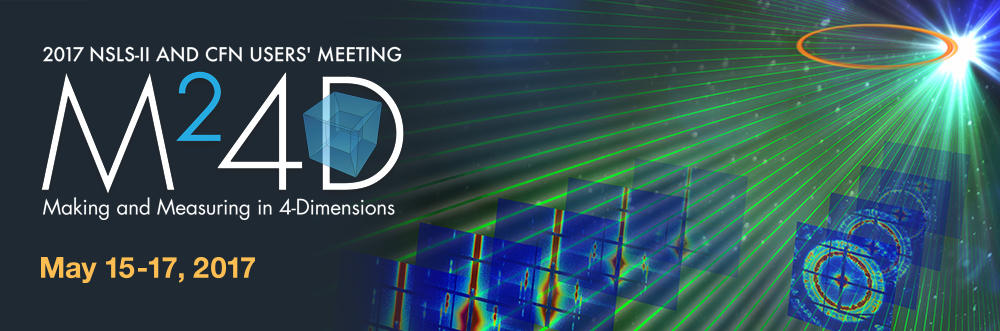
Making and Measuring in 4-Dimensions (M24D)
Workshops
Monday 15th
- Workshop 1. Multi-dimensional and multi-modal X-ray imaging and analysis
- Workshop 2. Spectro-microscopy at the Nanoscale: Exploring Chemical, Electronic and Magnetic Properties of Novel Materials
- Workshop 3. Synchrotron Techniques in Support of DOE's Subsurface R&D Effort
- Workshop 4. Measurement and Interpretation of Diffuse Scattering in X-Ray Diffraction for Macromolecular Crystallography
Wednesday 17th
- Workshop 5. Bringing Big Science into the Classroom
- Workshop 6. Polarized Resonant Soft X-ray Scattering at the NSLS-II
- Workshop 7. Prospects in Imaging Materials and their Dynamics by Coherent X-ray Scattering
- Workshop 8. Data Acquisition Cookbook: A Tutorial on NSLS-II's Python DAQ Software
- Workshop 9. Nano-mechanics: From Material Fabrication to In-Operando Characterization
2017 Nuclear Science Symposium and Medical Imaging Conference, together with the 24th Symposium on Room-Temperature X- and Gamma-Ray Detectors
| - |
In Atlanta, GA
CLEO/Europe - EQEC2017
| - |
In Munich
Conference on Lasers and electro-optics - European Quantum Electronics Conference
CA - Solid-state Lasers
CB - Semiconductor Lasers
CC - Terahertz Sources and Applications
CD - Applications of Nonlinear Optics

CE - Optical Materials, Fabrication and Characterisation
CF - Ultrafast Optical Technologies
CG - High-Field Laser and Attosecond Science
CH - Optical Sensing and Metrology

CI - Optical Technologies for Communications and Data Storage
CJ - Fibre and Guided Wave Lasers and Amplifiers

CK - Micro- and Nano-Photonics

CL - Photonic Applications in Biology and Medicine
CM - Materials Processing with Lasers
EQEC 2017 Topics
Â
EA - Quantum Optics
EB - Quantum Information, Communication, and Sensing
EC â€" Ultracold Quantum Matter and Quantum Simulation
ED â€" Precision Metrology and Frequency Combs
EE - Ultrafast Optical Science
EF - Nonlinear Phenomena, Solitons and Self-organization
EG â€" Light-matter Interactions at the Nano-scale
EH â€" Plasmonics and Metamaterials
EI - Two-dimensional Materials
EJ â€" Theoretical and Computational Photonics
CLEO®/Europe-EQEC 2017 Joint Symposia Topics
JSI - Free Electron Lasers and Applications
JSIV - Topological Insulators in Optics
JSV - Perovskite Optoelectronics

X-ray Nanoimaging: Instruments and Methods III
| - |
In San Diego
Conference OP316
X-ray Nanoimaging: Instruments and Methods IIIImportant Dates
- Abstract Due: 23 January 2017
- Author Notification: 3 April 2017
- Manuscript Due Date: 10 July 2017
Conference Committee
Conference Chairs
- Barry Lai, Argonne National Lab. (United States)
- Andrea Somogyi, Synchrotron SOLEIL (France)
Program Committee
- Yong S. Chu, Brookhaven National Lab. (United States)
- Michael Feser, Lyncean Technologies, Inc. (United States)
- Hans M. Hertz, Royal Institute of Technology (Sweden)
- Ian McNulty, Argonne National Lab. (United States)
- David Paterson, Australian Synchrotron (Australia)
- Christian G. Schroer, DESY, Univ. of Hamburg (Germany)
- Kazuto Yamauchi, Osaka Univ. (Japan)
Call for Papers
In recent years, both synchrotron and laboratory-based facilities have witnessed astounding progress in hard x-ray nanoimaging instruments and methods. Nanoprobes with sub-100-nm resolution have proliferated, while imaging with 1-nm spatial resolution may soon become possible. Combination and correlation with other analytical techniques such as x-ray spectroscopy, diffraction, tomography, ptychography, in-situ environment, and other methods are solving more important questions than ever.ÂThis conference will focus on the latest developments in optics, instrumentation and systems, data science, and integration with other techniques, for both scanning and full-field x-ray microscopes, including:
- nanoprobes, full-field microscopes, and dedicated beamlines
- high-resolution nanofocusing optics
- instruments for nanoimaging and nanopositioning
- in-situ and operando sample environments
- data science and data management
- novel nanoimaging methods and correlative techniques
- advanced control or detection schemes.
Understanding Biology Through Structure 2017
| - |
In Santa Fe, NM

ICTMS 2017: 3rd International Conference on Tomography of Materials and Structures
| - |
In Lund
This biannual conference of IntACT (International Association of Computed Tomography) will focus on the use of 3D tomographic methods for (non-clinical) studies of the internal structures of materials and their evolution.
ICTMS 2017 will bring together an international group of scientists, from universities, research organisations and industry, to discuss a broad range of issues related to 3D/4D tomographic imaging of materials and structures.
The call for abstracts will remain open until 28 January 2017.
The main focus of this conference will be recent advances in the following areas:
- Tomography acquisition hardware, software and associated experimental set-ups.
- In situ and in-operandi experiments
- "Standard" and novel modalities of tomographic imaging for material analysis (using diffraction, refraction, absorption... of X-rays, neutrons, electrons...)
- Tomographic reconstruction techniques
- 3D and 4D image analysis to extract pertinent information on internal structures and their evolution
- Case studies including applications to further the understanding of materials, structures and processes.
2016 IEEE Nuclear Science Symposium & Medical Imaging Conference
| - |
In Strasbourg
For more than 60 years, the IEEE Nuclear Science Symposium (NSS) has been the premier venue for presentation of the latest developments in radiation detection technology, for fundamental nuclear and particle physics, and for such diverse applications as nuclear nonproliferation, medicine, and environmental remediation.
The 23rd International Symposium on Room-Temperature Semiconductor Detectors (RTSD) represents the largest forum of scientists and engineers developing new semiconductor radiation detectors and imaging arrays.

Australian X-ray Analytical Association (AXAA) 2017 Conference and Exhibition
| - |
In Melbourne, VIC
Key Topics
- Mining, mineral processing and metallurgy
- Geology and geochemistry
- Functional materials incorporating nanoparticles
- Energy
- Environment
- Biomaterials
- Manufacturing
- Thin films
- In addition to AXAA's traditional focus areas of XRF and XRD, analytical methodologies including neutron scattering, micro-XRF/XFM, tomography, total scattering/PDF, SAXS and XAS

Mineral Fibres: Crystal Chemistry, Chemical-Physical Properties, Biological Interaction and Toxicity
| - |
In Modena
The 2017 EMU (European Mineralogical Union) School
The school will cover different multidisciplinary aspects related to the study of natural fibres and is thus aimed at students with a background in Biology, Chemistry, Geology, Material Science, Medicine, Physics who strive for working in the field of mineral fibre and asbestos and want to acquire both a strong background in this specific area of environmental protection and a multidisciplinary open vision of the asbestos related problems.
The following topics will be covered:
- Crystal structure and crystallography, occurrence of mineral fibres, and natural occurring asbestos
- experimental methods for the investigation of mineral fibres: optical microscopy, X-ray diffraction, electron microscopy, vibrational spectroscopy, iron spectroscopy and synchrotron radiation based techniques
- Surface and bio-chemical properties of mineral fibres
- Illustration of asbestos related diseases and bio-chemical mechanism inducing toxicity effects in the human body
- In vitro and in vivo tests to assess cyto/genotoxicity and carcinogenicity of mineral fibre
- Dissolution and biodurability of mineral fibres
- Epidemiological studies of asbestos related diseases
- Genetic factors, mutations and toxicity of mineral fibres
Â
5th Banff Meeting on Structural Dynamics
| - |
In Banff, Alberta
The meeting is devoted to the dramatic improvements in observing transient phenomena at the atomic scale, brought about by breakthroughs in high peak-brightness electron and X-ray sources opening up new capabilities in time-resolved X-ray and electron diffraction, crystallography, spectroscopy and imaging.
Previous meetings held in 2010, 2012, 2013, and 2015 were extremely exciting and vibrant, with presentations and discussions on spectacular developments that have been opening up new vistas with atomic clarity. The field is continuing with its explosion of ideas and disruptive technologies that greatly benefits from the sharing of information and cross pollination of concepts from a broad range of disciplines and technical approaches. No less is expected in 2017, with new developments in electron sources, and possibly first results from the European XFEL and
the Pohang XFEL appearing at that time. The beautiful setting of Banff brings an intangible quality to the meeting that really enhances these exchanges.
- Latest developments in ultrafast electron and X-ray sources
- Dynamic and diffractive imaging of molecules (diffractive imaging and laser alignment)
- Time-resolved X-ray spectroscopy of complex molecules
- Strongly correlated materials
- Structural dynamics in molecules and biomolecular systems

Coherent X-ray beams: Benchtop light sources for nanoscience
|
In Internet
Ever since the invention of the laser over 50 years ago, scientists have been striving to create an x-ray version of the laser. Advances in extreme nonlinear optics now make it possible to efficiently upshift tabletop femtosecond lasers into the ultraviolet (EUV) and soft X-ray regions of the spectrum, to wavelengths as short as 8 Ã....
This unique high harmonic (HHG) light source is ideally suited for host of applications in imaging and understanding how advanced materials function. A host of applications in nanoscience and nanotechnology have now been demonstrated using EUV HHG, including full-field microscopes with record 14nm spatial resolution, quantifying how nanoscale energy flow differs from bulk, measuring how fast a material can change its electronic or magnetic state, probing how spin currents can control and enhance magnetization in ultra thin films, and visualizing the dynamic band structure of material.
Speakers:
Margaret Murnane, Professor in Physics, ECE and Materials at the University of Colorado.
Joe d’Angelo, (Moderator), Executive Publisher.

RACIRI Summer School 2016
| - |
In Repino (near Saint Petersburg)
The novel format of the RACIRI Summer School is driven by scientific frontier themes and challenges in the field of materials sciences with a strong connection to the superb analytical potential at current and future research infrastructures (synchrotron radiation, X-rays and neutrons) in the Baltic region.
The RACIRI Summer School is held every year under a special focus theme. Its venue rotates annually among the three partnering countries.
The first RACIRI Summer School was organized 2013 in Petergof, Russia. Focus theme: "Soft Matter and Nano Composites".
The second RACIRI Summer School was held from 24-31 August 2014 in the Stockholm area, Sweden, under the focus theme "Imaging with X-rays and Neutrons in Life and Materials Sciences".
The third RACIRI Summer School was held during 22-29 August 2015 in Sellin, Island of Rügen, Germany. Its focus theme: "Time-resolved and In-situ Studies of Materials: Basics and Applications".
CGE2016 â€" Cinquième école Cristallographie et Grands Equipements
| - |
In Saint Aubin (SOLEIL)
Hard X-ray Spectroscopies and Imaging. CHESS-U Workshop
| - |
In Ithaca, NY

18th National School on Neutron & X-ray Scattering. NX School
| - |
In Oak Ridge, TN AND Argonne, IL
The school will take place July 30-August 13, 2016. The school will start at Oak Ridge National Laboratory (ORNL), Oak Ridge, TN and will continue at Argonne National Laboratory (ANL), Argonne, IL after roughly one week. Students will be housed and transportation will be provided from lodging to the school. Lodging accommodations will be available starting July 30, 2016. Lectures and hands-on experiments will be held during normal working hours, but some experiments will be conducted during evening sessions. Social events will be arranged for participants.
Â
 Program
The program of the school focuses on the following areas:
- The fundamentals of the interaction of X-rays and neutrons with matter
- X-ray and neutron production and experimental instrumentation
- Theory and practical application of various X-ray and neutron experimental techniques
- Hands on experience gained through experiments at the Advanced Photon Source (APS), Spallation Neutron Source (SNS) and High Flux Isotope Reactor (HFIR).
Lectures are given by prominent scientists drawn from universities, several national laboratories, and industry. Subjects for lectures include:
- Interactions of X-rays and Neutrons with Matter
- Neutron Generation and Detection
- Neutron Instrumentation
- X-ray Generation and Detection
- X-ray Instrumentation
- Single-Crystal and Surface Diffraction
- Powder Diffraction
- Inelastic Scattering
- Reflectivity
- Magnetic Scattering
- EXAFS
- Small Angle Scattering
- Diffuse Scattering
- Nuclear Resonant Inelastic X-ray Scattering
- Coherent X-ray Scattering
- Amorphous Scattering
Experiments are led by the staff of the beamlines at the APS and the staff of SNS and HFIR. Students will be divided into groups and will do six experiments. Experimental areas include:
- Powder Diffraction
- Small Angle Scattering
- Reflectivity
- Inelastic Scattering
- Quasi-elastic neutron scattering
- Liquids and Amorphous Scattering
- Stress/Strain/Texture
- EXAFS
- Single Crystal Diffraction
- Magnetic Dichroism
- Coherent X-ray Scattering
- X-ray Microprobe
International Beam Instrumentation Conference IBIC 2016
| - |
In Barcelona
IBIC is dedicated to exploring the physics and engineering challenges of beam diagnostic and measurement techniques for particle accelerators worldwide. The conference program will include tutorials on selected topics, invited and selected talks, as well as poster sessions that will cover the following topics.
Overview and Commissioning
Beam instrumentation at new facilities, commissioning results
BPMs and Beam Stability
Beam Position Monitors (for electron/hadron/photon beam, both electronics and pickups), orbit/trajectory feedback systems, bunch-by-bunch or intra train feedback systems
Time Resolved Diagnostics and Synchronization
Streak camera, transverse deflecting cavity, cavity based arrival time, fibre based timing distribution
Beam Loss Detection
Scintillator (both bulk or fibre) and PMT, ion chambers, electronics detectors (PIN, FET etc)
Transverse Profile Monitors
Screens (fluorescent and OTR), wire scanners (physical or laser), synchrotron radiation monitors (visible and X-rays, imaging and interference techniques), Ionization Profile Monitors (IPMs for hadron colliders)
Charge Monitors and Other Instruments
Current Transformers, Faraday cups, wall current monitors; also all other instruments and measurement procedures not part of other categories
Machine Parameter Measurements
Procedures and systems like betatron tune measurement, chromaticity measurement, luminosity monitors, beam-beam diagnostics, precise measurement of optics

XRM2018: 14th International Conference on X-ray Microscopy
| - |
In Saskatoon, Saskatchewan

X-Ray and Neutron Science - International Student Summer Programme
| - |
In Grenoble
2016 International Workshop on Bragg Coherent Diffractive Imaging
| - |
In NSRRC, Hsinchu
Invited Speakers
- Ian K. Robinson (Imperial College London, UK)
- Marcus C. Newton (University of Southampton, UK)
- Oleg Shpyrko (University of California San Diego, USA)
- Ross Harder (Argonne National Laboratory/APS, USA)
- Virginie Chamard (Aix-Marseille University, France)
- Yukio Takahashi (Osaka University, Japan)
Recently the National Synchrotron Radiation Research Center (NSRRC) has successfully constructed Taiwan Photon Source (TPS), a low-emittance 3 GeV synchrotron light source. The 7 phase-I beamlines at the TPS will soon be available to users and be able to demonstrate their wide variety of applications. Three of them, Coherent X-ray Scattering, Soft X-ray Scattering beamline and X-ray Nanoprobe beamlines, are designed for X-ray coherent experiments. Bragg Coherent Diffractive Imaging (CDI) has become an emerging tool for the forefront research of nano-scaled science owing to the advances of high-brilliance synchrotron sources and X-ray free-electron laser techniques. For example, many scientific results such as probes of static defects and operando dislocation imaging have been successfully demonstrated. The two-day scientific program of 2016 International Workshop on Bragg CDI will focus on the basics and latest applications of coherent X-ray on materials analysis. We also hope that the workshop will facilitate ample discussion for the new scientific opportunities at the TPS.
VI-th National Crystallographic Symposium (NCS2016)
| - |
In Sofia
We are happy to announce VI-th National Crystallographic Symposium (NCS2016) that will be held on October 05-07, 2016, Sofia, Bulgaria.
As you may have already recognized this is will be the sixth "NCS" of the series started in 2009.
We have already started the preparation of the next issue of the conference (submitted manuscripts will be published in the journal “Bulgarian Chemical Communicationsâ€, a special issues due April 2017).NCS16 papers will also be online available in full text via the present platform.  You are warmly invited to come and join us!
NCS2016 is held under the auspices of BCS and is the major event on Crystallography, crystal growth, structure analyses and related techniques in Bulgaria. The Symposium aims at the applications of different crystallographic techniques in combination with other methods in the fields of materials sciences, mineralogy, biology, environmental engineering, computational methods etc. Bringing together researchers from different areas NCS16 will provide them with a high-qualified platform for them to share their latest studies and to assist further findings and collaboration.
With passionate participants from the world, NCS2016 Â would be perfect for you to present your research and find collaboration for your future work.
