Events
Seminars
Macromolecular Materials. Gordon Research Seminar
| - |
In Ventura, CA
Macromolecules: From Synthesis to Application
The Gordon Research Seminar on Macromolecular Materials is a unique forum for graduate students, post-docs, and other scientists with comparable levels of experience and education to present and exchange new data and cutting edge ideas.
The focus of this meeting is to showcase innovative research from early career scientists working on novel materials synthesis routes, characterization methods or direct applications related to macromolecular materials research. The Macromolecular Materials GRS will provide an interdisciplinary forum for interaction and collaboration among colleagues in the areas of materials synthesis, characterization and processing.
2014 BCA-BSG Biological Structures Group Winter Meeting
| - |
In Grenoble
*The 2014 BCA-BSG Winter Meeting will take place on the European Photon and Neutron (EPN) Campus (hosting the European Synchrotron Radiation Facility and the Institute Laue Langevin), Grenoble, France on 15-17 December 2014. The meeting will be themed around opportunities for Structural Biology at large-scale research infrastructure and will include sessions addressing the combination of structural information from X-rays & neutrons in Structural Biology, Structural Biology on the EPN Campus, and Emerging Techniques in Structural Biology.
Confirmed speakers include:
- Arwen Pearson, CUI, Hamburg, Germany
- Cecilia Casadei, University of Leicester, UK
- Julia Richardson, University of Edinburgh, UK
- Selma Maric, Karolinska Institute, Sweden
- Stephen Cusack, EMBL, Grenoble
- Andrea Dessen, IBS, Grenoble
- Catarina da Silva, CEA, Grenoble
- Antoine Royant, IBS, Grenoble
- Gemma Newby, ESRF, Grenoble
- Manfred Burghammer, ESRF, Grenoble
- Matthew Bowler, EMBL, Grenoble
- Ulrich Zander, ESRF, Grenoble
- Estelle Mossou, University of Keele, UK/ILL, Grenoble
- Helmut Schober, Director of Science, ILL, Grenoble
- Elizabeth Duke, Diamond Light Source, UK
The first half of the meeting - supported by the UK Science & Technology Funding Council (STFC) - aims at presenting the strategic significance to the structural biology community of UK investment in large-scale research infrastructure. This part of the meeting will include visits to ESRF and ILL Experimental Facilities, a round table discussion and speakers including:
- Florent Bernaudat, Partnership for Structural Biology, Grenoble
- Harald Reichert, ESRF, Grenoble
- Colin Miles, BBSRC, UK
- Pamela Williams, Astex, UK
- David Scott, University of Nottingham, UK
- Adrian Mancuso, European XFEL, Hamburg, Germany
- Andrew Harrison, Diamond Light Source, UK
- Gordon Leonard, ESRF, Grenoble
- Trevor Forsyth, ILL, Grenoble
Â
The deadline for registration is the 8 December.
The programme includes a poster session. Contributions from younger and more senior scientists on any aspect of Structural Biology are actively encouraged.
 In order to help reduce the costs of attending the meeting, the registration fee (32EUR for students; 64EUR for regular participants) will include the cost of all meals during the meeting, including the meeting dinner on 16 December and as many participants as possible will be housed - at participants' own cost - in the cost effective ESRF/ILL Guesthouse. The registration fee also includes membership of the BCA for the year 2015.
Five Travel Bursaries, each of up to £200, are available from the BCA to support participation in the meeting by research students and postdoctoral workers who are BCA members. Please see http://crystallography.org.uk/prizes/bursaries/abbf-bursaries/ for details.
Femtosecond crystallography of membrane proteins in lipidic cubic phase (LCP)
|
In Internet
Free educational webinar to be presented by Dr Wei Liu titled “Femtosecond crystallography of membrane proteins in lipidic cubic phase (LCP).â€
Despite recent technological advances in heterologous expression, stabilization and crystallization of membrane proteins (MPs), their structural studies remain difficult and require new transformative approaches. During the past two years, crystallization in lipidic cubic phase (LCP) has started gaining widespread acceptance, owing to the spectacular success in high-resolution structure determination of G protein-coupled receptors (GPCRs) and to the introduction of commercial instrumentation, tools and protocols. The recent appearance of X-ray free-electron lasers (XFELs) has further enabled structure determination from substantially smaller crystals than previously possible, offering exciting new opportunities in structural biology. The unique properties of LCP material have been exploited to develop special protocols and devices that have established a new method of serial femtosecond crystallography of MPs in LCP (LCP-SFX). In this method, microcrystals are generated in LCP and streamed continuously inside the same media across the intersection with a pulsed XFEL beam at a flow rate that can be adjusted to minimize sample consumption. Pioneering studies that yielded the first room temperature GPCR structures, using a few hundred micrograms of purified protein, validate the LCP-SFX approach and make it attractive for structure determination of difficult-to-crystallize MPs and their complexes with interacting partners. Together with the potential of femtosecond data acquisition to interrogate unstable intermediate functional states of MPs, LCP-SFX holds promise to advance our understanding of this biomedically important class of proteins.
Â

DGBM 2014. Annual meeting of the German Society for Biomaterials
| - |
In Dresden

ALBA European User Offices Meeting
| - |
In ALBA Synchrotron, Bellaterra
The present meeting is a first discussion forum of European User Offices. It was initially proposed after some discussions during European projects meetings like PaNData and it will become an opportunity to know each facility workflows and achievements as well as common worries and future developments.

Characterising Biomolecular Interactions
|
In Wantage (near Oxford)
Complementary seminar presented by TA Instruments
This seminar includes a range of topics and will cover techniques available for the characterisation of Biomolecular interactions - with a focus on the use of Calorimetric tools such as ITC and DSC.
Attendance is free, but as numbers will be limited registration will be offered on a first come first serve basis.
LUNCH will be provided and the meeting will conclude with a free tour of the Williams F1 collection.
Agenda
________________________________
Studying Biomolecular Interactions by ITC
- John Ladbury, MD Anderson Cancer Centre, University of Texas
Protein-protein interactions in membrane trafficking
- David Owen, Cambridge Institute for Medical Research, Cambridge University
ITC for Enzyme Kinetics
- Malin Suurkuusk, TA Instruments
DSC Characterization of the Structure/Function Relationship for Proteins
- Dile Holton, TA Instruments
Studying interactions between protein, small molecules and water by DSC
- Robert Falconer, Chemical & Biological Engineering, Sheffield University
ITC and DSC data analysis -Tips and Tricks on Model Selection
- Malin Suurkuusk, TA Instruments
Free Tour of Williams F1 Museum

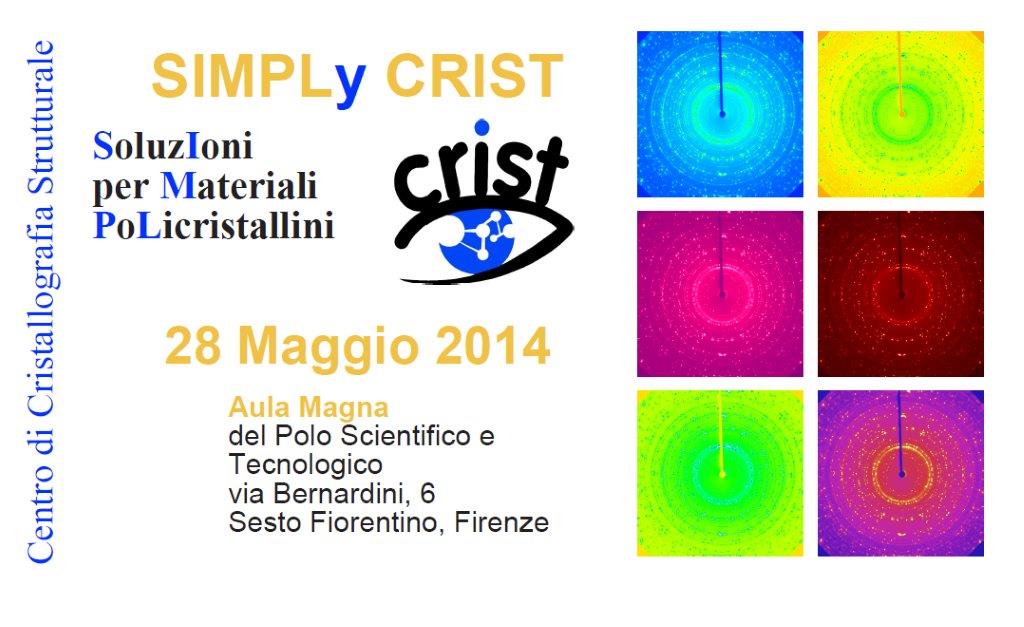
SIMPLy CRIST
|
In Florence
Confirmed lecturersÂ
Dott. Samuele Ciattini (Centro di Cristallografia Strutturale, Università di Firenze), Il CRIST ai raggi-X
Dott. Giorgio Guastella (Agenzia delle Dogane e dei Monopoli, Direzione Regionale per la Lombardia, Laboratorio e Servizi Chimici, Milano), Applicazioni della diffrazione a raggi X in ambito doganale
Dott.ssa Chiara Vladiskovic (Dipharma Francis S.r.l., Baranzate, Milano), Principi Attivi Farmaceutici: a cosa serve la diffrazione da polveri?
Dott.ssa Laura Chelazzi (Dipartimento di Chimica «Giacomo Ciamician», Università di Bologna), Oltre i confini del cristallo singolo: aspetti applicativi della determinazione strutturale da polveri microcristalline
ANKA Users' Meeting
|
In Karlsruhe

Nanoparticle Synthesis and Assembly. Faraday Discussion
| - |
In Chicago
Nanoparticles can be viewed as a new type of "atom" with size dependent physical, optical and electronic properties that make them suitable for a wide variety of applications. There are many open questions in the field of nanoparticle synthesis and assembly.Â
For example:
- How does the nanoparticle-nanoparticle potential govern nanoparticle formation or assembly?Â
- Can one design a nanoparticle from the ground up, according to theoretical predictions, which will self-assemble into a given nanoparticle superlattice structure?Â
- How does the assembly process vary with nanoparticle shape (e.g., spherical, rod, triangular, square, etc.) and the ligand coating which surrounds each nanoparticle?Â
- Can one make more robust nanoparticle superlattice structures, of macroscopic size (millimetre to centimetre), which can be moulded, milled and machined into desired shapes?Â
- Can one make nanoparticles that are stable at high temperature so that their assemblies can be melted, alloyed and cast?    Â
These questions cannot be answered in isolation. A successful attack on these difficult questions requires the coordinated and collaborative effects of nanoparticle theorists, synthesizers, and assemblers.
Format
The Faraday Division have been organising high impact Faraday Discussions in rapidly developing areas of physical chemistry and its interfaces with other scientific disciplines for over 100 years.
Faraday Discussions have a special format where research papers written by the speakers are distributed to all participants before the meeting, and most of the meeting is devoted to discussing the papers. Everyone contributes to the discussion - including presenting their own relevant research. The research papers and a record of the discussion are published in the journal Faraday Discussions.
Aims
The purpose of this Faraday Discussion meeting is bring together a diverse group of scientists to discuss the latest developments in nanoparticle theory, synthesis and assembly in order to generate new ideas and engender new collaborations between these groups.
Themes
- Nanoparticle synthesis - physical chemistry of nanoparticle shape and ligand control
- Theoretical insights into nanoparticle synthesis and nanoparticle assembly
- Nanoparticle self-assembly
- Nanoparticle directed assembly        Â
Corrosion Chemistry. Faraday Discussion
| - |
In London
Introduction
Over the last decade or so, there has been immense progress in the development of tools, both experimental and theoretical, for probing the solid/fluid interface at the nanoscale. These advances open the way towards mechanistic understanding, and potentially prediction, of chemical processes occurring at this interface. Amongst the fields beginning to benefit from such effort is corrosion science, which is primarily concerned with degradation of metallic materials immersed in either liquid or gaseous environments, and control thereof. Corrosion science does not always attract the plaudits of other more fashionable subjects, but is nevertheless of huge strategic importance. This statement is increasingly true as we move towards a world where every atom counts, e.g. in maintaining the performance of nano-devices, as well for ensuring sustainability through optimum use of natural resources.
Aims
The aim of this Faraday Discussion is to bring together experimentalists and theoreticians concerned with understanding at the nanoscale interfacial chemical processes relevant to corrosion and its control.
Format
The Faraday Division have been organising high impact Faraday Discussions in rapidly developing areas of physical chemistry and its interfaces with other scientific disciplines for over 100 years.
Faraday Discussions have a special format where research papers written by the speakers are distributed to all participants before the meeting, and most of the meeting is devoted to discussing the papers. Everyone contributes to the discussion - including presenting their own relevant research. The research papers and a record of the discussion are published in the journal Faraday Discussions.
Themes
- Solid/Fluid Interface
In this session, studies concerned with nanoscale elucidation of the structure and fundamental chemical processes (e.g. ion adsorption) at solid/fluid interfaces will be discussed. Particular attention will focus on the solid/aqueous solution interface, as it is of central importance to corrosion. Contributions will cover experimental work, with particular emphasis on in situ studies using state-of-the-art probes, and theoretical modeling.
- Corrosion Scales and Passive Films
Substrate adhered corrosion scales and passive films, which can both significantly affect corrosion (e.g. a passive film can reduce corrosion to a negligible rate), will be the topics of discussion here. Experimental/theoretical studies of both engineering and model (e.g. single crystal) substrates will be presented. Relationships between the composition-structure-chemistry-corrosion resistance of the scales/films will be addressed, together with insight into processes governing their initiation and growth, including the impact of environmental conditions
- Localised Corrosion
Spatially confined corrosion phenomena (e.g. pitting), which can lead to rapid failure of otherwise corrosion resistant substrates, will be of concern in this session. Studies aiming to understand at the nanoscale the combined influences of substrate microstructure/geometry, mechanical distortion, and fluid chemistry on local corrosion initiation/progression will be presented. Modeling of these processes will also feature, as prediction of their occurrence is of huge technological concern
- Corrosion Control
To complement the above sessions, this final session will address nanoscale understanding of corrosion control methods. In particular, it will be concerned with approaches where chemistry plays a key role, namely coatings, paints, and corrosion inhibitors. Topics of discussion will centre on those critical to gain mechanistic insight into corrosion resistance performance, including substrate bonding, structure/morphology, interfacial transport, and degradation mechanisms.
Nucleation - a Transition State to the Directed Assembley of Materials. Faraday Discussion.
| - |
In Leeds
Introduction
The crystallisation phase transformation process and the resulting creation of crystalline materials from liquid phase precursors are central to the science and process engineering of materials in their broadest sense. Crystallisation involves two distinct stages: nucleation and growth. Due to the nano-scale size domain within which the nucleation process functions it is a much less understood process compared to the growth process. As a result, elucidating the fundamental physics and chemistry that govern the formation and structure of the nucleation supra-molecular transition state remains one of the truly unresolved 'grand challenges' of the physical sciences.
Format
The Faraday Division have been organising high impact Faraday Discussions in rapidly developing areas of physical chemistry and its interfaces with other scientific disciplines for over 100 years.Â
Faraday Discussions have a special format where research papers written by the speakers are distributed to all participants before the meeting, and most of the meeting is devoted to discussing the papers. Everyone contributes to the discussion - including presenting their own relevant research. The research papers and a record of the discussion are published in the journal Faraday Discussions.Â
Themes
-
Molecular self-assembly in nucleationÂ
This session will focus on the transition pathway, and its associated molecular assembly process, for solute molecules as they aggregate and stabilise into clusters prior to their subsequent development in the growth stage into facetted crystals. The session will seek to examine the latest results from both experimental studies and advanced molecular and synthonic modelling. -
Nucleation kinetics and mechanismsÂ
The session will focus on the mechanistic processes underpinning the nucleation process, i.e. whether single/2-step, progressive/instantaneous, homo/heterogeneous etc. and The role played by secondary nucleation processes in modifying nucleation behaviour will be examined and the session will also seek to examine the latest research in kinetic modelling of the nucleation process. -
Solvent interactions as determinants in the nucleation pathwayÂ
This session will seek to examine the role played by crystallisation environment, notably solvent choice (whether polar/apolar, protic/aprotic and molecular size/shape) and resultant solution structure, in dictating the nucleation process. The role played by solution ideality as well as the influence hydrogen bonding and synthon architectures for directing specific solute-solute interactions will be examined. -
Nucleation in complex multi-component and multi-phase systemsÂ
This session will examine nucleation within complex crystallisation environments for situation where the presence of multi-components and phases are found to significantly change crystallisation behaviour and crystallisability of a material, e.g. in an extreme case leading to oiling out. Understanding the influence of phase composition, molecular speciation and chirality on behaviour and how this effects the solid form properties of the resultant crystals produced (polymorphic form, crystal size and crystallinity) will be also examined.Â
Aims
This meeting aims to bring together this growing body of theoretical and experimental work from both the academic and industrial spheres in order to assess recent progress, highlight on-going challenges in the domain area and route-map future work still needed.
European XFEL Users' Meeting and Satellite Meetings
| - |
In DESY, Hamburg

Temporally and Spatially Resolved Molecular Science. Faraday Discussion 177
| - |
In Bangalore
Introduction
Recently crystallography and spectroscopy have reached a level of experimental sophistication and theoretical and computational advancements such that it is possible to understand the structure of even the most complex molecular systems, such as, proteins. One community derives information from average atomic charge densities from X-ray data and the other from valence orbital electron densities based on vibrational spectroscopy data. The modern generation of synchrotrons and the powerful free electron lasers (X-FEL) offer new opportunities and exciting challenges in structural science, but they will require a coordinated approach of complementary methods if they are to achieve maximum impact. We are constantly improving technical and computational methods to accelerate and automate characterisation processes and this is crucial to the fields to be explored in this meeting.
This Faraday Discussion will bring together world experts in computational, crystallographic, spectroscopic, chemical, biological and numerous characterisation methods to share and enhance their expertise.
Aims
The main aim for this FD is to bring together crystallographers and spectroscopists from chemistry, physics and biology to promote new interdisciplinary research and to benefit from complementary approaches and techniques in the rapidly emerging areas of 'time resolved studies', leading to a greater overall understanding of structural dynamics.Â
We hope to achieve:Â
- cross-fertilization of recent knowledge in time and length scales
- linking structural and dynamical information (derived from both the techniques) to understand function
- understanding non-equilibrium states and their impact on reactivity
- new collaborations towards solving problems jointly. Â
In addition, the discussion meeting is expected to identify future challenges and the novel techniques yet to be developed towards addressing temporally and spatially resolved structure-function relationships in chemistry and biology.Â
Format
The Faraday Division have been organising high impact Faraday Discussions in rapidly developing areas of physical chemistry and its interfaces with other scientific disciplines for over 100 years.Â
Faraday Discussions have a special format where research papers written by the speakers are distributed to all participants before the meeting, and most of the meeting is devoted to discussing the papers. Everyone contributes to the discussion - including presenting their own relevant research. The research papers and a record of the discussion are published in the journal Faraday Discussions.Â
Themes
- Dynamics of the Chemical Bond New experimental and theoretical approaches to understand chemical bonding and the changes that take place in the excited state for a number of biologically and technologically important reactions. Obtaining insights into and recording data from processes associated with changes to chemical bonds, whether that is bond breaking, formation, changes in length or inter-/intra-molecular vibrations, is key to obtaining further understanding of a wide range of chemical and biological reactions.
- Time and Space Resolved Methods Development and exploitation of high resolution time-resolved crystallographic and spectroscopic methods predominantly for reactions occurring in the solid-state and examining processes occurring on a broad range of timescales (ms-fs), including novel methodologies and interdisciplinary approaches which are transferable to the study of a wide range of molecular processes. Combining structural, spectroscopic and theoretical data (in 1D, 2D or 3D) within the reaction energy landscape/surfaces will provide complementary information and give a more complete picture of the underlying the behaviour of chemical reaction or biological process.
- Local and Global Dynamics Understanding the relationship between local and global dynamics is essential to correlate knowledge of a molecular process to those occurring within an extended structure e.g. whether a process is cooperative and affected by the surround lattice or occurs independently of the local environment. A combination of current and emerging experimental and theoretical approaches, most of which are transferable between disciplines, will be discussed to provide maximum insight into the relationship between structure and function for both chemical reactions and biological processes.
- Future Challenges and Emerging Techniques Exciting new directions for combining time resolved spectroscopic and diffraction techniques with modern theoretical approaches and looking forward to how we can exploit lab sources to XFELs in novel ways, bringing together all of the topics and ideas covered in earlier sessions to define new research approaches and inter-disciplinary collaborations. Â
We look forward to welcoming you to Bangalore for this Faraday Discussion.
From Molecules to Medicine: How Structure Helps Cure Disease
|
American Chemical Society webinar
Thursday, October 9, 2014 @ 2-3pm ET
Learn about the quest to develop therapies for the major age-related neurodegenerative diseases such as Alzheimer's disease.
Presenter: Dr Greg Petsko is a member of the US National Academy of Sciences, the Institute of Medicine and the American Academy of Arts and Sciences and the American Philosophical Society. His research interests include protein structure and function and the development of methods to treat age-related neurodegenerative diseases, including ALS (Lou Gehrig's), Alzheimer's and Parkinson's diseases.
Moderator: Dr Martha Teeter is the current president of the American Crystallographic Association and demonstrated the first direct phasing of a protein structure with Wayne Hendrickson and the cooling of a protein with Håkon Hope, both techniques now routine in structural biology. She has promoted the International Year of Crystallography 2014 in the Americas.
What You Will Learn
How structural information can be used to identify and improve small-molecule therapeutics
The role of biological (large-molecule) drugs in the fight against neurologic disorders and how structure can help make better ones
What structural information cannot be expected to do and should not be expected to do
Download Slides: Available on the Day of Broadcast
The Fine Print ACS Webinars® does not endorse any products or services. The views expressed in this presentation are those of the presenters and do not necessarily reflect the views or policies of the American Chemical Society.
20th NSRRC Users' Meeting & Workshops
| - |
In NSRRC Hsinchu
- Workshop 1: High-Resolution RIXS and NanoARPES
- Workshop II: Coherent X-ray Scattering
- Workshop III: Applications of Synchrotron Radiation to Structural Biology
- Workshop IV X-ray Nano-analysis on Condensed Matter Physics and Materials Science
IYCr2014: Challenges in Crystallography
| - |
In Rome
The meeting celebrates the International Year of Crystallography (IYCr2014) by introducing and discussing the intriguing chances offered by the new frontiers of crystallography. Some talks will introduce new radiation sources suitable for diffraction studies, as well as modern strategies for data collection from nanocrystals, and experimental and computational studies of  the behaviour of crystalline phases under extreme conditions. Other talks will focus on the impact of future crystallography-based studies on different research branches, such as molecular biology, Earth and environmental sciences, and materials sciences. Outstanding speakers have confirmed their participation: Immanuel Bloch (Max Planck Institut of Quantum Optics), Henry N. Chapman (Center for Free-Electron Laser Science, DESY), Emil Makovicky (University of Copenhagen), Enrico Mugnaioli (University of Mainz), Fabrizio Nestola (University of Padua), Artem Oganov (Stony Brook University), Joao Rocha (University of Aveiro), Maria Selmer (University of Uppsala), Ilme Schlichting (Max Planck Institute for Medical Research).
The organising committee (S. Merlino, chair, G. Allegra, M. Bolognesi, M. Brunori, S. Califano, G. Ferraris, C. Giacovazzo, M. Inguscio and R. Oberti) acknowledges sponsorship by the following institutions: Associazione Italiana di Cristallografia (AIC), Istituto Nazionale di Ricerca Metrologica (INRiM), Società Italiana di Mineralogia e Petrologia (SIMP), Società Toscana di Scienze Naturali (STSN).

Ion Channels. Gordon Research Seminar
| - |
In South Hadley, MA
Channel Structure, Function, Disease and Drugs
The Gordon Research Seminar on Ion Channels is a unique forum for graduate students, post-docs, and other scientists with comparable levels of experience and education to present and exchange new data and cutting edge ideas.
The 2014 Ion Channels GRS will bring together post-docs, graduate students, and undergraduates from diverse backgrounds to present recent data and discuss the quantitative analysis of ion channels and ion transporters. Scientific sessions will focus on classical and emerging concepts related to structure, function, regulation, and dynamics of diverse channel types, with an eye on how these complex molecular characteristics integrate to generate cellular excitability and control cellular and organ physiology. Special attention will be given to the use of emerging analytical tools and the next generation of ion channel drugs. In addition to presenting, discussing their data, and sharing research experiences with their peers "in the trenches", young researchers will have the opportunity to discuss the next leap in their career with mentors in the field - whether that’s choosing a postdoc, becoming an independent investigator, or transitioning to industry and other fields.
Â
Intrinsically Disordered Proteins. Gordon Research Seminar
| - |
In Easton, MA
Fundamental Characteristics and Approaches to Understand the Biological Functions of IDPs
The Gordon Research Seminar on Intrinsically Disordered Proteins is a unique forum for graduate students, post-docs, and other scientists with comparable levels of experience and education to present and exchange new data and cutting edge ideas.
The focus of this meeting is to introduce the topic of IDPs to those just entering the field while motivating interest in key areas of IDP research. Topics covered will include: (i) what characteristics define an IDP, (ii) what experimental and computational tools can be used to study IDPs, and (iii) what roles IDPs play in vivo. The GRS will also include a career development session featuring a panel of scientists at different points in their career path who will offer career advice and answer questions on the academic job search from a variety of perspectives.
Â
Noble Metal Nanoparticles. Gordon Research Seminar
| - |
In South Hadley, MA
Synthesis, Characterization and Applications
The Gordon Research Seminar on Noble Metal Nanoparticles is a unique forum for graduate students, post-docs, and other scientists with comparable levels of experience and education to present and exchange new data and cutting edge ideas.
The scientific focus of the meeting will be on the synthesis of novel metal nanostructures, techniques for their characterization, and a range of their applications.
Â
Energetic Materials. Gordon Research Seminar
| - |
In Newry, ME, USA
The Influence of Microstructure on Performance
The Gordon Research Seminar on Energetic Materials is a unique forum for graduate students, post-docs, and other scientists with comparable levels of experience and education to present and exchange new data and cutting edge ideas. The focus of this meeting is on the response of energetic materials at the microstructural level, which is a complex process involving both mechanical and chemical components that lends itself to a coupled experimental and computational approach. This seminar will discuss both computational and experimental efforts to understand the processes influencing the thermodynamic and constitutive response of energetic materials over multiple length scales.Â