Links
Some useful links to other international powder diffraction sites.
Some useful links to other international powder diffraction sites.
The newsletters will only be available online as printed copies of the newsletter will no longer be produced. The old contact list only included mailing addresses so is moribund. Notification of new newsletters will be made through mailing lists but anyone needing individual notification should send their email address to:
Pamela Whitfield (Chair, USA)
This page links to Schools and Workshops with useful educational content.
Erice, Italy, 2-12 June 2011
An initiative of the Commission starting in the 2021-23 'triennium' is the promotion of good practice in the use of the powder CIF (pdCIF) standard, including validation and analysis tools. Some of the results of those efforts will be available from this web site.
The Commission on Powder Diffraction (CPD) was formed in 1987 and had its first meeting as a satellite to the main IUCr congress in Perth, Australia in that year.
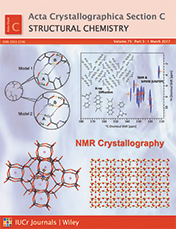
Guest editors: David Bryce (University of Ottawa, Canada) and Francis Taulelle (Université de Versailles Saint Quentin en Yvelines, France).
Each Commission is defined by its Terms of Reference, which are approved by the General Assembly of the IUCr.
The Commission on NMR Crystallography and Related Methods was established at the Montreal General Assembly in August 2014. The Commission will serve several useful roles for the community that studies the crystalline state using magnetic resonance, as well as for the larger crystallographic community. The terms of reference are as follows:
Speakers from some relevant Microsymposia at the recent IUCr Congress in Montreal.
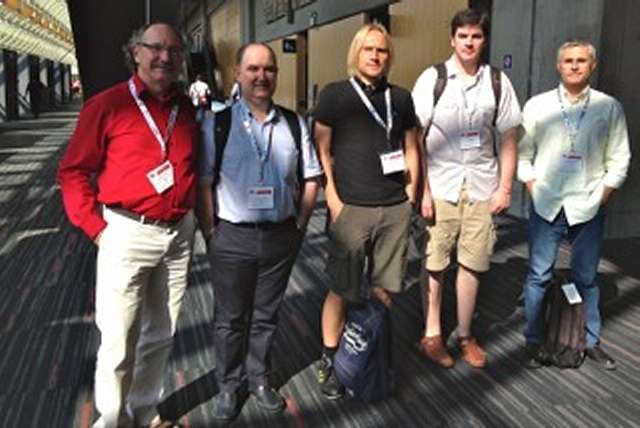
MS 73: Cross-disciplinary Investigations of Structural and Magnetic Properties of Materials by Solid State NMR and Diffraction Techniques.
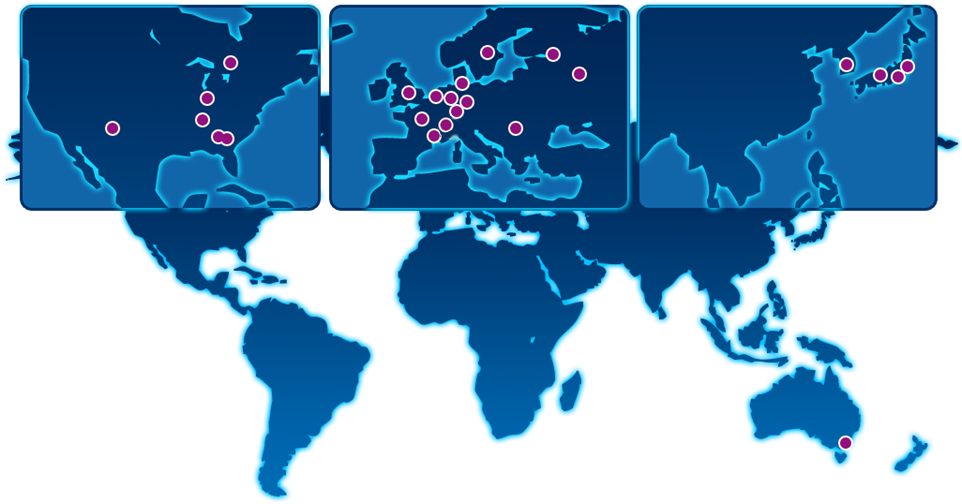
Neutron beams are produced in nuclear reactors or spallation sources. This means that experiments using neutrons can only be performed in specific institutions.
In many of those institutes instruments are free to use for academic researchers through a proposal system. External users receive a high level of support during experiments to optimize the use of beam time.
Electrically Neutral. Neutrons are non-destructive and can penetrate deep into matter. This makes them an ideal probe for biological materials and samples under extreme conditions of pressure, temperature, magnetic field or within chemical reaction vessels.