3 September 2026
Cockroach milk crystals reveal an unusual solution to protein crystallization
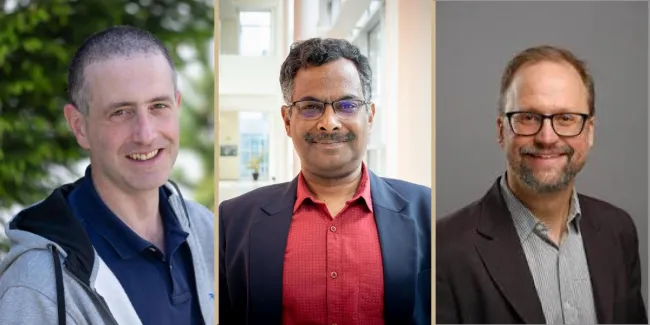
2026 Ig Nobel Prize-winning researchers Ramaswamy Subramanian, Leonard Chavas and Nathan Coussens were among the authors of a remarkable study that revealed how naturally formed protein crystals in the viviparous cockroach Diploptera punctata challenge conventional ideas about protein crystallization. The study’s full author team was awarded the Ig Nobel Prize in Chemistry for their research into the unusual way a species of cockroach nourishes its developing embryos.
Ramaswamy Subramanian is a professor in Purdue University’s Department of Biological Sciences; Leonard “Leo” Chavas is a structural biologist and General Manager and Representative Director of DECTRIS Japan; and Nathan Coussens is Director of the In Vitro Evaluation and Molecular Pharmacology Laboratories at the Frederick National Laboratory for Cancer Research. This accomplishment results from an exceptionally international collaboration: India, US, Japan, Canada and France.
Rather than relying on a highly uniform protein sample, the cockroach embryo forms highly ordered crystals from a complex mixture of related proteins, sugars and fatty acids. Remarkably, these crystals diffract to atomic resolution despite containing the kind of molecular variation that structural biologists would normally expect to make crystallization difficult.
The crystals also appear to have a clear biological function. Nutrient-rich liquid taken up by the embryo becomes concentrated in the gut and crystallizes into a compact reserve containing protein, carbohydrate and lipid, providing an efficient way to store and release nutrients during development.
The study, published in IUCrJ, shows how structural science can reveal both molecular architecture and biological function, while offering an unusual example of how nature can solve crystallization problems that are difficult to reproduce in the laboratory.
The Ig Nobel Prizes are presented annually by Improbable Research to honour scientific achievements that first make people laugh, then make them think. Winners are chosen by the Ig Nobel Board of Governors from nominations submitted from around the world. The prizes recognise unusual, imaginative or unexpected research that nevertheless reflects genuine scientific inquiry.